
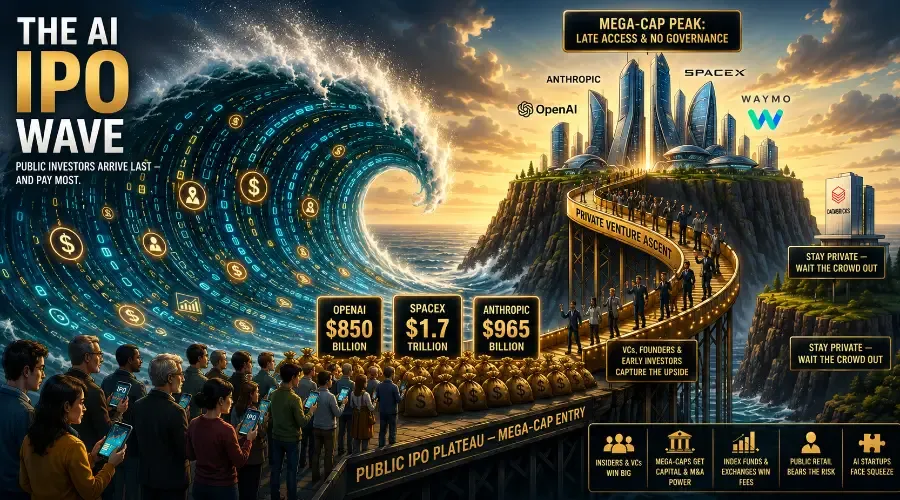
A handful of names – SpaceX already public, OpenAI and Anthropic filed – will absorb more listing capital than the entire 2025 IPO market. But they arrive as fully-formed mega-caps, with restricted governance and tiny floats, while the cleanest business of the bunch chooses to wait.
By Manish T. · August 16, 2026 · 10 min read
Editor’s note: This is analytical commentary, not investment advice. Figures are as publicly reported as of August 2026 and may be revised. Private valuations are self-reported or press estimates. Nothing here is a recommendation to buy or sell any security.
The story many are telling about 2026 is that the AI giants are finally going public – that after years of private, venture-funded growth, ordinary investors will at last get to own them.
The structure of what is actually happening is far more complicated. This wave does not simply broaden access to AI’s value creation. It concentrates much of it, hands public investors late-stage entry points at valuations that already embed years of private-market optimism, and offers minimal governance control in return.
That does not mean these stocks cannot generate positive returns. It does mean the popular framing – “your turn to own them early” – is a complete structural illusion.
Two models are running at once
On one track is the mega-IPO. SpaceX priced on June 11 at $135 a share, raising roughly $75 billion – the largest IPO on record, nearly three times Saudi Aramco’s – and debuting near a $1.77 trillion valuation. Behind it, OpenAI filed confidentially in early June at a reported valuation around $852 billion, and Anthropic filed at a reported valuation near $965 billion, according to Bloomberg and Reuters. Add Stripe, Waymo, and a rumored Anduril round, and you have a private cohort worth roughly $3 trillion in aggregate. Bankers estimate the listing demand from these names at $100–200 billion – more than the entire 2025 U.S. IPO market combined.
On the other track is the deliberate decision not to list. Databricks recently closed $5 billion at a $190 billion valuation – its second $5 billion round in eight months – with revenue past a $7 billion run-rate, net revenue retention above 140%, and positive free cash flow. It is arguably the cleanest, most operationally mature candidate in tech. Yet it is staying private, with CEO Ali Ghodsi openly characterizing 2026 as a poor window precisely because mega-cap listings ahead of it will drain available listing capital.
When a cash-flow-positive enterprise can raise multi-billion-dollar rounds privately at will, the IPO ceases to be a necessity and becomes purely a strategic timing choice.
Why the “access at last” story is incomplete
Four structural realities break the democratization narrative:
1. Buying the plateau vs. the ascent (and the $1T counter-thesis)
At debut valuations ranging from $850 billion to $1.8 trillion, the steep hyper-growth phase of the venture lifecycle has already been captured by founders, venture capital, and crossover funds. Public investors are buying near the mature plateau.
This is the central distinction between private venture compounding versus IPO investing. The private-market investor captures the valuation expansion from early-stage company to late-stage giant; the public investor enters after that transformation and must earn returns primarily from future business execution and continued compounding.
The Counter-Argument: Skeptics made an identical "plateau" argument when Apple, Microsoft, Alphabet, and Nvidia crossed $1 trillion between 2018 and 2020, only to watch them compound into $3 trillion and $4 trillion powerhouses. If frontier AI delivers on its broader macroeconomic productivity promises, a $1 trillion entry point could theoretically represent the middle innings of a $5 trillion enterprise. However, the margin of safety at a $1 trillion debut is exponentially thinner: multiples today leave almost zero room for execution missteps, chip supply bottlenecks, or commoditization of model inference.
2. Adverse sequencing: capital-burners list first
The companies facing multi-billion-dollar annual compute and infrastructure deficits are rushing to public liquidity, while the profitable outlier chooses to wait.
This is not proof of bad faith – it is standard corporate finance. But it invalidates the premise that public markets are being served the highest-quality, most resilient balance sheets first.
3. The float illusion and the lock-up cliff
Headline market caps mask a critical mechanical reality: tiny initial free floats.
If an AI giant lists at a $900 billion market cap but only floats 5% to 8% of its shares, synthetic scarcity can inflate early pricing regardless of underlying fundamentals. When the standard 180-day lock-up period expires and employees, founders, and early venture backers begin liquidating paper wealth, public markets must absorb hundreds of billions in secondary supply. The risk of sharp post-lockup repricing is high.
4. Bespoke governance: capital without control
In past tech cycles, public listing meant entering a regime of common shareholder accountability. In the AI mega-wave, public investors are buying economic exposure with severely diluted – or non-existent – governance rights.
Between multi-class share structures with 10:1 or 20:1 super-voting rights, Public Benefit Corporation (PBC) mandates, and specialized safety covenants (such as Long-Term Benefit Trusts or independent mission boards), public shareholders have virtually no say over capital allocation, board composition, or strategic pivot decisions. You provide the liquidity; insiders retain total control.
The second-order event: benchmark shock, but staggered
There are roughly 1,680 unicorns globally worth an aggregate $8.6 trillion, with the top ten holding 41% of that value. When entities of this scale list, they do not arrive as ordinary additions – they arrive as structural index events.
The resulting price action is not driven purely by fundamental investors. As these companies enter major benchmarks, institutional positioning and mandatory passive allocations can create demand that is mechanically linked to index membership rather than an independent assessment of valuation.
However, benchmark integration will be uneven:
- S&P 500 GAAP Barrier: Membership in the S&P 500 requires positive GAAP earnings over the most recent quarter and the trailing four quarters. Companies burning billions on model training will be barred from the S&P 500 initially.
- Broad Index Inflows: They will immediately qualify for Russell 1000/3000 and total-market passive indexes, forcing broad-market funds to allocate billions into these names.
- Displacement & Concentration: For the companies that do meet profitability metrics, a trillion-dollar entry will instantly command a massive weighting, displacing mid-tier constituents and forcing every indexed 401(k) to buy at mega-cap multiples.
Acquisition currency: an example, not yet a template
The mega-IPO provides something beyond cash: liquid public M&A currency.
Days after its debut, SpaceX used its public stock to acquire AI coding platform Cursor for $60 billion in an all-stock deal – representing just ~3.4% equity dilution against its market valuation.
Liquid equity at trillion-dollar valuations enables mega-caps to absorb mid-tier infrastructure, tooling, and application startups with negligible dilution. If replicated across the sector, this wave will not just concentrate market cap in public indexes – it will accelerate the consolidation of the entire independent AI software ecosystem.
The same ecosystem can also create financing loops in which suppliers, customers and capital providers become increasingly interconnected. AI circular financing can reinforce capital flows and demand while making it harder for investors to distinguish genuine end-user economics from financing-supported growth.
Winners and losers – a structural breakdown
| Cohort | Position | Key Drivers |
|---|---|---|
| Pre-IPO Insiders & VC/Crossover Funds | Clear Winners | Captured the 10x–100x compounding phase in private rounds; achieve massive liquidity events at peak multiples. |
| Listing Mega-Caps | Clear Winners | Secure permanent capital to fund astronomical compute bills and gain high-value stock currency for M&A roll-ups. |
| Passive Index Intermediaries & Exchanges | Clear Winners | Capture surging trading volume, listing fees, and expanded AUM baselines across institutional and retail channels. |
| Unwary Public Retail Investors | High Risk | Enter at fully priced multiples, absorb post-lockup supply overhang, and hold low-voting shares with minimal downside protection. |
| Independent AI Startups | Pressured | Face intense talent and customer squeeze from newly liquid public giants weaponizing stock-based compensation and acquisitions. |
| Traditional Tech IPOs | Crowded Out | Mid-market tech listings face drained institutional liquidity windows monopolized by trillion-dollar AI balance sheets. |
Why this matters
The phrase "the AI leaders are going public" sounds like an invitation to participate in the ground floor of a technological revolution.
In reality, public investors are being offered late-stage, non-voting equity at valuations that leave minimal margin for error, floated in small percentages that obscure early price discovery, from companies whose capital requirements remain voracious.
You are not getting in early. You are financing the plateau. That trade can still work if AI alters global economic productivity faster than current high expectations anticipate – but it is a large-cap execution trade, not an early-stage venture return.
Catalysts to watch
- Float Ratios & S-1 Lockup Schedules: Watch what percentage of shares OpenAI and Anthropic float at debut, and track the exact dates for employee/VC lockup expirations.
- Dual-Class & PBC Governance Disclosures: Pay close attention to S-1 voting rights structures, super-voting ratios, and board fiduciary restrictions.
- Index-Inclusion Milestones: Monitor GAAP profitability trajectories to distinguish between names bound only for total-market indexes versus those eligible for immediate S&P 500 entry.
- Databricks’ S-1 Timing: The true indicator of whether the "stay private" thesis holds once the primary mega-cap capital drain clears.
- All-Stock AI Roll-ups: Whether other newly public leaders mirror the SpaceX–Cursor playbook to aggressively consolidate private application layers.
The bottom line
This wave is not democratization wrapped in a public ticker – it is capital concentration. A small cohort of mega-caps will absorb market liquidity, alter benchmark index weights, and wield high-value stock currency to consolidate the ecosystem, all while retaining tight insider control.
Public investors do get access. But they arrive last in line, pay the highest entry price, receive the least control, and bear the operational execution risk of proving that multi-trillion-dollar valuations can be justified.
BreakoutBulletin publishes analytical research and education for informed investors. Nothing here is a buy or sell recommendation or personalized investment advice; the author is not a registered investment adviser. Valuations, revenue figures, and filing details are as publicly reported and may be revised; private valuations are self-reported or press estimates. Do your own research.