
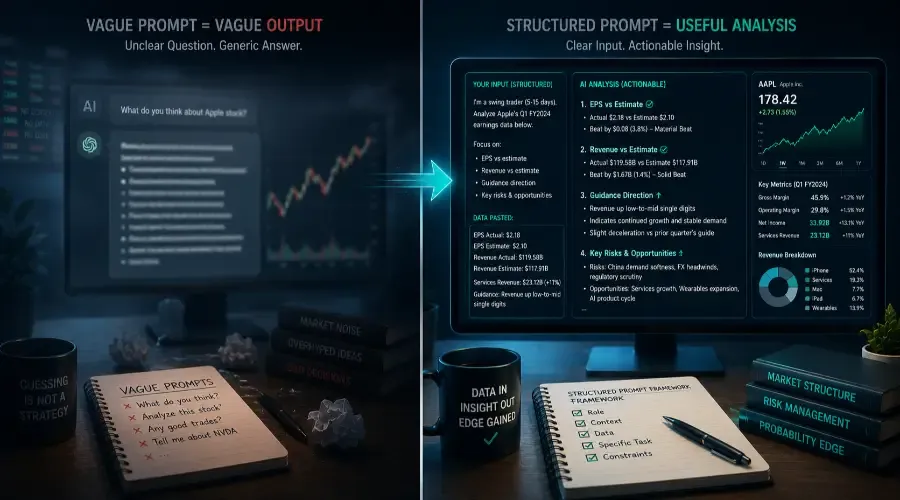
The difference between a trader who finds AI genuinely useful and one who gives up on it after a week usually comes down to one thing: how they write their prompts.
The tool is the same. The underlying model is the same. What changes the output dramatically is the quality of the input. Prompt writing is a learnable skill–not a technical one requiring a background in machine learning, but simply a clear understanding of what you’re asking for and how to ask for it.
This post covers that skill from the ground up. By the end, you’ll have a repeatable structure for writing effective trading prompts, clear boundaries for managing AI limitations, and templates you can start using immediately. Whether you’re using ChatGPT, Claude, or any other large language model, these techniques will help you get stock analysis that’s actually actionable.
If you're new to AI trading tools entirely, Getting Started with AI for Stock Trading covers the tool landscape and the input-output mental model that makes prompt construction make sense.
Why Vague Prompts Produce Vague Output
Before covering what works, it’s worth being specific about what doesn’t–and why.
When you write a vague prompt, you give the model very little to work with. It doesn’t know your timeframe, your strategy, your risk tolerance, or what decision you’re trying to make. Because it lacks specific parameters, it generates a response calibrated to the broadest possible interpretation of your question–something general enough to be technically relevant but too vague to be useful.
That’s not the model failing; it’s the model doing exactly what it should do given the lack of boundaries. The classic phrase is garbage in, garbage out–but for LLMs, a more precise version is: ambiguous in, averaged out.
The Contrast in Practice
A trader types:
“What do you think about Apple earnings?”
The model has no idea which earnings release the trader means, whether they are a day trader or a long-term investor, or what specific data they care about. It produces a generic response: Apple beat estimates on EPS, revenue came in above consensus, services growth continues to be a key driver, and there are ongoing concerns about China exposure.
Every sentence is technically defensible. None of it is useful to a trader trying to make a specific position decision on a specific timeframe.
Now contrast that with a trader who pastes the actual earnings table, includes the guidance statement, specifies they’re looking at a 5-to-15 day swing trade, and asks:
“Based on the data above, identify whether the EPS beat or miss vs estimate was material, what the guidance direction signals for the next quarter, and whether there’s any language in the results that differs meaningfully from last quarter’s tone.”
Same underlying model. Completely different output–because the second prompt gave the model concrete parameters and real boundaries.
The Anatomy of an Effective Trading Prompt
Effective trading prompts share a consistent structure. Understanding these five components helps you build inputs that produce precise, actionable outputs.
1. Role
Assign the model a specific analytical perspective before you ask your question. This frames the style and focus of the response.
“Act as a fundamental analyst reviewing this earnings release…”
“You are a risk manager assessing this trade setup…”
“Act as a technical analyst interpreting the following price data…”
Crucial Caveat: Role assignment is a stylistic framing tool, not magic. It does not transform the model into an actual professional with real-world competence, nor does it guarantee accuracy. Instead, it simply biases the model’s output focus. A “fundamental analyst” role shifts the focus toward margins and revenue quality; a “risk manager” framing shifts the output toward exposure and downside scenarios.
2. Context
Tell the model what you’re dealing with before you ask what you want to know. This includes the instrument, your holding period, your strategy, and broader market conditions.
“I’m a swing trader looking at a 5-to-15 day hold on NVDA. The stock has pulled back 8% from its recent high and is sitting at its 50-day moving average. The broader market is in a mild risk-off phase.”
3. Data
This is the most important element. Paste the actual data you want the model to work with–the earnings table, the filing section, the transcript excerpt, or the indicator readings. Do not ask the model to retrieve data from its memory when you can provide it directly. This ensures the model is working with accurate, verified information rather than stale training data.
4. Specific Task
Tell the model exactly what to do with the data. Avoid vague phrases like “analyze this.” Specific tasks produce specific outputs.
“Identify the three most important signals for short-term price direction from the data above.”
“Extract any language in this transcript that differs from the prior quarter’s tone–specifically around guidance.”
5. Constraints
Tell the model what boundaries to stay within–and what to stay out of. This is the element most traders skip, yet it is vital for preventing the model from wandering off into generalized opinions.
“Base your analysis only on the data I’ve pasted above. Do not introduce external information.”
“Keep the output to five bullet points or fewer.”
“Do not make a directional trade recommendation. Frame your output as factors to consider.”
The Paste-and-Ask Method (And Its Real-World Limits)
For most trading research tasks, the most effective workflow is simple: paste the verified document or data table first, then ask your questions about it.
This keeps the AI grounded in the text in front of it. However, to use this method effectively in the real world, you must manage two technical limitations:
1. Managing Context Windows and “Loss in the Middle”
While modern AI models can accept massive amounts of text, pasting a full 200-page 10-K or a massive 45-minute earnings call transcript can backfire. Models can suffer from “loss in the middle,” where they miss critical details buried deep in a massive block of text.
The Fix: Practice data chunking. Instead of pasting an entire filing, copy and paste only the specific sections you care about–such as the “Management’s Discussion and Analysis (MD&A)” or the “Risk Factors” section.
2. The Illusion of Perfect Constraints
Using a constraint like “use only the data provided” significantly reduces hallucinations, but it does not completely eliminate them. Models can still occasionally misread a number in a complex table, flip a bullish/bearish phrase, or subtly bring in external information from their training data.
The Fix: Never treat AI output as an absolute truth. Treat it as a rapid first-draft summary that always requires human cross-checking before capital is put at risk.
The paste-and-ask method only works when the data you're pasting is clean and correctly sourced. How to Feed Market Data into AI the Right Way covers where to get each data type and how to format it before it goes into the prompt.
How to Use Follow-Up Questions
A single prompt is rarely the end of a useful analysis session. The most efficient way to work with AI is iteratively–starting with a broad extraction and then drilling down.
An initial prompt might ask for the three most important signals from an earnings release. If the response identifies a shift in language around margin expectations, you now have a target to pursue.
A follow-up prompt might be:
“The margin language you identified–can you pull the exact sentences from the transcript I pasted above and explain how that specific phrasing compares to standard corporate boilerplate?”
Each follow-up narrows the focus and deepens the analysis. Treat your first prompt as an extraction layer and follow-up prompts as a drill-down layer. You will get far more useful output through three focused, iterative exchanges than through one massive prompt trying to ask everything at once.
Three Prompt Templates to Use Immediately
These frameworks are designed to be copied, pasted, and customized to your specific strategy and timeframe.
Template 1: Earnings Analysis (Fundamental Focus)
Act as a fundamental financial analyst reviewing corporate earnings. I've pasted [Company]'s [Quarter/Year] earnings release text below.
[PASTE DATA HERE]
Based only on the text provided above, perform the following tasks:
- Extract the final EPS and revenue figures and state whether they beat or missed consensus estimates.
- Identify the core direction of management's guidance for the upcoming quarter.
- Flag any specific financial metrics or operational language that stands out as a meaningful change from standard performance.
Constraints: Do not introduce external market commentary, analyst price targets, or outside training data. If a metric is not present in the text, state "not provided" rather than estimating.
Template 2: Technical Setup Review (Data-Grounded)
Act as a technical chart analyst. I am a swing trader with a [X]-day holding period looking at [Ticker] on the daily chart. I've pasted the last 10 days of OHLCV data and key indicator readings below.
[PASTE TABULAR DATA OR INDICATOR VALUES HERE]
Based on this data, address the following:
- Describe the near-term price structure (e.g., higher highs, consolidation, distribution).
- State whether the momentum indicator readings support or diverge from the recent price action.
- Identify the exact price level that would technically invalidate a bullish or bearish interpretation of this structural setup.
Constraints: Do not provide a definitive directional trade recommendation or buy/sell advice. Frame the output strictly as structural factors to consider.
Template 3: SEC Filing Risk Factor Extraction
Act as a corporate risk analyst reviewing an SEC filing. I've pasted the "Risk Factors" section from [Company]'s most recent [10-K / 10-Q] below.
[PASTE RISK FACTORS TEXT HERE]
Based only on this text, execute the following tasks:
- List the three risk factors most likely to impact short-term operational performance or stock price volatility.
- Identify any specific financial thresholds, debt covenants, or regulatory deadlines mentioned in the text.
- Highlight any phrases that appear customized to the company's current situation rather than standard legal boilerplate.
Constraints: Limit your response to a concise, bulleted format under three clearly labeled headings. Do not cross-reference external industry news.
These templates are starting points. The real compounding happens when you refine them through use and build a library of your best versions. How to Build a Reusable Prompt Library for Trading covers the eight categories every trader's library should contain and the three-use rule that sharpens prompts over time.
The Skill That Pays Off Every Session
Prompt writing is not a one-time configuration; it is an ongoing workflow skill that improves with deliberate practice.
By structuring your inputs with a clear role, tight context, verified data, specific tasks, and rigid constraints, you transition from a casual user getting generic summaries to an efficient analyst running targeted market research. Gather your source text, chunk it appropriately, ground the model in the facts, and verify the output before making your next move. Integrating these prompt engineering habits into your daily workflow will improve the consistency of your AI-assisted research, whether you’re analyzing equities, ETFs, or options.
Risk Disclaimer: AI models are pattern-recognition engines, not financial advisors. They lack real-world market intuition, do not understand live liquidity dynamics, and are prone to subtle calculation or contextual errors. All AI-generated analysis should be viewed strictly as a supplemental research tool. Always independently verify all data, numbers, and structural conclusions before making financial decisions or placing trades. Using proper AI prompt structures for stock and options analysis ensures you get data-grounded insights rather than vague market commentary, but the responsibility for trading decisions always remains yours.
Frequently Asked Questions (FAQ)
Q: Can I use ChatGPT or Claude to get live, real-time stock prices?
A: While some AI models have web-browsing capabilities or live financial plug-ins, they are generally not optimized for real-time tick data or execution tracking. The safest and most reliable method is to use your broker or charting platform (like TradingView) for live data, and feed specific data tables or indicator readings into the AI for contextual analysis.
Q: Why does the AI sometimes get basic financial numbers wrong even when I paste them?
A: LLMs process text by breaking it down into tokens (characters or pieces of words) rather than understanding numbers math-first. This can occasionally cause them to misread columns or drop a decimal point in complex tables. Always double-check key figures–such as EPS, revenue guidance, or key support levels–directly against the primary source document.
Q: How long can a text selection be before it triggers “loss in the middle”?
A: While model limits vary widely, a good practical rule of thumb is to keep your pasted source text under 4,000 to 5,000 words per prompt if you need deep, highly meticulous analysis of specific sentences. For broader thematic summaries, larger contexts work well, but targeted “chunking” yields the highest accuracy for trading data.
Disclaimer: For educational and informational purposes only. This content does not constitute financial, investment, or trading advice. Trading stocks and options involves significant risk of loss. Always do your own research or consult a licensed professional before making any financial decisions.