
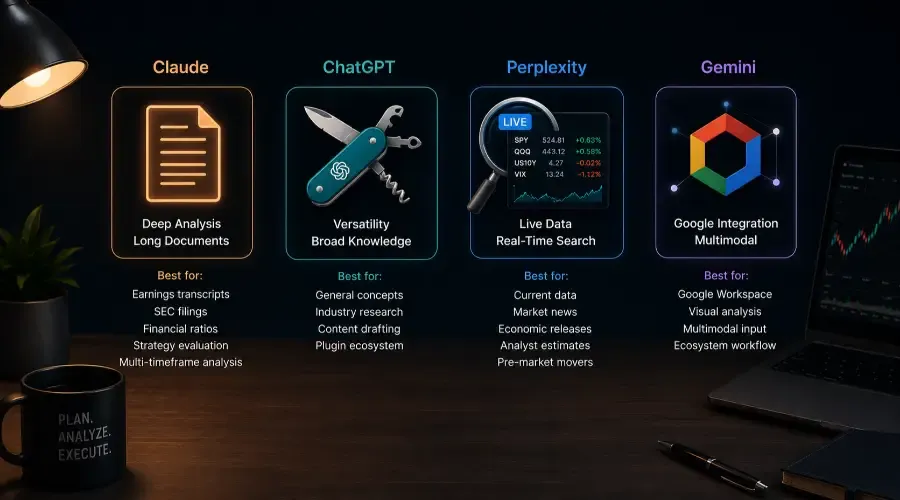
Every tool recommendation on this topic has an agenda. This one doesn't. The honest answer to "which AI tool is best for stock market research?" is that it depends entirely on what you're trying to do. Each of the four main tools has a genuine strength and a genuine limitation. Traders who build the best AI financial research stack don't pick one and ignore the rest – they understand where each tool excels and route tasks accordingly.
This is a routing guide, not a ranking. The author uses Claude most heavily for analytical work, and the comparison reflects that experience – stated upfront rather than hidden behind a neutrality claim.
Why No Single Tool Handles Everything
A pre-market briefing requires current data about what happened overnight. A deep earnings transcript analysis requires sustained reasoning across a long, complex document. A quick regulatory question requires broad general knowledge. These are fundamentally different tasks, and expecting one tool to handle all of them at the highest possible quality produces research that's adequate across everything and excellent at nothing.
One important baseline across all four tools: none of them should be the final arbiter of a risk decision. AI models are probabilistic – even the best-prompted session can misapply a rule or produce plausible-sounding but incorrect calculations. Verify critical financial figures against primary sources regardless of which tool generated them.
Claude – Depth of Analysis and Long Document Processing
Claude's primary strength in a trading context is analytical depth – sustained, nuanced reasoning across complex, multi-part inputs. It handles long documents well, maintains analytical coherence across extended contexts, and produces structured output that retains precision across all parts of a response.
For earnings call transcripts, 10-Q filings, and multi-company ratio comparisons, Claude consistently produces more complete and more structured output than the alternatives. It picks up on language shifts and tone changes that shorter-context tools miss. It maintains the constraints and frameworks specified in the prompt across a full, detailed response.
Claude's depth is further enhanced when used inside a Claude Project – a persistent workspace where your strategy parameters, risk rules, and sector focus live permanently in the system prompt. This means every analytical session starts pre-calibrated to your trading style without re-establishment, making Claude's deep-analyst role significantly more efficient in a daily workflow.
The limitation is the knowledge cutoff. Claude doesn't know what happened this morning. Without live data provided in the prompt, any response about current market conditions draws from training data that may be months stale. This requires a two-stage workflow: live data from Perplexity in Stage 1, analytical processing from Claude in Stage 2.
Best for: Earnings transcript analysis, SEC filing extraction, financial ratio contextualisation, sector rotation interpretation, multi-timeframe technical analysis, strategy logic evaluation.
ChatGPT – Versatility and Broad Knowledge
ChatGPT's primary strength is versatility across a wide range of tasks. It performs well on general knowledge questions, handles diverse formats – code, prose, structured tables – and adapts to broad task types without requiring the precise prompt structuring that produces Claude's best output.
One important qualification: a well-prompted ChatGPT can narrow the analytical gap with Claude significantly. The margin of advantage on complex financial documents depends heavily on prompt construction, not just the tool. For traders willing to invest in prompt refinement, ChatGPT's 128k context window and analytical capability make it a legitimate alternative for many tasks.
ChatGPT's plugin ecosystem extends its capabilities further – connecting to external services, running code, and accessing various data sources in ways the base model doesn't cover.
Best for: General financial concept explanation, regulatory and industry background research, content drafting and editing, tasks requiring the plugin ecosystem.
Perplexity – Live Web Access and Real-Time Market Data
Perplexity is built differently from the other three. Its core architecture centres on live web search – it retrieves current information, synthesises it, and cites its sources. For using Perplexity for real-time market data, it is the most distinctly specialised tool of the four.
For anything requiring current data – a CPI print that released this morning, analyst estimates for next week's earnings, overnight futures positioning, breaking news – Perplexity is the right tool. The citation feature matters specifically for trading: when Perplexity states that CPI came in at 3.1%, it cites the BLS source, allowing verification against the primary source in seconds.
The limitation is analytical depth. Perplexity synthesises well but does not reason deeply about what the information means for a specific trading strategy, current portfolio position, or macro regime classification.
Best for: Current economic data, pre-market movers, overnight news, breaking developments, current analyst estimates, earnings headline figures within minutes of release.
Gemini – Google Ecosystem Integration and Multimodal Capability
Gemini's distinguishing features are its integration with Google's data ecosystem and its multimodal capabilities. For traders whose workflow runs within Google Workspace – research in Google Docs, positions tracked in Google Sheets – Gemini's native integration provides advantages the other tools don't match.
One important clarification the comparison requires: Gemini can also ground its responses in Google Search, meaning it can surface current market data and news – not uniquely Perplexity's territory. Where Perplexity maintains an advantage is citation quality and retrieval freshness for fast-moving data like intraday releases. For traders already in the Google ecosystem, Gemini's live search capability may reduce the need for a separate Perplexity subscription for some tasks.
One caution on Gemini's expanding context window: raw context window size and analytical depth are different metrics. Gemini's 1M+ token window means it can hold more material in memory, but holding more text doesn't automatically produce better analysis on complex financial documents. Analytical depth – the ability to reason precisely across competing signals – is a separate capability from raw memory, and this distinction matters when choosing between tools for automating financial statement analysis.
Best for: Google Workspace integration, multimodal analysis where visual document input matters, traders whose primary workflow runs within Google's ecosystem.
The Same Task Across All Four – What the Outputs Actually Showed
Using a hypothetical earnings excerpt as the common input:
"Revenue came in at $8.4 billion, 14% YoY growth, slightly above guidance of $8.2–$8.3 billion. Gross margins expanded to 67.3%, up 180 basis points, driven by software mix shift. Q2 guidance: $8.6–$8.9 billion, approximately 11–15% YoY growth. We remain cautious about the macro environment in the back half of the year and are closely monitoring enterprise spending patterns, particularly in EMEA."
Task: identify the three most important signals for near-term stock direction, assess the guidance, and flag language warranting monitoring.
Claude identified:
(1) revenue beat with margin expansion confirming operating leverage; (2) guidance midpoint of $8.75B representing ~12.5% growth – middle of range, not signalling toward the upper end despite the beat; (3) "remains cautious" and "closely monitoring" as new hedging language, specifically flagging the EMEA geographic callout as a regional risk signal not present in prior guidance language. The tone-shift identification was the key differentiator.
ChatGPT identified:
the revenue beat, margin expansion, and cautious macro language – correctly and usefully – but described the caution as "worth watching" without the geographic specificity or the guidance midpoint calculation. Solid for a general earnings summary; less complete for identifying what a headline reader would miss.
Perplexity (without live search engaged for this text-analysis task)
produced the most general output – correctly identifying the main points but without the sustained analytical depth the task required. Retrieval is Perplexity's strength; reasoning on provided text is not.
Gemini produced
output comparable to ChatGPT – solid on headline signals, less specific on the language analysis and guidance midpoint. For traders in the Google ecosystem, a capable general output without being the strongest for this specific task.
The pattern: for sustained analytical reasoning on a specific financial document with precise signals to extract, Claude's output was the most complete. For tasks that don't require that level of depth, the differences between Claude, ChatGPT, and Gemini narrow, and the choice legitimately becomes one of workflow convenience and prompting investment.
The Recommended Stack
Perplexity for live data – Stage 1 of every research session involving current market conditions, cited and verifiable.
Claude for deep analysis – Stage 2 of every session requiring sustained reasoning on complex financial documents or structured data.
ChatGPT or Gemini for versatility and workflow integration – either as a third tool for tasks outside the specific strengths of the other two, or as the primary alternative where cost is a constraint.
On cost: specific pricing changes frequently. The practical consideration is that a paid tier for at least Perplexity and Claude is worth the investment for traders running daily analytical workflows. Free tiers are adequate for initial experimentation. For the session volume that serious trading preparation requires, paid tiers remove the friction that interrupts workflow at the worst possible moments.
Q&A: Building an AI Trading Research Stack
Q: Can I rely on one single AI tool for all my trading research?
No single AI tool is currently best for everything in a trading context. Research requires real-time data, deep analytical reasoning, and workflow integration – capabilities that currently sit in different tools. A stack using Perplexity for live data and Claude for deep analysis lets you leverage each model's genuine strength rather than accepting a generalist's limitations across all tasks.
Q: Why do traders prefer Claude over ChatGPT for analyzing earnings transcripts?
Claude maintains analytical coherence across long, dense documents – it doesn't lose the thread of the analysis as the input grows and picks up on subtle language shifts that indicate tone changes in management guidance. That said, a well-prompted ChatGPT can narrow this gap significantly. The margin depends on prompt construction, and traders willing to invest in prompt refinement will find ChatGPT's long-context capability more competitive than a simple tool-versus-tool comparison suggests.
Q: How do I know which tool to choose for a specific research task?
Three questions cover most situations. Does this task require current information – news, overnight moves, CPI prints? Route to Perplexity for live search and cited data. Does this task require deep analysis – 10-Qs, transcripts, strategy logic, sector rotation interpretation? Route to Claude for sustained analytical reasoning. Does this task require general help – drafting, industry background, Google Docs integration? Route to ChatGPT or Gemini for broad versatility and ecosystem compatibility. Most research sessions will use Perplexity and Claude together for anything connected to current market conditions; Claude alone for tasks that don't require live data.