
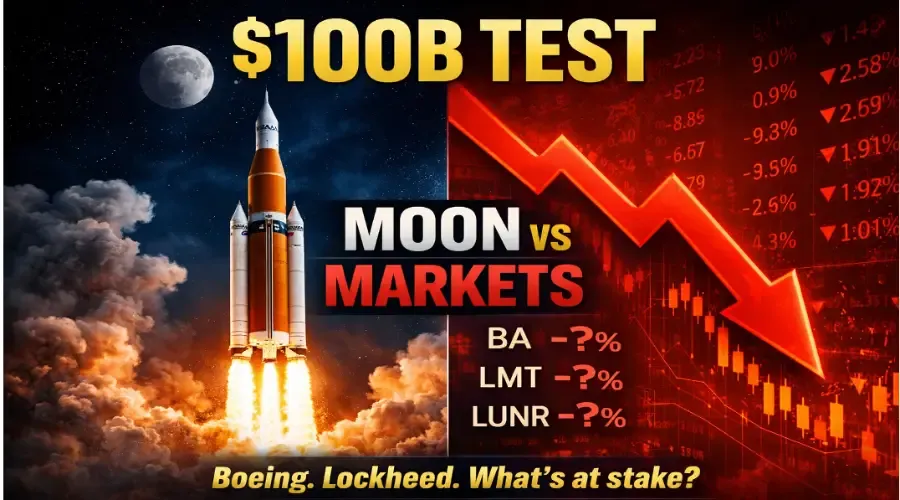
NASA’s first crewed lunar mission since 1972 tests Boeing’s SLS, Lockheed’s Orion, and the future of the space economy. Scenario analysis, key risks, and what traders should watch.
Breakout Bulletin | April 2026 | Event-Driven Analysis
NASA’s first crewed lunar mission in over 50 years is a real-time validation of the SLS and Orion systems. We break down the scenario impact on Boeing (BA) and Lockheed Martin (LMT), and why a potential “medical narrative” could become the hidden tail risk for space stocks this April.
What Is Artemis II and Why Does It Matter?
Artemis II is NASA’s first crewed mission to the Moon’s vicinity since 1972. Scheduled for April 2026, it marks humanity’s return to deep space after 53 years and serves as a critical validation step before a lunar landing mission.
This is not just a space mission. It is a real-time stress test of a multi-billion dollar space economy.
What Is Happening - The Mission
NASA will launch four astronauts aboard the Orion capsule using the Space Launch System (SLS) rocket.
Mission profile includes launch, system validation, a lunar flyby (free-return trajectory), and a Pacific splashdown approximately 10 days later.
There is no landing. This mission exists to validate systems, not achieve a destination.
Every system that works accelerates Artemis III. Every failure delays it.
The Historic Crew
The Artemis II crew represents a shift from Apollo-era missions.
Reid Wiseman, Victor Glover, Christina Koch, and Jeremy Hansen form a globally representative crew.
This is the first human mission to the Moon’s vicinity in 53 years.
It is also the first mission with a woman traveling to lunar space and the first with a non-NASA astronaut in deep space.
Why This Mission Is Structurally Different
Apollo was government-driven. Artemis is built on a public-private space economy model.
Key contractors include Boeing (SLS), Lockheed Martin (Orion), Northrop Grumman (boosters), and emerging players like Intuitive Machines (LUNR) and Rocket Lab (RKLB).
This structure distributes value across multiple listed companies rather than concentrating it within a single government program.
Why Markets Care - The Investment Framework
Artemis II is an event-driven catalyst for specific space stocks, not a broad market mover.
Key companies include Boeing (BA), Lockheed Martin (LMT), Northrop Grumman (NOC), Intuitive Machines (LUNR), and Rocket Lab (RKLB).
Space ETFs such as ARKX and UFO also provide diversified exposure to this theme.
This mission will influence sentiment, not just fundamentals.
Boeing Is the Most Sensitive Name
Boeing sits at the center of the Artemis program through the SLS rocket.
A successful mission provides narrative relief for Boeing’s credibility. A delay or anomaly reinforces existing concerns.
This mission is as much about Boeing’s reputation as it is about NASA’s execution.
The Hidden Risk - Medical Uncertainty
A key underappreciated risk stems from the January 2026 medical evacuation of astronaut Mike Fincke.
NASA is reviewing astronaut health data, and this introduces a new variable.
If Artemis II is delayed due to medical reasons rather than technical ones, markets may react more negatively.
This would connect two separate risk events into a broader narrative of crewed mission unreadiness.
Historical Context - Market Reaction Patterns
Past NASA milestones have produced short-term sentiment-driven moves in related stocks.
These moves are typically modest and fade unless supported by long-term catalysts.
Markets respond to milestones, but they sustain trends only when narratives evolve into fundamentals.
Scenario Analysis - What Happens Next
A successful mission validates Orion and SLS systems and supports sentiment across LMT, NOC, LUNR, and RKLB while providing relief for Boeing.
A technical delay creates short-term pressure, primarily on Boeing, but is often forgiven if resolved quickly.
A delay linked to medical uncertainty creates the strongest negative narrative and broader sector impact.
The real validation is not launch-it is the safe return of the crew.
What Traders Should Watch
Focus on execution signals rather than headlines.
NASA launch confirmation, mission performance, Orion system validation, crew health updates, Boeing commentary, and NASA budget signals will determine market direction.
Event-driven trades depend on outcomes, not expectations.
The Bigger Picture
Artemis II is not the destination.
It is a risk-reduction milestone for the long-term space economy.
Future catalysts include Artemis III, NASA funding cycles, and commercial lunar contracts.
The real opportunity lies in what follows this mission.
Final Take
This mission is historic, but markets do not price history.
They price execution.
If Artemis II succeeds, it reduces systemic risk across the space sector. If it fails or delays, uncertainty increases.
This is not just a launch. It is a credibility test for the future of space investing.
Frequently Asked Questions
Which stocks are most sensitive to the Artemis II mission outcome?
Boeing (BA) is the most sensitive name as it sits at the center of the Space Launch System program. A successful launch provides narrative relief for Boeing’s credibility. Lockheed Martin (LMT) and Northrop Grumman (NOC) are also key beneficiaries of a successful mission.
Is Artemis II expected to land on the lunar surface?
No. Artemis II is a crew validation mission that will execute a lunar flyby without landing. Its purpose is to test life support, navigation, and re-entry systems before a lunar landing mission.
What is the “medical uncertainty” risk?
It refers to NASA’s review of astronaut health following the Mike Fincke medical evacuation. A delay tied to crew health would create a stronger negative market narrative than a technical delay.
How can investors gain exposure to Artemis?
Investors can participate through companies like Boeing, Lockheed Martin, and Northrop Grumman, or through ETFs such as ARKX and UFO, which provide diversified exposure to the space economy.
Disclaimer
This article is for educational purposes only and not financial advice. References to BA, LMT, NOC, LUNR, RKLB, ARKX, and related companies are for illustrative purposes only. Space missions involve uncertainty and timelines may change. Always consult a licensed financial advisor.