
Most Elliott Wave traders don’t fail because they don’t understand the theory. They fail because they trust a count that should have been invalidated hours ago.
A wave count can look precise, logical, and internally consistent - and still be completely wrong. The reason is simple: Elliott Wave is governed by rules, not interpretation.
If a rule is violated, the count is invalid. If the count feels forced, the structure is wrong.
Professional traders do not interpret Elliott Wave - they validate or reject a count based on structure. A valid count must satisfy all rules, align across degrees, and confirm through internal wave subdivision. Anything less is not analysis - it is pattern fitting.
This guide identifies the five most common mistakes - plus a sixth - and gives you a correction protocol for each.
Elliott Wave Mistakes Quick Summary
- Degree mismatch → verify structure on lower timeframe
- Three-wave move labelled as impulse → corrective, not motive
- Rule violation ignored → count is invalid
- Wrong starting point → all projections become useless
- No alternative count → bias increases
- Forced structure → emotional attachment, not analysis
Frequently Asked Questions
Why is internal verification the most important step in Elliott Wave analysis?
Because Elliott Waves are fractal. A valid impulse wave must subdivide into five smaller waves at the next lower degree. If a supposed Wave 3 contains only three sub-waves, the structure is invalid.
What is the B-wave trap and how do you avoid it?
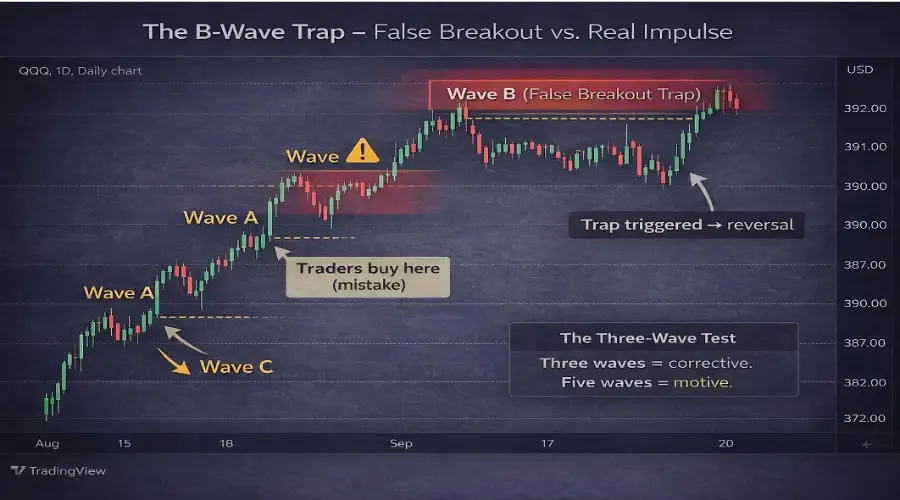
The B-wave trap occurs when a corrective rally is mistaken for the start of a new impulse. Apply the three-wave test: if the prior move was three waves, the rally is corrective - not a new trend.
What should you do after a rule violation?
Stop relabeling and start rebuilding. A rule violation invalidates the entire count. Step back one degree, identify the last confirmed structure, and restart.
How do you choose the correct starting point?
Start from a confirmed prior extreme - typically the end of a completed corrective pattern such as an A-B-C structure.
Mistake 1: Degree Errors
The Problem
Labelling one degree as another without verifying internal structure.
What It Looks Like
A Wave 3 on the daily chart that only contains three waves on the hourly chart.
The Fix
Drop to the lower timeframe and verify structure:
- Five waves = impulse
- Three waves = correction
No internal verification, no valid count.
To understand how corrections behave across different structures: Corrective Waves: Zigzag vs Flat Explained
Mistake 2: Trading Corrections as Impulses
The Problem
Entering a supposed Wave 3 that is actually a Wave C within a correction.
What It Looks Like
A three-wave decline followed by a rally that appears impulsive.
The Fix
Always count from the prior high or low:
- If the initial move is three waves → correction
- If five waves → impulse
The Three-Wave Test
If Wave 1 has three internal waves, it is Wave A - not Wave 1.
Three waves = corrective. Five waves = motive.
To understand how real trends form: Elliott Wave Motive Wave Strategy (Wave 3 Guide)
Visual Example (Wrong vs Correct Count)
CHART: Side-by-side QQQ example
- Left → incorrect count (3-wave labelled as impulse)
- Right → corrected A-B-C structure
- Callout → “Three-wave test identifies the error”
Mistake 3: Forcing a Count
The Problem
Adjusting labels to fit price instead of accepting invalidation.
What It Looks Like
Relabelling after a Wave 2 violation instead of abandoning the count.
The Fix
Rules are binary. If violated, the count is wrong.
The market is not wrong - the count is.
The moment you adjust a label to preserve a narrative, you have stopped analyzing and started rationalizing. In professional trading, invalidation is not a failure - it is information.
To validate whether a structure should be accepted or rejected: Elliott Wave Rules vs Guidelines
Mistake 4: Wrong Starting Point
The Problem
Beginning the count from an arbitrary level.
What It Looks Like
A valid-looking structure built on an incorrect baseline.
The Fix
Start from:
- End of a corrective pattern
- Major support or resistance reversal
Wrong starting point makes all Fibonacci projections unreliable.
To project accurate price targets once structure is correct: Fibonacci Targets for Wave 3, 4 & 5
Mistake 5: Ignoring Alternative Counts
The Problem
Operating with a single interpretation.
What It Looks Like
Holding bias despite market disagreement.
The Fix
Maintain:
- Primary count
- Alternative count with invalidation level
When invalidation is triggered, switch immediately without hesitation.
To understand how complex corrections create multiple valid scenarios: X-Wave Trap: Double Three (WXY) Strategy
Mistake 6: Expecting Perfect Symmetry
The Problem
Rejecting valid structures because they do not look textbook.
What It Looks Like
Discarding a valid count because Wave 3 is not extended enough.
The Fix
Rules define validity. Guidelines define probability.
An imperfect but rule-compliant structure remains valid.
Recovery Procedure After a Mistake
When your count is invalidated, follow this process:
- Move to a higher timeframe
- Identify the last confirmed structure
- Restart from that point
- Reapply rule validation
- Do not relabel — rebuild
Mistake-Proof Checklist
Before entering any trade:
- Internal structure verified at lower degree
- All four rules satisfied
- Wave origin clearly identified
- Alternative count defined
- No forced interpretation
Red Flags
- Any rule violation
- Wave 1 contains three waves
- Weak momentum in Wave 3
- Divergence appears too early
- Labels adjusted to fit price
To confirm whether the move is weakening or continuing: Wave 3 vs Wave 5 Divergence Strategy
Key Takeaways
- Rule violations invalidate the entire count
- Three-wave structures are corrective, not impulsive
- Degree alignment is essential for accuracy
- Alternative counts reduce bias
- Rebuilding is superior to relabelling
Next Step in the Framework
Now that you understand the most common Elliott Wave mistakes and how to avoid them, the next step is learning how to execute trades using validated structure, precise targets, and momentum confirmation.