
US Market Analysis | July 23, 2026 | By Manish T., BreakoutBulletin
This is a sample market analysis from the BreakoutBulletin archive, set in July 2026 to illustrate the format. All events, price levels, and analyst calls are hypothetical.
Market Summary
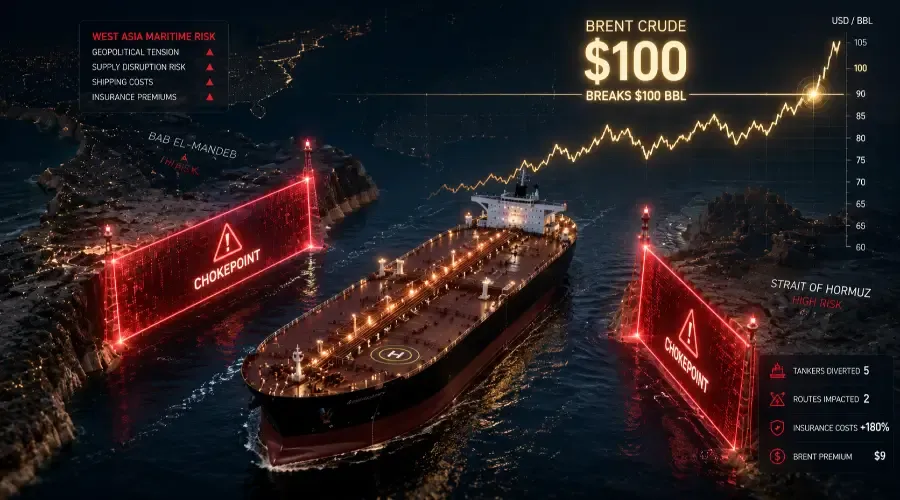
Brent crude crossed $100 a barrel Thursday morning, up 6.4% to $100.05 as of 9:15 a.m. ET, its first move above triple digits since May 26. WTI rose more than 5% to $91.08. The roughly $9 Brent premium reflects the heavier impact of a Middle East maritime disruption on seaborne Brent-linked crude versus US landlocked WTI. The trigger was a claimed Houthi strike on two Saudi oil tankers in the Red Sea, days after the group declared a naval blockade of the kingdom. The move caps a rally of more than 30% for Brent in July alone.
Key Takeaways
Brent above $100 for the first time in eight weeks; WTI at its highest since June 11.
The trigger: Houthi attacks on two Saudi tankers, following a declared maritime embargo. Five Saudi tankers have diverted course.
The structural problem: both of the Gulf's export routes are now compromised at once.
Historical contrast: past Red Sea disruptions moved Brent roughly 1% to 4% before normalizing. This one produced a 6% day.
Analyst views vary widely: Goldman Sachs (July 22 note) sees Brent above $120 by Q4 if disruptions persist; RBC Capital Markets (July 22) has flagged scenarios reaching the 2022 highs near $128 in a full regional war.
The Dual Chokepoint: Why There Is No Reroute Left
The reason this attack repriced crude so violently has less to do with the tankers themselves than with geography.
When Hormuz traffic fell sharply after the collapse of the US-Iran ceasefire earlier this month, Saudi Arabia did the logical thing: it redirected more crude exports through the Bab el-Mandeb corridor and out via the Red Sea. That reroute was the release valve that kept the earlier disruption from becoming a genuine supply shock. Oil traded around $88 to $90 through that period, elevated but contained.
The Houthi campaign has now closed the valve. The secondary route is effectively impassable for Saudi shipments at the same time the primary route remains under threat. Both the main and the backup exits for Persian Gulf crude are compromised simultaneously, and that is a materially different situation from either one being disrupted alone.
That is what separates this move from the pattern. Previous Red Sea episodes produced Brent increases of 1% to 4% that faded once vessels rerouted. Rerouting was always the answer. With Hormuz constrained, there is nowhere left to route to, which is why the market repriced 6% in a session instead of absorbing the headline.
The Mediation Trade Has Fully Unwound
On Monday, Brent traded near $90.79 after US-Iran strikes around Hormuz. By Tuesday, mediation headlines pulled it back toward $88 as markets priced a contained, short-duration conflict.
That read is now wrong. The US has run 12 consecutive nights of strikes on Iranian targets, Rubio has publicly downplayed near-term diplomacy, and the conflict has widened to a second shipping lane. The contained-conflict thesis held for roughly 48 hours.
The Sector Mechanics
The transmission channels are well established, though the magnitude depends entirely on duration.
Sustained crude at these levels flows to producers, refiners, and oilfield services on the revenue side while acting as an input-cost tax on airlines, transportation, chemicals, and fuel-sensitive consumer names. Historically the equity market treats the first days of a spike as rotation and only reprices margins broadly when prices hold.
The second channel matters more for the index. Energy feeds headline inflation, and a sustained move of this size complicates the disinflation picture supporting rate-cut expectations. That is how an oil shock becomes a broad-market problem rather than a sector rotation: through yields and Fed expectations, not energy weightings.
Related reading: What Happens When Crude Oil Prices Crash? Sector Winners, Losers & Market Impact Explained
https://www.breakoutbulletin.com/article/what-happens-when-crude-oil-prices-crash
What Traders Are Watching
Four things separate a spike from a regime change.
Whether Brent holds above $100. The level is psychological rather than technical, but a sustained hold versus a fade back into the low nineties tells you whether the market believes the dual-chokepoint problem persists.
The Treasury reaction. A meaningful move up in yields would signal the market is repricing inflation and the rate path, which is when the oil story stops being contained to energy.
Shipping and insurance behavior. Tanker diversions, war-risk premiums, and whether any Saudi cargoes resume through Bab el-Mandeb are the physical indicators, and they lead the price rather than follow it.
Duration signals. A pause in strikes, credible mediation, or naval escort arrangements would each begin restoring the reroute option that made previous disruptions manageable.
The Bottom Line
Crude above $100 reflects a supply map with no obvious workaround rather than a single headline. Both Gulf export corridors are compromised at once, and the reroute that absorbed earlier disruptions is no longer available. Whether this holds depends on physical shipping flows and the pace of escalation rather than on any single day's price action, and the Treasury market is where the broader consequences will show up first.
Sources: CNBC, NBC News, Washington Post, Bloomberg, The National, July 22-23, 2026. These are referenced as part of the hypothetical scenario; no actual reporting is cited. Educational content only. Not investment advice. Oil markets move rapidly; verify current prices before acting. Markets involve risk.