
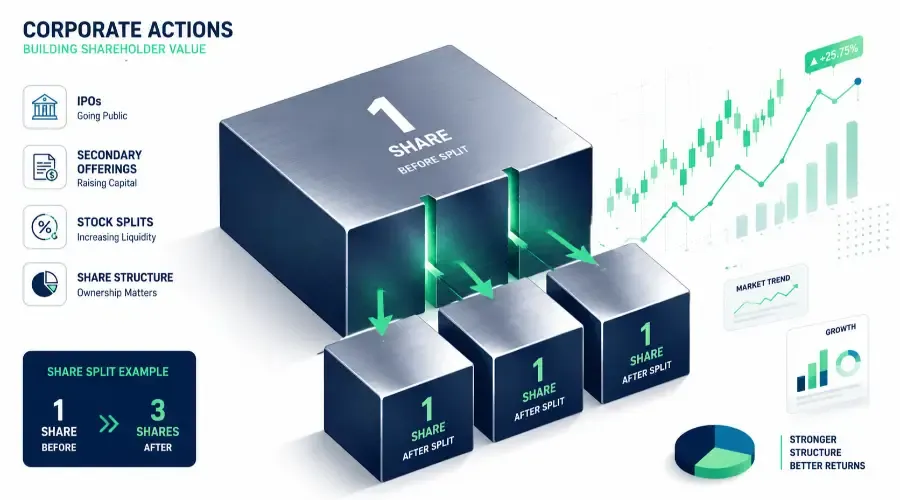
Companies don't just trade passively on exchanges – they take periodic actions that alter their share structure, ownership composition, and capital base. These events range from a company's first day on a public exchange to decisions about splitting shares years later. Each one carries specific implications for existing and prospective investors.
IPOs: The Entry Point to Public Markets
An Initial Public Offering is the first time a company sells shares to the public on a stock exchange. Before the IPO, ownership is restricted to founders, employees with equity, venture capital firms, and private equity investors. After it, anyone with a brokerage account can buy a stake.
The process in six steps:
Investment banks (underwriters) are hired to manage the offering, advise on pricing, and distribute shares to institutional investors.
An S-1 registration statement is filed with the SEC – a public document containing audited financials, risk disclosures, competitive analysis, and planned use of proceeds. The Risk Factors section is one of the most informative sections of any S-1 for understanding what management believes could go wrong.
A roadshow presents the company to large institutional investors to generate demand and establish pricing parameters.
Underwriters set a final IPO price based on roadshow demand, often above the initially proposed range when demand is strong. Airbnb's December 2020 IPO originally proposed $44 to $50 per share and priced at $68, raising $3.5 billion.
On listing day, the stock trades publicly for the first time. The opening price – what retail investors actually pay – is set by market supply and demand at the open, not by the institutional IPO price.
A lockup period (typically 90 to 180 days) prevents insiders from selling shares immediately. When lockups expire, significant share volume can enter the market simultaneously, often pressuring prices lower. That said, the market anticipates these expiration dates, so some of the downward pressure often materializes in the weeks leading up to the event rather than on the day itself.
The Greenshoe option: Underwriters typically have an over-allotment option allowing them to sell up to 15% more shares than the offering size, then buy them back later to stabilize the price. This mechanism helps support the stock in the immediate post-IPO period.
The retail disadvantage: Institutional investors receive IPO allocations at the IPO price. Retail investors buy at the opening price – which for Airbnb was $146, more than double the $68 institutional price. The "first-day pop" that generates headline coverage has already happened before retail investors can access the stock.
Direct listings: an alternative path: Not all companies use the traditional IPO underwriting process. Some, like Spotify, Slack, and Coinbase, have entered public markets through direct listings–selling existing shares without underwriters or a formal IPO price. Direct listings involve no lockup period, no "first-day pop" disadvantage for retail buyers (the opening price is purely market-driven), and no dilution (no new shares are created). While less common, understanding this alternative provides a complete picture of how companies access public markets.
The post-IPO performance pattern: Academic studies, such as those by Professor Jay Ritter of the University of Florida, consistently document that IPOs as a group underperform the S&P 500 over 3 to 5-year periods after listing. The first-day pop is memorable; the multi-year performance trajectory is not. Exceptions exist, but the base rate for IPOs beating the index over five years is historically below 50%.
Waiting 6 to 12 months after listing accomplishes several things: actual public earnings reports (not just the roadshow narrative) become available, lockup expiration and its price impact plays out, and a clearer picture of how the business performs under public scrutiny emerges. Many companies that IPO at premium valuations trade at lower prices six to twelve months later.
Secondary Offerings: When Companies Issue More Shares
After the IPO, companies can return to the equity market when they need additional capital. Secondary offerings are the only other moments at which a company directly receives cash from its stock.
Dilutive offerings involve the company creating and selling new shares that didn't previously exist. Proceeds go to the company. Total shares outstanding increase; every existing shareholder's proportional stake shrinks.
The dilution formula: new shares divided by (old shares plus new shares), multiplied by 100.
A 10 million share offering on a 200 million share base: 10 ÷ 210 × 100 = 4.8% dilution.
Secondary offerings typically price 3 to 7% below the prevailing market price to ensure institutional demand. The market price usually falls to close the gap with the offering price on announcement day.
Non-dilutive offerings involve existing shareholders – founders, early investors, employees – selling shares they already own. No new shares are created. The company receives no proceeds. Total shares outstanding don't change. Your ownership percentage is unaffected. The only thing that changes is who holds those shares.
At-the-market (ATM) offerings: A variation on dilutive offerings, ATM programs allow companies to sell small amounts of new shares gradually into the open market at prevailing prices over time. These are more common among smaller-cap companies and generally have less immediate price impact than a single block offering. However, an active ATM program can signal ongoing cash needs rather than a one-time strategic capital raise, making it worth monitoring.
Reading the use of proceeds: The single most informative data point in any offering announcement. Capital raised for market expansion, strategic acquisitions, or R&D investment signals a company strengthening its position. Capital raised to cover operating losses, repay debt, or fund ongoing cash burn signals something different. The dilution math is identical; the long-term implications are not.
The valuation signal: When a company issues equity, it's worth considering what management is signaling about valuation. If management believed the stock was deeply undervalued, they would typically buy it back or use debt (which is cheaper relative to equity). Issuing new equity often suggests that management views the current price as fair or even rich – a subtle but informative data point for existing shareholders.
Multiple offerings as a warning pattern: One secondary may be strategy. Two or three within 12 to 18 months, particularly following disappointing earnings, suggests a company returning repeatedly to equity markets because operations can't cover expenses. That pattern is materially different from a single strategic capital raise. Context matters, however: some cyclical businesses, like energy companies, raise capital during downturns and return it during upturns. The warning is strongest for serial issuers whose operations perpetually fail to cover expenses, rather than for companies raising capital through temporary cycles.
Response framework:
Under 5% dilution with specific, growth-oriented use of proceeds: review thesis, hold if intact.
5 to 10% dilution with vague or defensive use of proceeds: reassess the original investment case.
Above 10% dilution or repeated offerings within a short window: evaluate whether the business model has changed materially from what you originally assessed.
Stock Splits: When Price and Share Count Restructure
A stock split changes the number of shares outstanding and the price per share simultaneously, leaving total market capitalization unchanged. An investor's portfolio value is identical before and after a split.
Forward splits: In a 3-for-1 split, every shareholder receives three shares for each one previously held. The stock price adjusts to one-third of its pre-split level. An investor holding 10 shares at $900 now holds 30 shares at $300 – total value $9,000 in both cases.
Companies split their stock when high per-share prices create a perception barrier for smaller investors, or when they want to improve daily liquidity by increasing the number of shares trading. Tesla conducted a 3-for-1 split in August 2022. Apple has split five times in its history, most recently 4-for-1 in August 2020.
The split itself has no direct effect on value – subsequent returns depend entirely on business performance.
Cost basis update after a split: After a 3-for-1 split, your original cost basis per share divides by three. If you held 10 shares at $300 cost basis each ($3,000 total), you now hold 30 shares at $100 cost basis each. Most brokerage platforms update this automatically, but verifying against personal records prevents errors when calculating future capital gains.
Reverse splits: A reverse split reduces share count and proportionally increases per-share price. In a 1-for-10 reverse split, an investor holding 200 shares at $1.50 now holds 20 shares at $15 – value unchanged.
Reverse splits typically happen because the stock has declined to levels triggering exchange listing concerns. NYSE and NASDAQ require minimum share prices – generally $1 per share – for continued listing, and provide a compliance window (typically 180 calendar days on NASDAQ and a similar period on NYSE) to regain compliance. A reverse split raises the per-share price mechanically, satisfying the exchange requirement without addressing the underlying business. Additionally, if the reverse split leaves you with a fractional share that your broker can't hold, the cash settlement for that fraction becomes a taxable event.
Why reverse splits are warning signals: They treat the symptom, not the cause. If a company's stock fell 85% due to deteriorating revenue or failed strategy, a reverse split doesn't fix those problems – it just changes the number on the screen. History shows that many stocks conducting reverse splits continue declining afterward. Multiple reverse splits by the same company over several years is a severe pattern – consistent value destruction without correction. Beyond business deterioration, many institutional investors have policies prohibiting investment in stocks below $5 per share. A reverse split that moves the price from $1.50 to $15 may satisfy the exchange listing requirement, but it often does not bring the stock back into institutional buy ranges, reducing potential liquidity and price support.
Distinguishing the two at a glance: Forward splits happen to companies whose stock has risen substantially – the high per-share price prompts the split. Reverse splits happen to companies whose stock has fallen substantially – the low per-share price prompts the split. Seeing "stock split" in a headline: check which direction before forming an opinion.
How Corporate Share Events Connect to Each Other
These events don't happen in isolation – they often occur in sequence and in patterns that tell a coherent story about a company's trajectory.
A company that IPOs successfully, grows its business, eventually conducts a forward split (reflecting price appreciation), and periodically raises additional capital through small secondary offerings for strategic acquisitions represents a healthy, growing public company.
A company that IPOs at an elevated valuation, conducts multiple large secondary offerings within two years (suggesting ongoing cash burn), never grows into its valuation, and eventually conducts a reverse split represents a deteriorating story – each event a logical consequence of the preceding one.
Reading corporate actions as a sequence rather than isolated events gives you a more complete picture of what's actually happening at the business level.
The Shareholder Perspective on Each Event
IPO: You're buying a business at its first moment of public pricing – when information asymmetry is highest (insiders know the business far better than new public shareholders) and lockup expiration creates a known near-term overhang.
Secondary offering: Management is asking existing shareholders to absorb dilution. The question is whether what the company does with that capital justifies the cost of the dilution.
Forward split: No value change. The split signals the stock has appreciated substantially. Subsequent performance depends entirely on the business.
Reverse split: No value change. The split signals the stock has declined substantially. Requires careful reassessment of why – and whether the underlying problem has been corrected.
This content is for educational purposes only and does not constitute investment, legal, or tax advice. Investing in securities involves risk, including possible loss of principal. Always conduct your own research and consult a licensed financial professional before making investment decisions.
Free educational guide by BreakoutBulletin.com
Go deeper:
IPOs, secondary offerings, and splits are the moments when a company's share structure changes materially. Understanding each one helps you respond deliberately rather than react to a headline. The full guide connects these events to dividend policy, buybacks, and the broader framework of corporate capital allocation.
→ Corporate Actions Explained → The complete guide: dividends, buybacks, and every share event in context - www.breakoutbulletin.com/article/guide-to-corporate-actions
→ The IPO Process Explained → Why the first-day pop benefits institutions, not retail investors - www.breakoutbulletin.com/article/ipo-process-explained-for-beginners
→ Secondary Offerings Explained → How to evaluate dilution and what the use of proceeds reveals - www.breakoutbulletin.com/article/secondary-offerings-explained-for-teen-investors
→ Stock Splits and Reverse Splits → Why forward splits are neutral and reverse splits are a warning - www.breakoutbulletin.com/article/stock-splits-vs-reverse-splits-explained