
The Dow Jones Industrial Average declined 437 points, or 0.89%, to close at 48,468 on March 3, down from its prior close of 48,905. The headline figure has been widely reported alongside the broader market weakness linked to the geopolitical escalation involving Iran and the associated oil price shock.
What the index number alone does not reveal is the internal composition of that decline. Component-level performance within the Dow shows a clear divergence: some companies absorbed most of the selling pressure while others held steady or even gained.
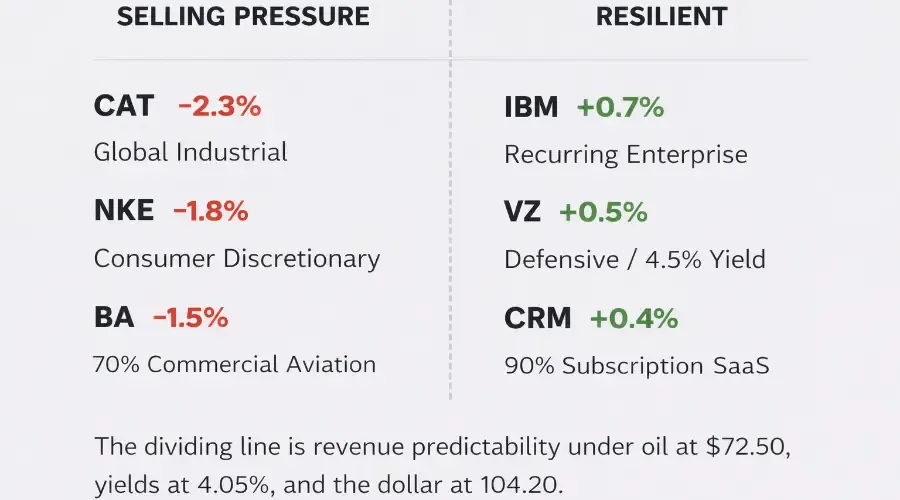
That distinction is not incidental. It reflects how institutional capital interprets macro shocks at the individual company level. When Caterpillar, Nike, and Boeing decline in the same session that IBM, Verizon, and Salesforce remain stable or advance, the market is expressing differentiated judgments about business models, revenue exposure, and macro sensitivity rather than applying a uniform view across equities.
Understanding those distinctions provides a clearer lens into how professional investors interpret a geopolitical inflation shock within equity markets.
The Macro Filter Applied to Dow Components
The geopolitical catalyst driving the broader market narrative is well established. Escalating tensions between the United States, Israel, and Iran disrupted shipping flows through the Strait of Hormuz and pushed oil prices higher. WTI crude rose to $72.50 (+3.5%), while Brent reached $83.90 (+3.7%).
Rising oil prices fed into inflation expectations and Treasury yields, with the 10-year yield rising 8 basis points to 4.05%, altering the discount-rate environment for equities. The U.S. dollar strengthened alongside yields, with the DXY index climbing 0.8% to 104.20.
At the component level, that macro combination creates a specific analytical filter. Companies with global supply chains, cyclical demand exposure, or revenue streams sensitive to currency fluctuations and energy costs tend to face selling pressure. Businesses with stable domestic revenue, subscription-based models, or defensive demand characteristics tend to hold up better.
The Dow's internal leadership on March 3 aligns closely with this framework.
Caterpillar – Global Cyclical Exposure
Caterpillar declined approximately 2.3% on March 3, making it one of the session's weakest Dow components. The company represents one of the clearest global industrial proxies within the Dow. Its business is closely linked to construction activity, mining investment, and infrastructure spending around the world.
When institutional investors reduce exposure to Caterpillar during a geopolitical supply shock, the interpretation often centers on two concerns. First, higher oil prices raise operating costs for large-scale construction and resource projects, which can delay or reduce capital spending globally. Second, disruptions in global shipping routes can complicate equipment delivery and increase input costs.
Caterpillar also maintains meaningful exposure to international markets, including China, where construction activity has shown signs of slowing. A stronger U.S. dollar at 104.20 and higher energy prices create additional pressure for customers operating in dollar-sensitive commodity sectors.
The decline in CAT therefore reflects concerns about global industrial demand under a rising-cost environment.
Nike – Consumer and Currency Sensitivity
Nike declined approximately 1.8% on March 3, illustrating how consumer discretionary businesses respond to macro shocks that affect both spending and currency dynamics.
As a premium global brand, Nike relies heavily on international manufacturing and cross-border logistics. Production centers in Southeast Asia and China require extensive shipping infrastructure, which becomes more expensive when oil prices increase.
At the same time, a strengthening U.S. dollar — the DXY rose 0.8% to 104.20 — reduces the translated value of international revenue when earnings are reported in dollars. With approximately 60% of Nike's revenue generated outside the United States, this currency headwind is meaningful.
The market reaction in Nike reflects this combined pressure. Higher transportation costs, currency headwinds, and potential softness in discretionary spending create a macro environment that challenges margins and revenue visibility.
Boeing – Complex Industrial Exposure
Boeing declined approximately 1.5% on March 3, occupying a unique position among Dow components because its revenue base spans both commercial aviation and defense.
During geopolitical conflicts, defense spending expectations typically increase. However, Boeing's commercial aviation division remains the dominant contributor to its financial performance, accounting for roughly 65-70% of revenue compared to defense's 30-35%.
Higher oil prices raise jet fuel costs for airlines, which can pressure airline profitability and slow aircraft purchasing decisions. At the same time, operational challenges and production constraints have limited Boeing's ability to fully capitalize on defense demand in the near term.
The market reaction suggests investors view Boeing's immediate commercial exposure as outweighing the longer-term defense demand tailwind.
IBM – Contract-Based Revenue Stability
IBM gained approximately 0.7% on March 3, highlighting the role of recurring enterprise revenue models during macro uncertainty.
Much of IBM's business is tied to long-term enterprise infrastructure agreements, government contracts, and hybrid cloud services — approximately 60-70% of revenue is recurring or subscription-based. These contracts typically span multiple years and involve mission-critical systems that organizations cannot easily discontinue during short-term economic fluctuations.
Because of that structure, IBM's revenue profile tends to be less sensitive to immediate changes in energy prices, consumer spending, or shipping costs.
The stability of IBM's share performance reflects the market's recognition of that recurring revenue durability.
Verizon – Defensive Demand Characteristics
Verizon gained approximately 0.5% on March 3, demonstrating how telecommunications companies often behave similarly to defensive utilities during periods of market stress.
Wireless connectivity represents a non-discretionary service for most households and businesses. As a result, Verizon's revenue base tends to remain stable even when economic conditions weaken.
In addition, Verizon offers a relatively high dividend yield of approximately 4.5%. During risk-off periods, dividend-paying companies can attract capital from investors seeking stable income while reducing exposure to cyclical sectors.
The stock's resilience during the Dow decline reflects that defensive positioning.
Salesforce – Enterprise Software Durability
Salesforce gained approximately 0.4% on March 3, illustrating an important distinction within the broader technology sector.
While some technology companies depend heavily on hardware sales or cyclical capital expenditures, Salesforce generates most of its revenue through subscription-based enterprise software — approximately 90% of total revenue.
These contracts are typically embedded within core corporate operations such as customer relationship management, sales tracking, and analytics. Because they support critical workflows, companies rarely cancel them abruptly even when economic conditions tighten.
That recurring SaaS revenue model provides a degree of insulation from the macro shocks affecting other sectors.
What the Component Rotation Reveals
When the six Dow components are examined together, a clear analytical pattern emerges:
| Company | Ticker | March 3 Change | Business Model | Key Sensitivity |
|---|---|---|---|---|
| Caterpillar | CAT | -2.3% | Global industrial | China exposure, energy costs |
| Nike | NKE | -1.8% | Consumer discretionary | 60% int'l revenue, currency |
| Boeing | BA | -1.5% | Aerospace | 70% commercial, fuel costs |
| IBM | IBM | +0.7% | Enterprise IT | 65% recurring revenue |
| Verizon | VZ | +0.5% | Telecom | 4.5% dividend yield, defensive |
| Salesforce | CRM | +0.4% | SaaS | 90% subscription revenue |
Companies experiencing the most selling pressure share certain characteristics: global supply chains, exposure to energy cost fluctuations, and dependence on discretionary spending or cyclical investment.
In contrast, the companies that held or gained during the session tend to generate stable revenue streams supported by contracts, subscriptions, or non-discretionary services.
The dividing line between the two groups is revenue predictability under the specific macro conditions created by the geopolitical shock: oil at $72.50, the 10-year yield at 4.05%, and the dollar at 104.20.
An index-level decline of 0.89% therefore represents a weighted average of multiple differentiated judgments about business resilience.
Structural Implications
Some of the price movement within individual Dow components may reflect short-term positioning adjustments. Institutional investors frequently rebalance portfolios, hedge exposures, or adjust sector allocations during periods of elevated volatility.
However, the direction of the rotation itself carries structural significance. Global cyclicals, consumer discretionary companies, and complex industrial businesses appear more sensitive to rising energy costs and currency fluctuations. Defensive telecommunications, enterprise infrastructure, and subscription-based software appear comparatively resilient.
If oil prices remain elevated and Treasury yields stay near current levels, those differences in macro sensitivity may continue to influence sector performance.
Portfolio Context
Educational context only. Not investment guidance.
Growth-oriented portfolios are already experiencing a higher sensitivity to interest rate changes. When Treasury yields rise above key thresholds, the valuation of long-duration earnings streams becomes more sensitive to discount-rate adjustments.
Defensive portfolios, particularly those emphasizing stable cash flows or dividend income, tend to behave differently during these periods. Companies with predictable revenue streams can attract capital as investors seek stability within uncertain macro environments.
Balanced portfolios may see offsetting effects, with energy and defensive sectors partially compensating for weakness in cyclical or growth-oriented holdings.
The Broader Market Lesson
The Dow's component-level behavior during the March 3 session demonstrates how professional investors interpret macro shocks through the lens of individual business models.
A headline decline in a major index does not represent a uniform judgment about all companies within that index. Instead, it reflects a combination of selective repricing decisions based on revenue stability, supply-chain exposure, and sensitivity to inflation or interest rates.
The presence of both decliners and resilient performers within the same index suggests markets are differentiating rather than reacting indiscriminately.
That differentiation often provides deeper insight into how institutional capital views the evolving macro environment.
-
Attachment Title
Dow Component Analysis: March 3, 2026 - Summary Table -
Attachment Content
Dow Jones Industrial Average: March 3, 2026
Index: Closed at 48,468 | Decline: -437 points (-0.89%) | Prior close: 48,905
Macro Context
-
Oil: WTI $72.50 (+3.5%) | Brent $83.90 (+3.7%)
-
10-year Treasury: 4.05% (+8bps)
-
Dollar Index (DXY): 104.20 (+0.8%)
Component Performance & Business Model Analysis
| Company | Ticker | Change | Business Model | Key Sensitivity |
|---|---|---|---|---|
| Caterpillar | CAT | -2.3% | Global industrial | China exposure, energy costs |
| Nike | NKE | -1.8% | Consumer discretionary | 60% int'l revenue, currency |
| Boeing | BA | -1.5% | Aerospace | 70% commercial, fuel costs |
| IBM | IBM | +0.7% | Enterprise IT | 65% recurring revenue |
| Verizon | VZ | +0.5% | Telecom | 4.5% dividend yield, defensive |
| Salesforce | CRM | +0.4% | SaaS | 90% subscription revenue |
Disclaimer: This article is for informational and educational purposes only and does not constitute financial, investment, or trading advice. You are solely responsible for your own investment decisions and should consult a licensed financial professional before acting on any information in this post.