
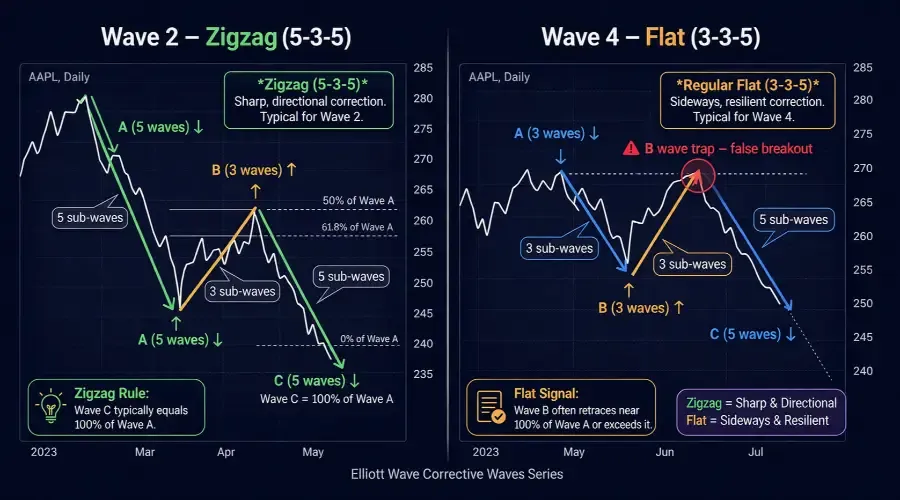
Most traders lose money during pullbacks, not trends, because they misread corrective structure as reversal, chase B wave breakouts, and enter precisely where the market is preparing to move against them.
In Elliott Wave analysis, corrections are not noise inside a trend; they are the mechanism through which the market resets positioning, absorbs liquidity, and creates the conditions for the next directional move. Understanding corrective wave structure is therefore not optional—it is the difference between reacting to price and anticipating it.
Before learning corrections, you must understand how trends form: Elliott Wave Motive Wave Strategy (Wave 3 Guide)
What is a Corrective Wave
A corrective wave moves against the direction of the larger trend and typically unfolds in a three-wave sequence labeled A, B, and C, reflecting a temporary imbalance rather than a structural shift in market direction.
In a bullish trend, corrections appear as pullbacks; in a bearish trend, they appear as counter-trend rallies. The defining characteristic is not direction but structure: corrective moves subdivide into three waves, whereas impulse waves subdivide into five.
This distinction is critical, because identifying whether a move is A-B-C or 1-2-3-4-5 determines whether you are looking at an entry opportunity within a trend or the beginning of a reversal.
Most Common Mistake: B Wave Traps
The most dangerous mistake traders make during corrections is treating the B wave as a breakout, particularly when price briefly exceeds prior highs and momentum appears to expand.
A B wave often creates the illusion of trend continuation, but structurally it remains corrective, typically subdividing into three waves rather than five, and once complete, it is followed by a C wave that moves sharply in the opposite direction.
The only reliable way to avoid this trap is to examine the internal structure on a lower timeframe: if the move resolves into A-B-C rather than 1-2-3-4-5, it is not a new impulse, regardless of how convincing it appears.
Deep dive into false breakouts: B-Wave Trap: False Breakout Explained
The Four Corrective Patterns
Corrective waves are not uniform; they follow distinct structural patterns, each with its own implications for depth, duration, and the strength of the underlying trend.
Zigzag (5-3-5)
A zigzag is the most common corrective pattern and typically represents a sharp, directional pullback that retraces a meaningful portion of the prior trend. Wave A subdivides into five waves, Wave B into three, and Wave C into five, creating a clear 5-3-5 structure.
Zigzags usually retrace 50% to 61.8% of the preceding impulse, and Wave B tends to be relatively shallow, often retracing between 38% and 50% of Wave A.
The key relationship that makes zigzags tradable is that Wave C is typically equal to 100% of Wave A, allowing you to project a precise target once Wave B completes.
Example: If Wave A declines from 500 to 480 and Wave B retraces to 490, the projected Wave C target is 470. When price approaches this level with a clear five-wave decline, the correction is likely complete and the trend is preparing to resume.
Regular Flat (3-3-5)
A regular flat forms when the market corrects in a more sideways manner, reflecting underlying strength that prevents deep retracement. Wave A subdivides into three waves, Wave B retraces close to 100% of Wave A, and Wave C completes the pattern in five waves.
Because the correction ends near its starting point, regular flats often indicate that the trend remains strong and that the market is consolidating rather than reversing.
Expanded Flat (3-3-5)
An expanded flat extends the logic of the regular flat but introduces a false breakout dynamic, where Wave B exceeds the start of Wave A before reversing sharply into Wave C.
Wave C in this structure typically extends to 138.2% or 161.8% of Wave A, making it deeper and more aggressive than a standard zigzag correction. Expanded flats are common in Wave 2 positions within strong trends and frequently trap traders who interpret the B wave breakout as continuation.
Running Flat (3-3-5)
A running flat is the rarest corrective pattern and reflects extreme underlying strength, where Wave B exceeds the start of Wave A but Wave C fails to break below the end of Wave A.
The result is a correction that barely retraces before the trend resumes, often occurring within extended Wave 3 environments where momentum remains dominant.
Wave C Targets: The Mathematical Edge
Corrective waves become actionable when structure is combined with measurement. The most consistent relationship across corrective patterns is the projection of Wave C relative to Wave A.
- Zigzag: Wave C ≈ 100% of Wave A
- Expanded flat: Wave C ≈ 138.2% to 161.8% of Wave A
- Regular flat: Wave C terminates near the end of Wave A
These relationships allow you to define high-probability support zones before price reaches them, turning corrective analysis into a forward-looking framework rather than a retrospective label.
To project these targets precisely: Fibonacci Targets for Wave 3, 4 & 5
Decision Logic: Trading Corrective Waves
Structure alone is insufficient without execution rules, and corrective waves provide a clear decision framework once their internal pattern is identified.
- If Wave A subdivides into five waves, treat the correction as a zigzag and project the Wave C target equal to Wave A from the end of Wave B
- If Wave A subdivides into three waves, anticipate a flat and monitor whether Wave B retraces or exceeds the start of Wave A
- If a rally subdivides into three waves, do not treat it as a breakout, as it is likely a B wave
- If price reaches the projected Wave C level with momentum divergence, prepare for trend continuation rather than further decline
- If price moves beyond the expected Wave C level without a clear five-wave structure, reassess the count as part of a larger or more complex correction
The Alternation Principle
One of the most useful guidelines in Elliott Wave analysis is the principle of alternation, which states that Waves 2 and 4 within an impulse tend to differ in character.
If Wave 2 is sharp and directional, typically forming a zigzag, Wave 4 is more likely to be sideways, forming a flat or triangle. Conversely, if Wave 2 is sideways, Wave 4 often becomes sharp.
This principle is not absolute, but it provides a probabilistic edge, allowing you to anticipate the nature of future corrections once one has already been identified.
Differentiating Wave 2 and Wave 4
Although both are corrective waves, Wave 2 and Wave 4 differ in depth, structure, and constraints.
- Wave 2 typically retraces 50% to 61.8% of Wave 1 and is often sharp in nature
- Wave 4 typically retraces 23.6% to 38.2% of Wave 3 and tends to be sideways
- Wave 2 cannot retrace more than 100% of Wave 1
- Wave 4 cannot enter the price territory of Wave 1
These distinctions allow you to identify where you are within a trend, even before the full structure is complete.
To validate whether your structure is correct: Elliott Wave Rules vs Guidelines
Regime Sensitivity
Corrective behavior varies depending on broader market conditions, and ignoring this context often leads to misinterpretation of structure.
In expansionary environments characterized by strong liquidity and risk appetite, corrections tend to be shallow, with flats and running flats appearing more frequently.
In contractionary environments, corrections become deeper and more directional, with zigzags dominating and retracements often reaching or exceeding 61.8%.
Aligning your expectations with the prevailing regime improves both pattern recognition and trade timing.
Corrective Wave Identification Checklist
- Wave A subdivides into five waves → likely zigzag
- Wave A subdivides into three waves → likely flat
- Wave B retraces less than 90% of Wave A → zigzag scenario
- Wave B retraces approximately 100% or more → flat scenario
- Zigzag target → Wave C equals Wave A
- Expanded flat target → Wave C extends to 138.2%–161.8% of Wave A
- Always confirm internal structure on a lower timeframe before acting
Frequently Asked Questions
What signals that a correction is complete
A correction is typically complete when Wave C finishes a five-wave structure and momentum begins to diverge, followed by a new impulse in the direction of the trend. To confirm reversal timing using momentum: Wave 3 vs Wave 5 Divergence Strategy
What if Wave C exceeds 100% of Wave A
This often indicates that the pattern is an expanded flat rather than a zigzag, requiring a reassessment of Wave A’s internal structure.
How do I avoid B wave traps
By verifying internal structure: three-wave moves indicate correction, while five-wave moves indicate impulse. Volume contraction during B waves also provides a supporting clue.
Key Takeaways
- Corrective waves follow an A-B-C structure and move against the trend
- Zigzags are sharp (5-3-5), flats are sideways (3-3-5)
- Wave C projections provide precise, tradable targets
- B wave traps are the most common source of losses during corrections
- Alternation helps anticipate the nature of future pullbacks
- Market regime influences whether corrections are shallow or deep
Internal Links
Explore the Motive Wave Strategy to understand how trends form and where Wave 3 opportunities emerge.
Refer to the Elliott Wave Rules guide to reinforce structural constraints and validation.
Call to Action
This article is part of the Elliott Wave Mastery Series. Start from the beginning or continue to the next step to build a complete trading framework.
Next Step in the Framework
Now that you understand how corrections work and where traders get trapped, the next step is learning how to confirm whether a trend is strengthening or exhausting.
Wave 3 vs Wave 5: RSI & Volume Divergence Strategy