
Most traders draw Fibonacci levels after the move is already complete. Professionals calculate them before the wave begins.
Elliott Wave analysis is not about reacting to price — it is about projecting high-probability termination zones in advance. Fibonacci ratios provide the mathematical framework that makes this possible.
Momentum confirms a move. Fibonacci defines where that move is likely to end.
Why Fibonacci and Elliott Wave Are Inseparable
Fibonacci ratios are not decorative lines on a chart. They define the proportional relationships between waves in a structure that is inherently self-similar across degrees.
The most important ratios - 0.382, 0.500, 0.618, 0.786, 1.000, 1.272, 1.618, 2.000, 2.618 - appear consistently because each wave reflects a scaled version of the larger structure.
This is not theory. It is a repeatable framework that allows traders to pre-calculate where a wave is likely to terminate before it unfolds.
To understand the structure behind these projections: Elliott Wave Motive Wave Strategy (Wave 3 Guide)
Fibonacci Tool Setup
- Use Fibonacci retracement for Wave 2 and Wave 4
- Use Fibonacci extension for Wave 3 and Wave 5
- Measure Wave 1 first — it becomes the baseline for all projections
To ensure your structure is valid before applying Fibonacci: Elliott Wave Rules vs Guidelines
Fibonacci Quick Reference
- Wave 2 → 50% to 61.8% retracement of Wave 1
- Wave 3 → 161.8% to 261.8% extension of Wave 1
- Wave 4 → 23.6% to 38.2% retracement of Wave 3
- Wave 5 → Equality with Wave 1 or 161.8% extension
The Complete Fibonacci Grid by Wave Position
Wave 1
Wave 1 is not projected. It establishes the measurement unit for all subsequent waves.
The distance from Wave 1 start to Wave 1 end defines every future retracement and extension.
Wave 2 (Corrective)
Wave 2 retraces Wave 1 and typically finds support within a defined Fibonacci zone.
- Common levels → 50% and 61.8%
- Deep retracement → 78.6%
- Shallow retracement → 23.6% or 38.2% (strong trend)
Pre-calculation:
Multiply Wave 1 amplitude by 0.500 and 0.618, then subtract from Wave 1 high.
This defines your Wave 2 support zone before price reaches it.
Wave 3 (Extension)
Wave 3 is the strongest and most predictable wave in terms of Fibonacci projection.
- Minimum target → 161.8% of Wave 1
- Standard extension → 200%
- Strong trend → 261.8%
Pre-calculation:
Multiply Wave 1 amplitude by 1.618, 2.000, and 2.618, then add to Wave 2 low.
These levels define your Wave 3 target cluster.
Wave 4 (Corrective)
Wave 4 retraces Wave 3 but is typically shallower than Wave 2.
- Common levels → 23.6% and 38.2%
- Rare deeper retracement → 50%
Also consider:
The prior Wave 4 of one lower degree often acts as structural support.
Pre-calculation:
Multiply Wave 3 amplitude by 0.236 and 0.382, then subtract from Wave 3 high.
This defines your Wave 4 support zone.
Wave 5 (Extension or Equality)
Wave 5 behavior depends on whether Wave 3 extended.
- If Wave 3 extended → Wave 5 tends toward equality with Wave 1
- If Wave 3 did not extend → Wave 5 may reach 161.8% of Wave 1
Alternative projection:
Wave 5 may equal 61.8% of the distance from Wave 1 start to Wave 3 end
Pre-calculation (most reliable):
Add Wave 1 amplitude to Wave 4 low → this is the Wave 5 equality target
To apply these levels in real trades: Wave 3 Entry Strategy (Entry, Stop, Target)
Fibonacci Clusters: The Real Edge
The highest-probability targets are not single levels - they are zones where multiple Fibonacci relationships converge.
For example:
A Wave 3 target at 161.8% that aligns with a higher-degree retracement creates a significantly stronger level than either signal alone.
In practice:
- Calculate all projections in advance
- Identify overlapping levels
- Treat that region as a decision zone
Clusters define where attention should be focused — not where prediction must be exact.
Wave C Targets in Corrective Structures
Corrective waves follow their own Fibonacci relationships.
Zigzag
- Primary target → 100% of Wave A
- Extended → 127.2% or 161.8%
Flat
- Regular → 100% of Wave A
- Expanded → 127.2% to 138.2%
Running Flat (Rare)
- Wave C may terminate near 61.8% of Wave A
Triangle
- Each leg typically retraces ~61.8% of the previous leg
To understand how these corrections form structurally: Corrective Waves: Zigzag vs Flat Explained
Fibonacci Target Calculation Reference
Wave 2
- Wave 1 × 0.500
- Wave 1 × 0.618
- Wave 1 × 0.786
Wave 3
- Wave 2 low + (Wave 1 × 1.618)
- Wave 2 low + (Wave 1 × 2.000)
- Wave 2 low + (Wave 1 × 2.618)
Wave 4
- Wave 3 high − (Wave 3 × 0.236)
- Wave 3 high − (Wave 3 × 0.382)
Wave 5
- Wave 4 low + Wave 1
- Wave 4 low + (Wave 1 × 1.618)
- Wave 4 low + (Waves 1–3 × 0.618)
Corrections
- Zigzag → Wave A × 1.000 / 1.272 / 1.618
- Flat → Wave A × 1.272 / 1.382
- Running Flat → Wave A × 0.618
Visual Application (Chart Reference)
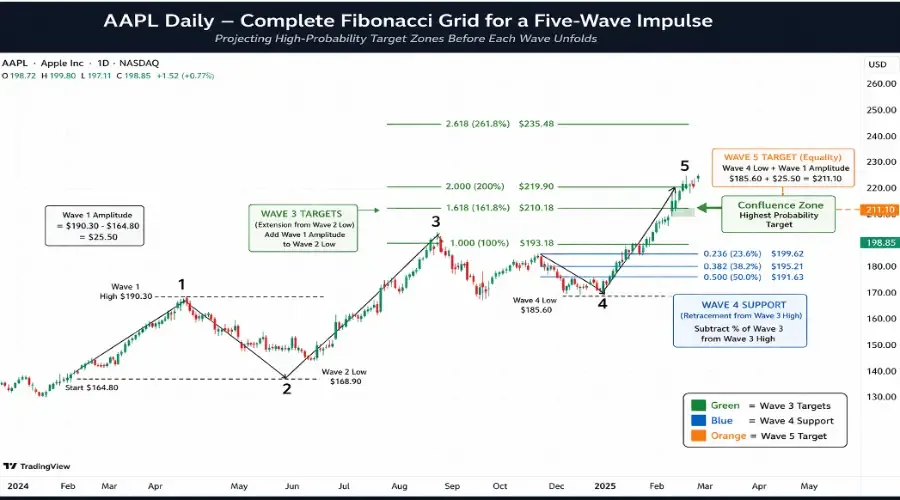
The chart above illustrates how Fibonacci levels align with Elliott Wave structure in a real market scenario.
- Wave 3 targets (green) → 161.8%, 200%, 261.8% extensions
- Wave 4 retracements (blue) → 23.6%, 38.2% pullback zones
- Wave 5 projection (orange) → Wave 1 measured from Wave 4 low
- Confluence zone → Area where multiple Fibonacci levels overlap, creating a high-probability decision zone
The key insight is not a single level, but the clustering of levels - this is where institutional reactions typically occur.
Key Takeaways
- Fibonacci defines probable wave termination zones before price reaches them
- Wave 3 extensions and Wave 5 equality are the most reliable projections
- Wave 2 and Wave 4 retracements differ in depth and structure
- Confluence zones provide the highest-probability targets
- Pre-calculation is the core edge in Elliott Wave trading
Frequently Asked Questions
What is the most reliable Fibonacci level in Elliott Wave?
The 161.8% extension for Wave 3 and the 100% equality projection for Wave 5 are the most consistently observed levels.
Why are Fibonacci clusters important?
Clusters combine multiple projections into a single zone, increasing the probability of a reaction compared to a single isolated level.
Can Fibonacci work without Elliott Wave?
Yes, but its accuracy improves significantly when aligned with wave structure, as it provides context for which levels matter.
Next Step in the Framework
Now that you understand how to project price targets using Fibonacci, the next step is learning how to avoid structural mistakes that invalidate these projections.
Elliott Wave Mistakes: B-Wave Trap & Common Errors Explained