
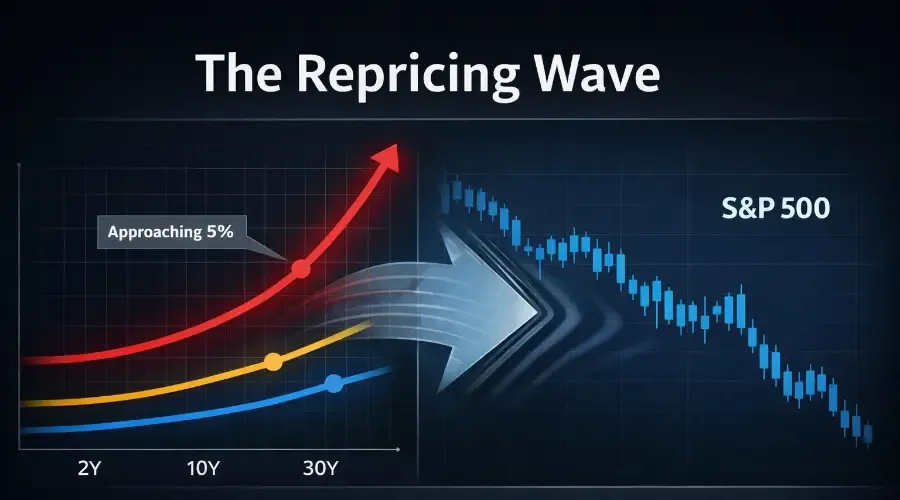
My take: The market’s reaction to the March FOMC meeting isn’t just a one-day hangover. We’re now two weeks out, and yields are still climbing—the 30-year Treasury has pushed toward 5%, and the S&P 500 is feeling the weight. What started as a simple repricing of rate-cut expectations has morphed into something broader: a structural shift driven by both inflation concerns and Treasury supply dynamics. If you’re only watching the Fed, you’re missing half the story.
Primary Catalyst: The FOMC Sets the Policy Anchor
The March 18 FOMC decision kept rates at 3.50–3.75%, but the real signal came from the updated dot plot. Policymakers now see at most one rate cut in 2026—a stark contrast to the two or three cuts markets had been pricing just weeks earlier.
That matters because equity valuations are essentially discounted cash flows. When the expected path of future rates moves higher, the discount rate applied to corporate earnings rises. Even if earnings estimates stay unchanged, present values fall. This is valuation compression in its purest form.
Oil plays a supporting role here. Sustained elevated oil prices feed into inflation expectations, which in turn reinforce the Fed’s cautious stance. But oil is an input, not the main character—the Fed’s own forward guidance was the primary catalyst.
Reinforcing Signals: The Curve Reprices in Two Waves
What makes this repricing phase more consequential is its two-wave structure:
Wave 1 (March 20) – Immediate Repricing
A direct reaction to the FOMC. The 2-year yield rose toward 3.9%, the 10-year yield moved above 4.3%, and fed-funds futures rapidly priced out most 2026 rate cuts. Some probability even shifted toward a potential tightening.
Wave 2 (March 24) – Structural Extension
An extension, but this time driven by a different force: Treasury supply concerns. The 30-year yield approached 5%, and yields across the curve kept climbing even as near-term inflation expectations stabilized.
This second wave is critical. When supply pressures join inflation as drivers of yields, the move becomes more persistent. We’re no longer dealing with a single-variable adjustment.
Cross-Asset Confirmation: It’s All About Rates
The broader market is aligning with this rate-driven narrative:
- Treasury yields → rising across the curve, led by the long end
- S&P 500 & Nasdaq → lower, reflecting higher discount rates
- Gold → recovering as short-term real yields eased during a brief oil pullback
- Oil → volatile, acting as an inflation-expectations input
- Dollar (DXY) → moving in sync with shifting rate expectations
This alignment confirms the dominant driver: rates. Other assets aren’t leading—they’re reacting.
One measure worth watching: the equity risk premium (ERP). With the 10-year yield above 4.3% and S&P 500 forward P/E near 20x, the ERP is approaching levels that historically act as a headwind for multiple expansion. That doesn’t guarantee a sell-off, but it does narrow the margin for error.
Structural Implications: Why This Feels Different
The current yield move is supported by two distinct inputs: inflation expectations and Treasury supply. That combination raises the threshold for reversal.
In practical terms, easing inflation alone may not be enough to bring yields down. If supply concerns persist—driven by larger fiscal deficits and steady Treasury issuance—yields could remain elevated even if headline inflation cools. A sustained shift lower would likely require both drivers to moderate simultaneously.
This isn’t a short-term positioning adjustment. It reflects a broader reassessment of where rates settle over the next 12–18 months. Structural repricing tends to reverse slowly, waiting for consistent changes in underlying data.
Portfolio Context: Adjusting to Higher Discount Rates
Growth & Technology
Longer-duration equities are most sensitive to rising long-term yields. Even stable earnings translate into lower present values when discount rates rise. The recent underperformance of megacap tech relative to value aligns with this dynamic.
Fixed Income
Long-duration bonds face pressure from both inflation and supply dynamics. Short-duration instruments have shown relative stability and offer a more direct way to capture current yield without as much term risk.
Balanced Portfolios
Gold’s recent rebound highlights its conditional role as a hedge, but its effectiveness depends on the interplay between oil, real yields, and inflation expectations. It’s not a straightforward “risk-off” asset in this environment.
The Bigger Picture: Temporary or Structural?
The market is transitioning into a higher-for-longer rate environment shaped by both energy-linked inflation and Treasury supply dynamics.
The key question is whether this environment is temporary or structural.
If yields decline alongside easing oil prices, the adjustment may prove cyclical.
But if yields remain elevated despite easing inflation signals—because supply concerns persist—it suggests a more durable shift.
Given that Wave 2 was driven by Treasury supply, this repricing phase is likely still unfolding, and the burden of proof for a reversal is higher than it was after the FOMC alone.
What to Watch Next
- Whether long-term yields stabilize below current levels
- Whether oil movements translate into sustained inflation changes
- Whether Fed communication reopens the rate-cut window
That combination will determine if we’re nearing the end of this repricing or still in the middle of it.
FAQ
Q: Why is the S&P 500 falling even though corporate earnings remain stable?
A: The decline is driven by valuation compression. As the 30-year Treasury yield approaches 5%, the discount rate used to value future earnings increases. This mathematically lowers the present value of stocks, particularly long-duration growth and technology names, even if their bottom-line earnings haven’t changed.
Q: What is the difference between “Wave 1” and “Wave 2” of this yield surge?
A: Wave 1 was a direct reaction to the March 18 FOMC decision, where the Fed signaled fewer rate cuts for 2026. Wave 2 is a more complex extension driven by Treasury supply concerns. This combination of a hawkish Fed and increased bond supply creates a more persistent upward pressure on yields that is harder to reverse than inflation spikes alone.
Q: Why is gold recovering while stocks are falling during this rate surge?
A: Gold is reacting to a temporary softening in short-term real yields triggered by a brief pullback in oil. While stocks are being pressured by the long end of the curve (30-year yields), gold found support as inflation expectations eased slightly, providing a conditional hedge that traditional 60/40 portfolios are currently lacking.
DISCLAIMER:
This article is for informational and educational purposes only and does not constitute financial, investment, or trading advice. You are solely responsible for your own investment decisions and should consult a licensed financial professional before acting on any information in this post.