
Subhead
As oil stays above $107 and the 10-year yield climbs to 4.45%, the same forces pushing gold lower are quietly compressing stock valuations. Here’s how the discount rate mechanism connects the two.
Key Question
Why Is Gold Falling During a War-and Why Does That Hurt Stocks?
Gold is falling because the US dollar is strengthening and real Treasury yields are rising, both of which mechanically suppress gold prices. The same forces are simultaneously pressuring equities: higher real yields increase the discount rate applied to future earnings, compressing stock valuations even when earnings themselves have not changed. Gold’s decline is not isolated—it is a signal of the same macro forces hitting stocks.
What the Gold Decline Is Really Telling You
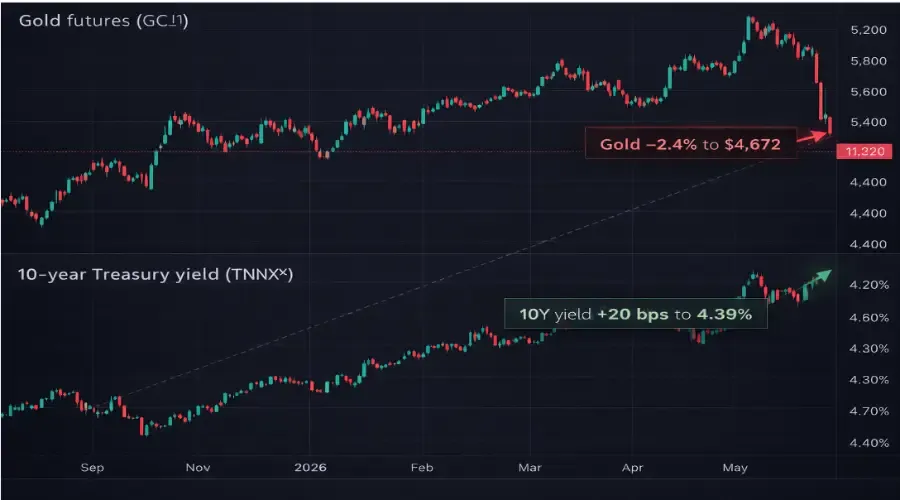
When gold drops more than **4% in a single session during an active geopolitical conflict—as it did on March 20, 2026, falling to $4,672—the instinct is to question gold’s reliability as a safe haven. The more important question is what this decline reveals about the broader market. Gold is not falling because geopolitical risk has disappeared. It is falling because the forces suppressing it—a stronger dollar and rising Treasury yields—are dominating the macro environment. These same forces are also impacting US equities, particularly long-duration technology and growth stocks that rely heavily on future earnings.
The Four-Signal Configuration - What the Market Is Pricing
Markets are currently reflecting a coordinated move across four critical assets: oil rising (Brent above $107, touched $110), yields rising (10-year Treasury at 4.39%, near 4.45%), dollar strengthening (DXY up 0.5% on the week), and gold falling (down 2.4% to $4,672). This combination represents a stagflation-scare regime, where inflation risk increases while growth expectations become uncertain. The key insight is that these assets are not moving independently. They are all responding to the same driver: oil remaining elevated above $100 due to the Iran-Qatar supply shock. Oil pushes inflation expectations higher, which reduces the probability of Fed rate cuts. Fewer expected rate cuts keep 10-year yields elevated, strengthening the dollar and mechanically suppressing gold.
Why Gold’s Safe-Haven Role Is Conditional
The belief that gold always rises during geopolitical crises is incomplete. Gold performs best in two environments: financial system stress and deflationary growth scares, where real yields decline. In an oil-driven inflation shock, the opposite occurs. Real yields rise as nominal yields increase faster than inflation expectations. This creates a positive real return in Treasuries, making gold less attractive. At the same time, a stronger dollar reduces global demand for gold. The current environment reflects this exact mechanism. Gold is declining not because risk is low, but because inflation dynamics are overriding safe-haven demand.
Why This Matters for US Stocks - The Discount Rate Mechanism
The connection between falling gold and falling equities is not sentiment-driven-it is mathematical. Equity valuation depends on the discount rate applied to future earnings. When the 10-year Treasury yield rises toward 4.45%, the discount rate increases. As a result, the present value of future earnings declines. This directly compresses equity valuations, especially for long-duration assets like technology stocks. Even if company earnings remain unchanged, their valuations decline because future cash flows are worth less in today’s terms. This explains why the Nasdaq-100 has underperformed during this period despite stable earnings expectations.
What the Current Macro Setup Looks Like
The current configuration resembles previous oil-driven inflation episodes, particularly the 2022 Russia-Ukraine period. In that case, oil surged, yields rose sharply, the dollar strengthened, and equities declined significantly over time-not due to immediate earnings collapse, but because of valuation compression. Today’s setup follows the same structure. The key variable is whether oil remains elevated long enough to impact inflation data. If it does, the pressure on equities could extend beyond valuation into earnings revisions, creating a dual headwind.
The Hidden Risk - Earnings Not Yet Adjusted
One of the most important insights in the current market is that earnings estimates have not yet fully adjusted to higher energy costs. Rising oil impacts transportation, manufacturing inputs, and consumer spending power. If earnings expectations begin to decline while valuations are already compressing, markets face a compounded effect. This is the scenario that typically leads to more sustained equity drawdowns.
What Investors Often Miss
Gold’s decline is often interpreted as a sign that risk is decreasing. In reality, it is signaling that real yields and the dollar are strengthening, which is a negative environment for both gold and equities. The more important takeaway is not gold itself, but the macro chain behind it: Oil → Inflation → Yields → Dollar → Gold → Equity Valuations. Understanding this chain provides clarity on why multiple asset classes are moving together in what appears to be a counterintuitive way.
Frequently Asked Questions
Does gold falling mean it is a buying opportunity?
Gold’s direction depends on whether real yields and dollar strength stabilize or continue rising. If oil remains elevated, the forces suppressing gold may persist. Historical episodes suggest waiting for a peak in real yields before re-entering.
If both gold and stocks are falling, where does capital move?
In this environment, capital typically moves toward US dollars, short-duration instruments, and energy-linked assets (XLE, XOM, CVX). Traditional diversification into bonds may not function effectively because yields are rising alongside equity losses.
How long can this market configuration last?
The duration depends on whether the energy shock resolves quickly or becomes structural. Historical precedents range from a few months (1990 Gulf War) to nearly a year (2022 Russia-Ukraine). Watch AIS tanker data and EIA inventory reports for early signals of supply normalization.
Bottom Line
The current gold selloff is not a contradiction-it is a signal of an inflation-driven macro regime where rising yields and a stronger dollar are dominating asset behavior. For equities, this matters because the same forces suppressing gold are also compressing valuations through higher discount rates. As long as oil remains elevated, markets remain in a yield-driven repricing environment where traditional safe-haven assumptions may not hold.
Watchlist
10-year Treasury yield - a move above 4.50% would further pressure both gold and stocks
Brent crude - a break below $100 would signal potential relief
Nasdaq-100 vs. S&P 500 relative performance - widening underperformance confirms the duration-sensitive channel
AIS Hormuz traffic - for early signs of supply normalization
Related Reading - BreakoutBulletin
→ Oil Shock Series Post 3: Why the Fed Cannot Cut When Oil Is at $90
→ The Energy Shock Deepens: VIX 27, Yields Spike, Equities Test Lows
→ Hormuz AIS Monitoring Guide: How to Track the Supply Signal Ahead of Headlines
Disclaimer
This article is for informational and educational purposes only and does not constitute financial, investment, or trading advice. You are solely responsible for your own investment decisions and should consult a licensed financial professional before acting on any information in this post. ©2026 BreakoutBulletin.com