
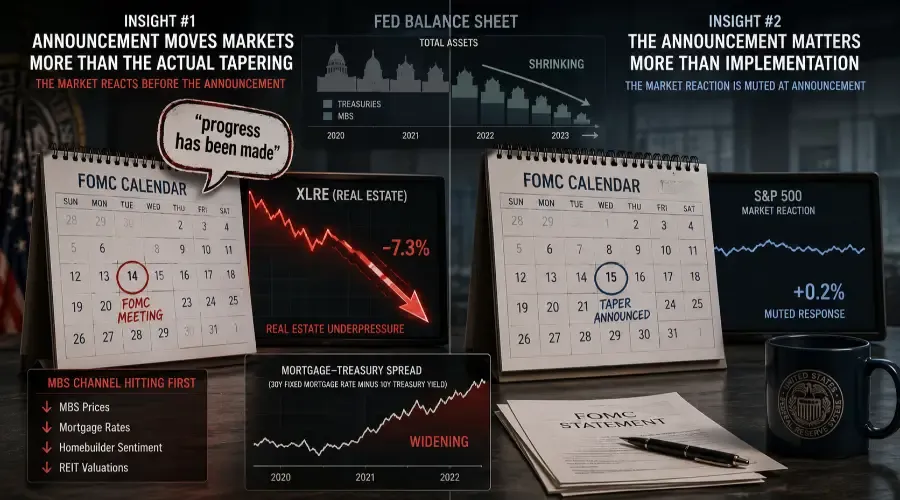
Brookings, J.P. Morgan, the St. Louis Fed, Bankrate, and Investopedia all explain tapering accurately: the Fed reduces its monthly bond purchases, yields can drift higher, and volatility increases. What none of them provide is the sector framework that converts a tapering cycle into a winners-and-losers map – and more importantly, none identifies the two most counter-intuitive insights in tapering analysis. First, the announcement moves markets more than the actual tapering. Second, the mortgage-backed securities component of tapering hits XLRE through a channel that rate hikes alone cannot replicate. Those two insights are the entire trade.
Why This Matters More Than Most Traders Realize
Tapering is the most misclassified monetary policy event in retail analysis. It is not a rate hike. During QE tapering, the Fed's balance sheet is still growing – just more slowly. Tapering is reducing the monthly pace of bond purchases from, say, $120 billion to zero over six to twelve months. The Fed is still the marginal buyer of Treasuries and mortgage-backed securities throughout – it is simply becoming a smaller buyer each month.
This matters enormously for sector positioning. A rate hike immediately and universally reprices every interest-sensitive asset through a direct mathematical mechanism. Fed tapering operates through expectations and through the removal of a marginal buyer – producing gradual yield drift rather than immediate repricing, with the MBS tapering channel creating a housing sector impact that is unique to tapering and independent of the federal funds rate.
The quantitative framing: at peak QE in 2020–2021, the Fed was purchasing 80 billion in Treasuries and 40 billion in mortgage-backed securities monthly. When it tapers MBS purchases specifically, mortgage-backed security prices drift lower, and mortgage rates rise – even if the federal funds rate has not moved at all. This MBS channel is the most direct and most frequently missed tapering transmission mechanism. [LINK: Central Bank Hub]
Regime Change, Not Data Event – And Why Announcement Beats Implementation
Tapering is a regime change: a sustained six-to-twelve-month policy direction that compounds month over month. Unlike a CPI print (which mean-reverts) or an NFP miss (which is revised), the taper commitment persists until purchases reach zero.
The most important Variant C insight for Fed tapering: the announcement creates the largest repricing, not the implementation. The 2013 Taper Tantrum proved this definitively. Bernanke's May 2013 congressional testimony – a casual reference to possible future tapering – produced a 130 basis point jump in the 10-year yield in less than three months. When actual tapering began in December 2013, markets barely moved. By the time the taper ended in October 2014, the 10-year yield was approximately where it had stabilised after the Tantrum. The announcement effect dominated the implementation effect by a factor of five to ten.
That said, this pattern is observed across only two modern tapering cycles (2013–2014 and 2021–2022), and both occurred in unique macro environments. Whether the announcement always dominates the implementation depends heavily on how surprised the market is, how well the Fed has telegraphed the move, and whether the broader growth and inflation backdrop amplifies the initial reaction. The framework is a strong tendency, not an iron law.
The practical implication: the maximum positioning opportunity is in the window between the credible tapering signal and the formal announcement – typically one to two FOMC meetings (six to twelve weeks) before the announcement itself. But this window is not perfectly clean: in 2013, the signal came in a single congressional remark with no neat runway; in 2021, the process was more drawn out.
The four-stage FOMC language sequence:
Stage 1 – "Patient": Not tapering. No action needed.
Stage 2 – "Substantial further progress": Criteria defined, not yet met. Begin monitoring.
Stage 3 – "Progress has been made": Criteria approaching or met. Taper announcement is one to two meetings away. This is the actionable positioning window.
Stage 4 – Taper announcement: Most repricing has already occurred.
This language sequence was a feature of the Powell/Bernanke communication era. A future Fed chair could abandon “substantial further progress” phrasing entirely, skip stages, or introduce new terms. The specific words are not guaranteed; the underlying concept–watch for a semantic equivalent signalling that the bar for tapering is close to being met–is the durable takeaway.
Tapering operates through three channels simultaneously: (1) the yield channel – fewer Treasury purchases allow yields to drift higher; (2) the MBS-specific mortgage rate channel – fewer MBS purchases push mortgage rates above what the general yield level would predict; and (3) the dollar and risk appetite channel – reduced QE liquidity produces modest dollar appreciation, creating headwinds for commodity sectors. A severe Tantrum-style taper could also cascade into broader emerging market stress, hitting global demand and amplifying the impact on US cyclicals (XLI, XLB) beyond the “mild” signal described below.
Sector Scorecard: Who Moves and When
All percentage ranges below are drawn from the two modern tapering cycles. They are directional guides, not precise forecasts–two data points cannot support statistical confidence.
Real Estate (XLRE) – Significant Negative – Immediate.
XLRE is the primary and most specific tapering victim because of the MBS channel. When MBS purchases decline, mortgage-backed security prices drift lower, mortgage rates rise, homebuilder economics weaken, and REIT valuations compress through higher discount rates – all before the federal funds rate has moved. Monitor the mortgage rate spread between the 30-year fixed mortgage rate and the 10-year Treasury (Freddie Mac weekly survey): when this spread begins widening before the taper announcement, the MBS pricing is already moving. However, the spread can widen for reasons unrelated to Fed tapering–prepayment uncertainty, shifts in bank portfolio demand, or housing liquidity dynamics–so treat it as a warning light, not a clean standalone signal. The Stage 3 language signal is the XLRE entry for the defensive trade. Historically, XLRE has underperformed by roughly 5–10% over a full tapering cycle, though the sample size is small.
Utilities (XLU) – Moderate Negative – Immediate.
Bond proxy repricing as Treasury yields drift higher reduces the relative appeal of utility dividends. The magnitude is smaller than in a rate hike cycle because yield drift from tapering is gradual, not immediate. Historically, XLU has underperformed by roughly 3–6% over the taper cycle, but this range is based on only two episodes.
Technology (XLK) – Mild to Moderate Negative – 1–3 Months.
Long-duration growth stock multiples compress modestly as discount rate expectations drift higher. The 2013 Taper Tantrum produced sharp XLK compression; the 2021-2022 orderly taper produced manageable compression that earnings growth partially offset. Speed of yield drift determines XLK impact magnitude: well-telegraphed taper (3–7% relative underperformance) versus surprise-speed taper (10–15%).
Financials (XLF) – Mildly Positive, but Regime-Dependent – Immediate.
Tapering's most unique sector signal: by reducing long-end bond purchases, the Fed allows long-term yields to drift higher while short-term rates remain anchored – steepening the yield curve. Borrow short, lend long: a steeper curve expands bank net interest margins. This curve-steepening NIM benefit is distinct from rate hike analysis and is the most direct tapering-specific XLF benefit. However, this dynamic holds only if inflation expectations remain contained. If tapering coincides with rising inflation fears, the curve can flatten as markets price in faster rate hikes, neutralizing or reversing the XLF tapering benefit. The 2021–2022 episode is a clear counterexample: the 2s10s spread peaked well before the taper began and flattened throughout 2022. In the two prior cycles, XLF outperformed by roughly 2–4% in the early taper phase when steepening occurred, but this is not an automatic consequence of tapering. Exit this position as the taper nears completion and the rate hike regime begins.
Materials (XLB) and Energy (XLE) – Mild Negative – 1–3 Months.
The modest dollar appreciation from reduced global QE liquidity creates headwinds for commodity-linked sectors priced in dollars. The magnitude is smaller than in a dedicated dollar bull cycle. Historically, 1–3% relative underperformance for each. However, if tapering triggers a severe EM stress event (Tantrum-style), demand destruction can amplify the hit to XLB and XLE beyond these mild ranges.
Consumer Discretionary (XLY) – Mild Negative – 1–3 Months.
Mortgage rate drift from MBS tapering creates housing affordability headwinds within XLY – homebuilder-adjacent stocks, home improvement retailers, and appliance brands. The broader XLY consumer spending effect is modest because tapering occurs against a typically healthy economic backdrop.
Industrials (XLI), Consumer Staples (XLP), Healthcare (XLV), Communication Services (XLC) – Approximately Neutral.
Tapering cycles occur when the economy is growing – the condition that enables the Fed to reduce stimulus. This healthy economic backdrop limits the cyclical sector damage that would accompany a recessionary rate event. These sectors trade approximately in line with SPY during well-managed tapering cycles, with modest divergence only if the pace surprises to the upside or if global demand weakens through EM contagion.
Historical Cases: Two Tapering Cycles
2013–2014 | The Taper Tantrum and the First Orderly Taper
Two distinct phases – frequently conflated but analytically separate:
The Tantrum Phase (May–September 2013): Bernanke's May 22 congressional testimony produced a 130bps 10-year yield surge in under three months. XLRE fell approximately 12% from its May peak to its September trough. XLU fell 8%. Emerging market currencies collapsed. The equity market fell only 6% – the broad market absorbed the shock better than rate-sensitive sectors. However, the Tantrum was not a pure US rate event: it was amplified by a sudden withdrawal of carry trades from vulnerable emerging economies. The EM crisis fed back into global risk appetite and likely intensified XLRE’s selloff beyond what the Fed announcement alone would have produced.
The Orderly Taper Phase (December 2013–October 2014): Actual tapering produced minimal additional market movement. By October 2014, when purchases reached zero, the 10-year yield was approximately 2.3% – barely changed from its post-Tantrum level. XLF outperformed on curve steepening. XLRE partially recovered as the feared rate spiral did not materialise. The announcement phase produced five to ten times more market movement than the implementation phase – confirming the announcement-beats-implementation principle, but in a context of high global fragility that may not repeat.
2021–2022 | The Telegraphed Taper in an Inflationary Regime
The Fed applied 2013's lesson aggressively. Powell tied taper timing to "substantial further progress" criteria more than a year before tapering began. By the November 2021 announcement, markets had positioned extensively. The 10-year yield moved only approximately 30 basis points in the announcement window – one-quarter of the Tantrum move. The taper pace was faster: $15 billion monthly reduction, completing in five months by March 2022. XLRE underperformed through the taper but the real 2022 equity damage came from the rate hike cycle that immediately followed, not the taper itself – confirming that tapering and rate hikes, while related, produce different magnitudes of sector impact.
Crucially, this taper occurred with inflation already running hot, supply chains snarled, and the Fed losing its “transitory” narrative. The yield curve flattened as markets priced in aggressive rate hikes, undermining the curve-steepening XLF trade that had worked in 2013–2014. This cycle demonstrates that the macro backdrop–particularly the inflation regime–can override the standard tapering sector map.
The Trading Playbook
Before
Read every FOMC statement for the language sequence (Fed.gov, 2pm ET after each meeting). Look for semantic equivalents of “progress has been made” or a clear signal that the criteria for tapering are close to being met–the specific words may change across Fed chairs, but the concept of approaching the taper threshold is durable. The window between this signal and the formal announcement (often six to twelve weeks, but variable) is the highest-value positioning entry.
Monitor the mortgage-Treasury spread weekly (30-year fixed rate from Freddie Mac Thursday survey minus 10-year Treasury yield). When this spread begins widening from its QE-suppressed level, the MBS pricing has already begun moving. Use it as an early warning, not a clean signal: the spread can widen for non-taper reasons (prepayment uncertainty, bank portfolio shifts), so cross-check with FOMC language and broader market conditions.
Assess the inflation and growth regime. If inflation expectations are anchored and the economy is growing steadily, the curve-steepening XLF trade is more likely to work. If inflation is already elevated and the Fed is expected to hike rapidly after tapering, the curve may flatten early, reducing or reversing XLF’s benefit.
Track the FOMC quarterly dot plot (published with Summary of Economic Projections). When the median dot shows rate increases in the near term, the taper completion date is crystallising – calculate it by dividing current monthly purchases by the announced monthly reduction amount.
During
Underweight XLRE at the language signal, not the announcement. The MBS channel means XLRE begins pricing mortgage rate drift before the formal taper begins. Size for the full taper duration, but remember that the historical 5–10% underperformance range is based on only two cycles.
Overweight XLF only if the curve-steepening conditions are in place – contained inflation expectations, anchored short rates, and a healthy growth backdrop. If inflation is running hot and rate hike pricing is compressing the long end, the XLF benefit may not materialize. When the taper is complete and the rate hike debate begins, reduce XLF positioning regardless.
Maintain approximately benchmark XLK unless the taper pace surprises to the upside (faster reduction than telegraphed), which would warrant a more defensive positioning in long-duration growth names.
Watch for EM stress signals. If tapering triggers significant emerging market currency or bond volatility, the risk-off contagion can hit cyclicals (XLI, XLB) harder than the “mild” category suggests. Global risk appetite indicators (EM bond spreads, VIX, dollar strength) should be monitored alongside the domestic sector scorecard.
After – The Exit and Next Regime Signal
The taper regime ends when purchases reach zero – a pre-calculable date. At completion, monitor the next FOMC statement for three possible next regimes:
"Balance sheet normalisation discussions" → QT incoming: additional XLRE and XLU pressure.
"Appropriate to begin raising the target range" → Rate hike cycle: apply the full hiking playbook.
"Comfortable holding the balance sheet" → Pause: begin rebuilding XLRE and XLU modestly.
The two-to-four month window between taper completion and the first rate hike (or QT announcement) has historically been the best risk-reward entry for modest XLRE and XLU re-establishment – the taper headwind has ended, the next headwind has not yet activated. However, as with all tapering patterns, the sample size is small, so treat this as a guide, not a guarantee.
The 3 Mistakes Most Retail Traders Make
Mistake 1: Applying the Full Rate Hike Playbook to a Taper.
Tapering produces yield drift; rate hikes produce immediate repricing. Investors who applied maximum XLRE and XLK defensive positioning in November 2021 (taper announcement) instead of March 2022 (first rate hike) were either too early in their defensive sizing or incorrectly attributed 2022's equity damage to the taper rather than the hiking cycle. Tapering sector underweights should be sized proportionally smaller than rate hike underweights.
Mistake 2: Waiting for the Announcement Instead of the Language Signal.
By the time the formal taper announcement is made, the majority of XLRE and XLU repricing has already occurred. The Tantrum confirmed this – most of the yield move happened before any formal decision was made. The language shift (or its semantic equivalent) is the optimal positioning window; the announcement is the confirmation, not the entry. However, the exact trigger words may vary, so focus on the concept of approaching the taper threshold rather than a fixed phrase.
Mistake 3: Ignoring the MBS Spread and Tracking Only the 10-Year Yield.
During 2022, mortgage rates rose faster than the 10-year Treasury yield because MBS purchases were reduced specifically. Investors who monitored only the 10-year yield underestimated the XLRE headwind because they were watching the wrong rate. Always monitor the mortgage-Treasury spread separately from the general 10-year yield during any tapering cycle, but recognize that the spread can widen for non-taper reasons as well.
Bottom Line: A Context-Aware Institutional Framework
When FOMC language signals that the tapering threshold is close to being met–historically “progress has been made”–immediately underweight XLRE through the MBS-specific mortgage rate channel, overweight XLF for yield curve steepening NIM benefit only if the inflation regime supports curve steepening, and reduce both positions as the taper nears completion. Monitor the subsequent FOMC statement for the QT or rate hike signal that determines the next regime.
This framework works because tapering operates through the same three channels – yield drift, MBS spread widening, dollar liquidity reduction – in every cycle, and the stage-sequence communication pattern creates a positioning window before the formal announcement. However, the precise magnitude and timing depend heavily on the growth and inflation backdrop, the degree of market surprise, and whether the taper triggers broader global stress. The MBS channel is the tapering-specific insight that no rate hike analysis provides – XLRE begins repricing before general rates have moved at all. Use the framework as a directional compass and a regime-awareness checklist, not as a calibrated entry script. Two cycles do not make a statistical sample.
Run this scenario through the [Breakout Bulletin Ripple Engine](LINK: Ripple Engine Tool) to see the full sector transmission map for a QE tapering cycle and compare how the yield drift, MBS spread widening, and dollar liquidity channels each activate at different rates across all twelve sectors.
Frequently Asked Questions
Q1. What is Fed tapering?
Fed tapering is the gradual reduction of the Federal Reserve’s monthly bond purchases under quantitative easing (QE).
Q2. How is tapering different from a rate hike?
Tapering slows the pace of balance sheet expansion, while a rate hike directly increases the federal funds rate and immediately reprices interest-sensitive assets.
Q3. Why does tapering hurt XLRE?
Fed tapering reduces mortgage-backed securities (MBS) purchases, which pushes mortgage rates higher and pressures REIT valuations and housing-related stocks.
Q4. What is the MBS channel in tapering?
The MBS channel refers to the direct impact tapering has on mortgage-backed securities prices and mortgage rates, independent of federal funds rate hikes.
Q5. Why did the 2013 Taper Tantrum happen?
Markets reacted sharply to the Fed’s early tapering signals in 2013 because investors feared reduced liquidity and higher long-term yields.
Q6. Which sectors benefit from Fed tapering?
Financials (XLF) often benefit early in tapering cycles because higher long-term yields steepen the yield curve and improve bank net interest margins.
Q7. Which sectors are most vulnerable during tapering?
Real Estate (XLRE), Utilities (XLU), and long-duration growth stocks are typically most vulnerable during tapering cycles.
Q8. Why does the taper announcement matter more than implementation?
Markets usually price tapering expectations before the actual reduction in purchases begins, making the announcement phase more impactful.
Q9. What is the Stage 3 FOMC signal?
The Stage 3 signal occurs when the Fed shifts language toward “progress has been made,” indicating tapering is likely one to two meetings away.
Q10. How should traders position during Fed tapering?
Many traders reduce exposure to XLRE and bond-proxy sectors while favoring XLF during the yield curve steepening phase of tapering.
This post is part of the BreakoutBulletin "What Happens When" series. [LINK: Central Bank Hub] · [LINK: Series Pillar Page]
Educational content only. Not investment advice. Past sector performance patterns do not guarantee future results.