
Breakout Bulletin | March 28, 2026 | Analysis by the BreakoutBulletin Editorial Team
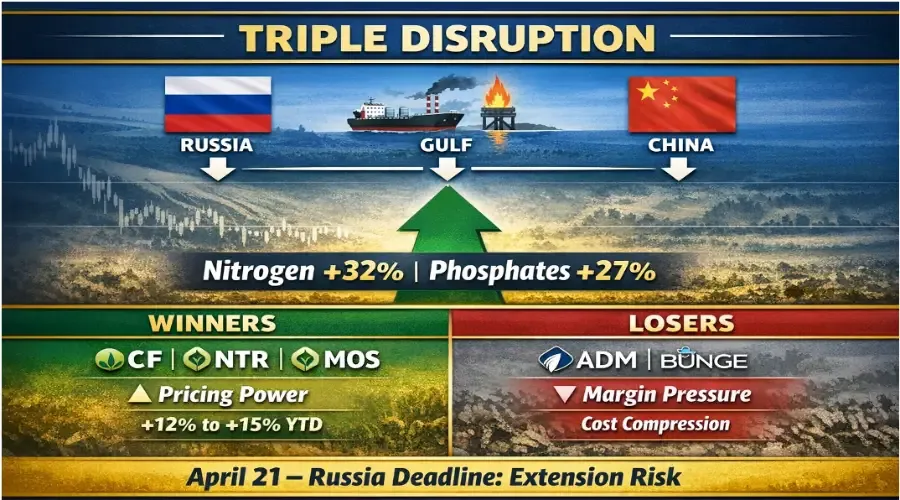
Synchronized disruptions from Russia’s ammonium nitrate pause, Gulf shipping constraints, and ongoing China export curbs are tightening global fertilizer markets simultaneously.
In practical terms, a triple supply shock is pushing fertilizer prices sharply higher, creating a clear divide in US equities between upstream producers and downstream processors.
The Three Supply Shocks - What Is Confirmed vs What Is Not
The current agricultural narrative is driven by multiple overlapping disruptions, but not all carry the same level of verification. Distinguishing confirmed data from market narrative is critical, as pricing reactions depend on credibility as much as magnitude.
Russia - Export Suspension (Verified)
Russia suspended ammonium nitrate exports from March 21 to April 21, 2026, prioritising domestic planting needs.
This is the most immediate and measurable supply shock, given Russia’s dominant role in nitrogen fertilizer trade.
The key variable is duration. A fixed April 21 deadline makes this a time-bound catalyst unless extended.
Gulf / Hormuz - Flow Disruption (Verified)
Shipping disruptions through the Strait of Hormuz are constraining fertilizer flows, affecting urea and phosphate exports.
This is a logistics shock rather than a production halt, meaning supply exists but cannot move efficiently.
Unlike Russia, this disruption has no fixed timeline, making it structurally more uncertain.
China - Export Curbs (Ongoing Policy)
China continues to restrict phosphate and urea exports, tightening global availability.
This is an ongoing constraint rather than a new shock, but it amplifies the impact of both Russia and Gulf disruptions.
Saudi Arabia - Unverified Narrative
There is no confirmed Saudi export ban.
Market narratives should be framed as Gulf flow disruption, not a Saudi-specific halt, to avoid misinterpretation.
This is not a single disruption-it is a synchronized tightening across nitrogen, phosphate, and potash markets, which explains the magnitude of price movement.
Fertilizer Price Surge - What the Market Is Pricing
Fertilizer benchmarks have moved sharply higher in response to supply tightening.
Urea prices are up roughly 32%, driven by Russia’s suspension and China’s export curbs.
Phosphate prices have risen approximately 27%, supported by Gulf disruption and restricted exports.
Potash has gained around 18%, reflecting broader logistics constraints.
The implication is clear: pricing power is shifting toward producers as global supply tightens across all major fertilizer categories.
US Stock Market Impact - The Sector Divide
The supply shock transmits into equities through two opposing channels: pricing power versus cost pressure.
Winners - Fertilizer Producers
US-based fertilizer companies benefit directly from rising global prices.
CF Industries (CF) gains from nitrogen exposure linked to the Russia shock.
Nutrien (NTR) benefits from diversified exposure across nitrogen and potash.
Mosaic (MOS) gains from phosphate pricing strength driven by Gulf disruption.
These companies experience margin expansion as selling prices rise faster than input costs.
Neutral / Lagged - Agricultural Equipment
Deere (DE) represents an indirect beneficiary.
Higher fertilizer prices can lead to higher crop prices, which may improve farm income and eventually support equipment demand.
However, this effect is delayed by multiple quarters, making it a secondary impact.
Losers - Food Processors and Grain Handlers
Archer Daniels Midland (ADM) and Bunge Global (BG) face rising input costs.
Higher fertilizer prices increase agricultural production costs, compressing margins if those costs cannot be fully passed through to consumers.
This creates a clear divergence: upstream producers gain pricing power, while downstream players face margin pressure.
The Domestic Buffer - Why the US Is Not Fully Exposed
The United States is approximately 70% self-sufficient in nitrogen fertilizer production, which reduces direct exposure to global supply shocks.
However, global pricing still sets the benchmark.
When international prices rise, US producers reprice domestically to align with global markets.
In practical terms, the US is buffered-but not insulated.
The Macro Transmission - Fertilizer to CPI to Fed
The impact of fertilizer prices extends beyond agriculture into inflation and monetary policy.
Fertilizer accounts for roughly 5% of upstream food costs.
A 30% increase in fertilizer prices can translate into a 0.3–0.5 percentage point rise in food CPI over time.
The transmission timeline is gradual:
8–12 weeks for input costs to affect crops
3–6 months for those costs to reach food products
Q3 2026 for visible impact in CPI data
This makes fertilizer inflation a medium-term macro risk rather than an immediate policy trigger.
In practical terms, it can delay rate cuts rather than force immediate tightening.
Historical Context - Lessons from 2022
The closest comparable event is the 2022 Russia-Ukraine supply shock, which drove a sharp rise in fertilizer prices.
CF Industries gained approximately 85%,
Mosaic rose around 120%,
Nutrien increased about 45%,
while ADM declined roughly 12% due to cost pressure.
The key difference today is duration.
The 2022 shock was prolonged and structural, whereas the current Russia suspension has a defined end date of April 21.
If extended, the current cycle could resemble 2022. If resolved, the price spike may reverse.
What Market Participants Are Monitoring
April 21, 2026 - Russia export suspension deadline
An extension would shift the narrative from temporary disruption to structural constraint
Hormuz shipping flows
Restoration of tanker movement would signal supply normalization
Global fertilizer benchmarks (especially urea)
Sustained price increases typically precede earnings upgrades for producers
Q1 2026 earnings - CF, Nutrien, Mosaic
Guidance will indicate whether pricing power is translating into margins
US CPI food component
Early signs of fertilizer-driven inflation entering the broader economy
Structural Takeaway
This is not a single shock-it is a synchronized tightening across multiple geographies and nutrients.
The market reaction reflects pricing power shifting upstream while compressing margins downstream.
In practical terms, the key variable is duration: if disruptions persist, current prices may become a floor; if resolved, they may prove to be a temporary spike.
FAQ
Why are US fertilizer stocks rising in 2026?
They are benefiting from a triple supply shock, including Russia’s export suspension, Gulf shipping disruptions, and China’s export curbs, which are tightening global supply and increasing pricing power.
Does Russia’s export pause directly impact the US?
Partially. The US produces most of its nitrogen domestically, but global pricing still influences local markets.
Who are the losers in this cycle?
Downstream processors like ADM and Bunge, which face rising input costs and margin pressure.
Will fertilizer prices increase inflation?
Yes, but with a lag. The impact is likely to appear in food CPI over the next 2–3 quarters.
Disclaimer
This article is for informational and educational purposes only and does not constitute financial, investment, or trading advice. You are solely responsible for your own investment decisions and should consult a licensed financial professional before acting on any information in this post.