
Equity Analysis · BreakoutBulletin · May 14, 2026
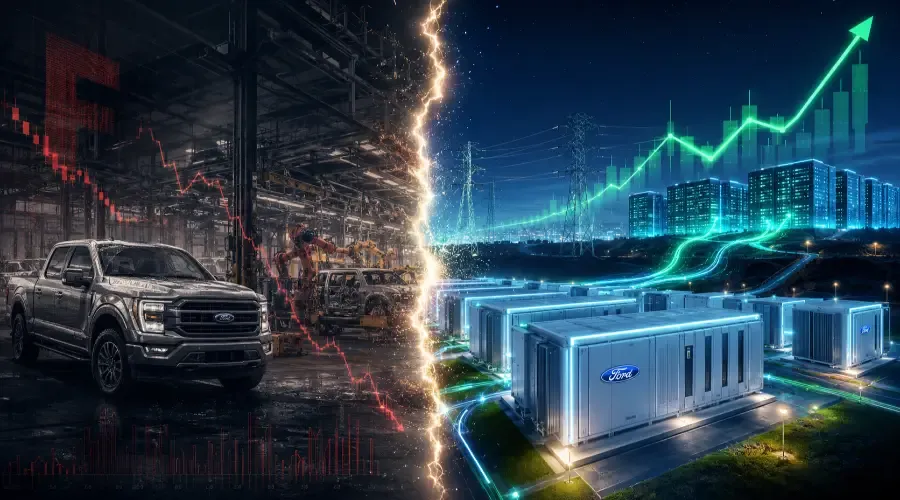
Ford shares are ripping higher – and for once, the catalyst has nothing to do with truck sales or EV delivery numbers. A Morgan Stanley upgrade and the unveiling of a concrete battery storage project are rewriting the investment thesis entirely.
What Just Happened
Ford Motor Company shares surged today after Morgan Stanley upgraded the stock to Overweight and set an 18pricetarget,flaggingtheautomaker’sexpandingbatterystorageambitionsasacrediblenewgrowthvector.Theanalystteam,ledbyAdamJonas,pointedtoanewlyannounced500MWhstorageprojectwithSouthernCompanyasproofthatFordismovingbeyondprototypes.ThenotehighlightedthepotentialforFord’sstoragedivisiontogenerate2 billion in revenue by 2029 – a contribution the market had largely ignored while fixating on Ford’s legacy vehicle business and its bumpy EV ramp.
The stock responded immediately, climbing over 7% intraday. Investors who had been sitting on the sidelines, waiting for a reason to re-engage with Ford beyond the traditional auto cycle, got exactly the narrative they needed.
This is not just a one-day pop story. What Morgan Stanley has effectively done is hand Ford a new identity – one that could, over time, trade on energy infrastructure multiples rather than auto industry multiples. That distinction matters enormously for how the stock gets valued from here, even if the re-rating is still in its early days.
The Battery Storage Play: Ford Takes On Tesla Energy
Ford’s push into battery storage is a direct challenge to Tesla’s Energy division – one of the fastest-growing and highest-margin businesses Elon Musk has built. Tesla Energy sells Megapack systems to utilities, commercial operators, and grid operators who need large-scale storage to balance renewable energy output. It is a serious, multi-billion dollar business that Wall Street increasingly values as a standalone entity.
Ford is now planting its flag in the same territory with a dedicated initiative called Ford Pro Storage. The unit leverages the company’s BlueOval SK battery joint venture, adapting EV battery technology for stationary applications. Today’s announced 500 MWh project with Southern Company marks Ford’s first utility-scale deployment, providing grid stabilisation services across the Southeast.
The venture targets three areas: grid stabilisation, commercial energy storage for industrial customers, and clean energy infrastructure buildout. These are not niche markets. As renewable energy penetration rises globally, the demand for storage – the technology that makes intermittent solar and wind power actually usable at scale – is growing at a pace that outstrips most industrial sectors.
Ford’s advantages in this space are underappreciated. The company has deep manufacturing expertise, established supplier relationships, and the scale to bring battery storage systems to market competitively. It is not starting from scratch. The foundational knowledge built through its EV battery supply chain work translates directly into stationary storage applications.
The question the market is now asking: can Ford execute? If it can, the addressable market being opened here dwarfs anything Ford could add through incremental truck or SUV sales.
Business Segment
Ford’s Traditional Profile
Revenue driver → Vehicle sales volume
Margin profile → Low single digits
Growth narrative → Cyclical / volume-dependent
Comparable → GM, Stellantis
New Battery Storage Angle
Recurring energy storage contracts
Potentially mid-to-high teens
Structural / infrastructure-linked
Tesla Energy, Fluence
The AI Data Center Angle: A Long-Dated Call Option
Here is where the story gets genuinely interesting – and entirely speculative for now.
A growing number of investors are starting to connect Ford’s storage ambitions to the AI infrastructure buildout. The logic runs like this: AI data centers consume extraordinary amounts of electricity. A single large-scale hyperscaler facility can draw as much power as a small city. As Microsoft, Google, Amazon, and Meta accelerate their AI infrastructure buildout, the strain on regional power grids is becoming a genuine constraint on expansion timelines. Grid operators are scrambling for storage solutions that can buffer supply volatility and ensure the consistent, uninterrupted power delivery that AI compute demands.
Battery storage systems – exactly what Ford is now building with Ford Pro Storage – sit at the intersection of that demand. Ford has not signed any hyperscaler contracts, and the company has not formally guided toward data center customers. But if Ford were to secure even a fraction of the energy infrastructure contracts flowing from AI capex expansion, the revenue profile of this new division could change materially over time.
This is the kind of narrative that Wall Street loves: an established industrial company with manufacturing muscle finding an unexpected seat at the AI infrastructure table. It does not need hard numbers to move sentiment right now. The optionality alone could be enough to support a re-rating – and that is precisely what today’s Morgan Stanley note has catalysed.
Investors have watched this playbook work with other companies. Utilities, HVAC manufacturers, data center REITs, and copper miners have all gotten AI-adjacent re-ratings over the past two years. Ford may now be joining that list, though the timeline for any real revenue from data center storage remains uncertain.
What Morgan Stanley Actually Said
Morgan Stanley’s upgrade was not a speculative moonshot call. The analysts took a measured but clearly positive stance, raising Ford to Overweight with an $18 price target based on a sum-of-the-parts valuation that assigns a higher multiple to the emerging storage business.
The note explicitly flagged three things: that Ford’s battery storage initiative addresses a large and underpenetrated market, that Ford’s manufacturing base gives it structural cost advantages, and – most critically – that the market is not currently pricing in any meaningful contribution from this segment. The $2 billion 2029 revenue estimate, while not guaranteed, provides a tangible number for investors to model.
That last point is the key. If the market is giving Ford zero credit for battery storage today, then any progress – contract wins, partnership announcements, capacity milestones – becomes a positive catalyst with no downside priced in. The asymmetry is attractive.
Morgan Stanley’s endorsement also carries weight because it signals that institutional investors with serious analytical resources have stress-tested this thesis and found it credible. That is different from retail enthusiasm around a press release.
Risks to Watch
No thesis is clean. Ford carries real execution risk here. The company’s EV ramp has been expensive and slower than guided. Battery manufacturing at scale is capital-intensive. Tesla Energy has a multi-year head start and brand recognition in the storage market.
The AI data center angle, while compelling narratively, has no signed contracts behind it yet. Sentiment can move a stock faster than fundamentals – but fundamentals eventually catch up. The stock could just as easily give back its re-rating gains if storage revenue fails to materialise on the expected timeline.
Watch for: battery storage contract announcements, partnership deals with utilities or hyperscalers, and any guidance update that breaks out storage revenue as a standalone segment. Those are the catalysts that would convert today’s re-rating from a sentiment trade into a structural position.
Bottom Line for Traders
Ford is not just a car company today. The Morgan Stanley upgrade and the Southern Company project have opened a window into a materially different investment thesis – one built on energy storage, grid infrastructure, and a speculative but intriguing connection to the AI capex supercycle.
Whether Ford can back the narrative with execution is the central question. But for traders and investors watching sector rotation, the signal is clear: Ford could deserve a fresh look at a different multiple – provided the storage revenue story starts showing up in the numbers.