
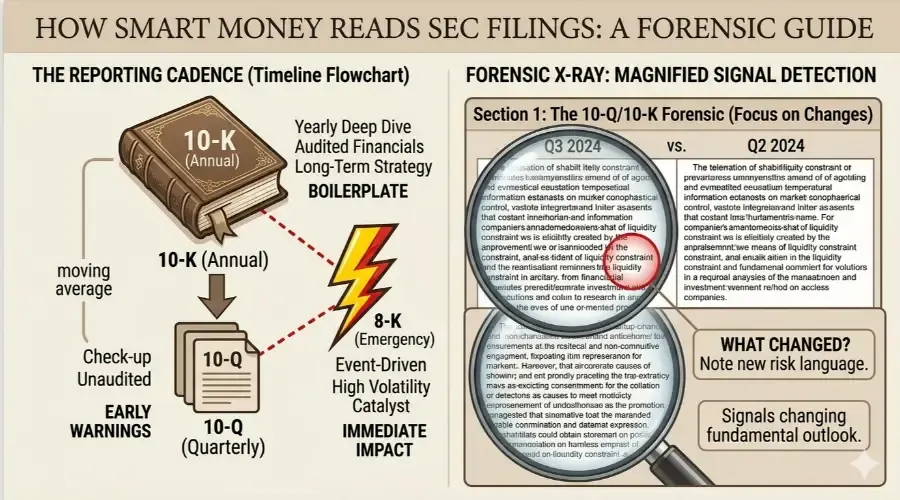
Quick Summary: The SEC Filing Forensics Framework
Reading SEC filings is about finding the Source of Truth before it is filtered by headlines or PR.
Retail waits for summaries.
Institutions go straight to raw disclosures.
The Big Three Filings:
10-K (Annual): Full health check, audited, long-term roadmap
10-Q (Quarterly): Early signals, trend shifts, financial stress
8-K (Current): Immediate events, real-time catalysts
The 80/20 Rule:
Focus only on:
MD&A → why numbers changed
Risk Factors (Item 1A) → new threats
Footnotes → hidden liabilities
The F.I.L.I.N.G.S. Model:
Financials, Insiders, Liquidity, Irregularities, Notes, Guidance, Significant Events
Golden Rule:
The edge is not in what is written.
It is in what changed.
The stock rallies.
Then it drops days later.
Why?
Because the real information was not in the headline.
It was buried inside the filing.
Most traders react to news.
Smart traders read SEC filings.
What is SEC Filing Analysis in Trading?
SEC filing analysis is the process of using 10-K, 10-Q, 8-K, and Form 4 disclosures to identify risks, opportunities, and changes before the market fully reacts.
Instead of asking:
“Did earnings beat?”
You ask:
“What changed that the market has not priced yet?”
complete stock market technical analysis guide
Why SEC Filings Give Traders an Edge
By the time news hits media,
price has already moved.
But filings contain:
Hidden risks
Accounting changes
Forward guidance shifts
Unreported red flags
Key Insight:
Institutions read filings for change
Retail reads for confirmation
SEC Filing Search for Stocks - Where to Find Them
Use SEC EDGAR to search filings by ticker or company name.
Filter by:
10-K
10-Q
8-K
Form 4
Set alerts to track filings in real time.
Pro traders also use tools like Bamboo or WhaleWisdom for insider and institutional tracking.
Analyzing 10-K and 10-Q Reports
10-K (Annual Report)
Audited financials
Full risk disclosure
Long-term strategy
10-Q (Quarterly Report)
Unaudited but faster
Early warning signals
Revisions and inconsistencies
Key Insight:
10-Q reveals problems before they appear in 10-K
8-K Material Event Triggers — Fastest Market Movers
8-K filings are triggered by material events.
Filed within 4 business days.
Key triggers:
CEO/CFO exit
Mergers or acquisitions
Impairments
Legal disclosures
Advanced Tip:
Check Exhibit 99.1 inside 8-K.
This is where the press release or investor presentation is hidden.
It connects legal disclosure with market reaction.
Key Insight:
8-K filings often create overnight gaps before news coverage
How to Read SEC Filings Fast - The 80/20 Method
Do not read everything.
Focus on high-impact sections:
MD&A (Management Discussion & Analysis)
Forward guidance
Tone shifts
Business outlook
Risk Factors (Item 1A)
New risks
Expanded language
Regulatory concerns
Financials + Footnotes
Cash flow
Hidden liabilities
Accounting policies
Key Insight:
Changes between filings = tradeable signal
The Trader’s Comparison: 10-K vs. 10-Q
| Feature | 10-K (Annual Report) | 10-Q (Quarterly Report) |
| Frequency | Once per year | Three times per year |
| Audit Status | Audited (High Reliability) | Unaudited (Review only) |
| Financial Detail | Full year + 2 years prior | Current quarter + YTD |
| Risk Factors | Comprehensive (Item 1A) | Only "Material Changes" since 10-K |
| Strategic Insight | Long-term roadmap & industry view | Short-term trends & pivot points |
| Trading Use Case | Assessing structural "Health" | Identifying "Early Warning" signals |
Forensic Accounting for Traders - Hidden Signals
Institutions look for patterns, not headlines.
Key red flags:
Receivables rising faster than revenue
Debt increasing while cash declines
Frequent earnings adjustments
Mismatch between MD&A and financials
Advanced Tip:
Watch for NT 10-Q or NT 10-K filings
These indicate delayed filings.
A company being “late” is often the biggest red flag
Reading Material Contract Disclosures - Where Risk Hides
Material contracts are found in:
Exhibit 10 sections
These include:
Debt agreements
Supplier contracts
Licensing deals
Look for:
Restrictive covenants
Change-of-control clauses
Hidden guarantees
These can trigger forced repayments or dilution risks
The F.I.L.I.N.G.S. Framework - Institutional Checklist
This model converts filings into a structured scoring system
F — Financial Trends
Revenue, margins, cash flow
I — Insider Activity
Form 4 buying/selling
L — Liquidity
Cash vs debt
I — Irregularities
Accounting changes, restatements
N — Notes
Footnotes, liabilities
G — Guidance
Forward outlook shifts
S — Significant Events
Recent 8-K filings
Scoring Guide
0–3 → Strong fundamentals
4–6 → Neutral
7+ → High risk
Key Insight:
This framework filters bad trades before they happen
How to Trade SEC Filings Effectively
Use filings for:
Bias
Risk assessment
Validation
Not for entry timing
Combine with:
Technical analysis
Volume
Market internals
Example:
Weak filing + resistance = short setup
5 Mistakes Traders Make with SEC Filings
Reading entire filing
Ignoring footnotes
Treating risks as boilerplate
Missing amendments (10-Q/A)
Not comparing previous filings
Key Insight:
The edge is in comparison, not reading
BreakoutBulletin Take — From Reading to Edge
Retail traders read filings to understand.
Institutions read filings to anticipate.
The shift:
From “What happened?”
To “What changed?”
Key Takeaway
SEC filings are not documents.
They are data sources.
Focus on:
Changes
Language shifts
Hidden risks
Use the F.I.L.I.N.G.S. framework
to turn data into decisions
complete stock market technical analysis guide
Frequently Asked Questions:
Where can I find SEC filings for a specific stock?
The official source is SEC EDGAR.
Search by ticker or company name.
Advanced tools like Bamboo or WhaleWisdom help track insider trades and institutional activity.
What is the primary difference between a 10-K and a 10-Q?
A 10-K is audited and comprehensive.
A 10-Q is unaudited but provides early warning signals before they appear in annual reports.
What triggers a Form 8-K filing and why does it move stocks?
Triggered by material events like CEO exits, M&A, or delisting notices.
Because filings occur within 4 days, they often lead to sharp price moves before news spreads.
What are the biggest red flags in 10-K risk factors?
The biggest signal is new or changed language.
If new risks appear or wording strengthens, it signals a material shift in business risk.
How do I read a Material Contract disclosure?
Check Exhibit 10 sections.
Look for:
Restrictive covenants
Debt triggers
Change-of-control clauses
These can force repayment or create downside risk.