
Oil above $100 is reigniting EV interest as consumers recalculate fuel costs. But this is not a simple bullish story.
Higher gas prices help EV demand - but inflation and interest rates decide whether that demand converts into sales.
Do High Gas Prices Actually Help EV Stocks?
Yes-but not immediately.
Higher gas prices reduce the total cost-of-ownership gap between EVs and petrol vehicles, which is the biggest barrier to adoption.
This is a sentiment driver, not an instant earnings trigger.
The Mechanism - How Gas Prices Drive EV Demand
The relationship between fuel prices and EV demand has appeared in every major oil spike since 2008.
Fuel Cost Gap - The Real Trigger
When fuel becomes expensive, the savings from switching to EVs become visible.
At current levels:
- Petrol car: ~$2,790/year
- EV: ~$640/year
That ~$2,000 annual gap is what changes behavior—not climate narratives.
Beyond Cars — The Clean Energy Spillover
The Iran-driven oil shock pushing oil above $100 is forcing consumers to rethink fuel dependence again.
Consumers are also reconsidering:
- Solar
- Heat pumps
- Electric appliances
High energy prices are triggering a broader clean-energy rethink.
The Reality - Why EV Adoption Takes Time
Even when the math is clear, behavior doesn’t change overnight.
Total Cost of Ownership Matters
EV adoption depends on total cost-not just fuel savings.
Key constraints:
- Higher upfront EV prices
- Financing costs in a high-rate environment
- Budget pressure from inflation
Sentiment vs Purchase Timing
The key insight: sentiment moves fast, purchases move slow.
During the 2022 oil spike, EV interest surged within weeks-but sales followed 6–12 months later.
Today’s demand signal becomes tomorrow’s earnings.
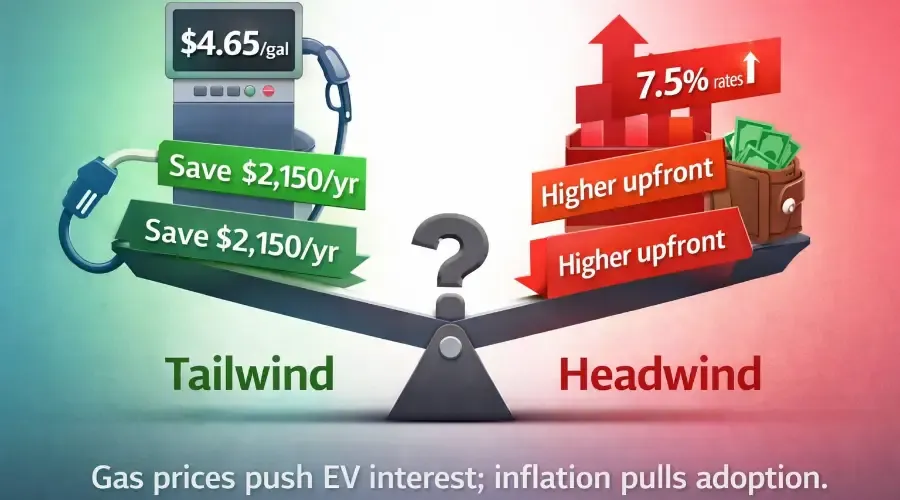
The Tension - Tailwind vs Inflation
This is where the story becomes complex.
Gas Prices - The Tailwind
- Improve EV economics
- Increase savings visibility
- Expand the demand pipeline
Inflation & Rates - The Headwind
- Reduce purchasing power
- Increase monthly payments
- Delay big-ticket decisions
Gas prices improve relative affordability. Inflation hurts absolute affordability.
What History Tells Us
The 2022 oil shock provides a clear reference point.
The 2022 Pattern
- Gas prices surged above $5
- EV interest hit record highs
- Sales growth slowed
The Key Lesson
Interest does not equal purchase.
Affordability-not awareness-drives actual adoption.
What This Means for EV Stocks
This is not a straight-line trade.
Short Term - Sentiment Driven
- Stocks may react quickly
- Narrative drives price
Medium Term - Fundamentals Follow
- Sales convert slowly
- Earnings reflect demand later
This is a medium-term thematic tailwind, not a short-term catalyst.
Stock Exposure - Who Benefits?
Direct EV Players
Tesla and Rivian benefit the most as their addressable market expands when fuel savings become visible. However, they remain exposed to pricing pressure and macro sentiment.
Charging Infrastructure
ChargePoint and EVgo benefit from long-term adoption, but their business models are capital-intensive and sensitive to interest rates.
Battery Technology
Battery players see sentiment improvement, but revenue impact remains years away.
Legacy Automakers
Ford and GM face a mixed outcome. EV demand helps, but their ICE business remains exposed to fuel price volatility.
Clean Energy Spillover
Sunrun and Enphase benefit from high energy prices, but are highly sensitive to interest rates.
The Hidden Competitor - Hybrids
Hybrids offer fuel savings without high upfront costs.
Many consumers may choose hybrids instead of EVs, slowing pure EV adoption.
What to Watch Next
To confirm whether this trend is real:
Gas Prices
Above $4.50 supports EV demand. A drop below $3.50 weakens the effect.
Search Trends
Early signal of consumer intent through rising EV-related searches.
EV Registrations
First hard confirmation of actual demand.
Earnings Commentary
Management guidance will validate or reject the thesis.
Interest Rates
The biggest constraint. Higher rates reduce affordability.
The Core Insight
This is a push-pull market.
Demand Driver
Gas prices are pushing consumers toward EVs.
Constraint
Inflation and interest rates are pulling them away.
The outcome depends on which force dominates.
Final Take
High gas prices are reigniting EV interest—but not guaranteeing immediate growth.
This is a sentiment-driven tailwind with delayed fundamentals.
If oil stays high, EV demand improves over time.
If rates stay high, adoption slows despite interest.
Markets are pricing the narrative now. Reality will show up in earnings later.
Frequently Asked Questions
Do high gas prices boost EV stocks immediately?
No. They improve sentiment first. Sales follow later.
Is this a long-term trend?
Only if high energy prices persist over time.
Do hybrids impact EV demand?
Yes. They offer a middle ground and can reduce EV adoption speed.
Disclaimer
This article is for educational purposes only and not financial advice. Market conditions and EV economics vary. Always consult a financial advisor.