
When GDP growth slowing hits the tape, the real question isn't whether the number missed — it's whether you're looking at a temporary inventory adjustment or a genuine economic downturn. Weak GDP reports can trigger Fed pivots, earnings revisions, and massive sector rotations, but only if you understand how to decompose the headline. Here's the framework for trading the GDP slowdown market impact, from false signals to follow-through.
The Bureau of Economic Analysis releases its GDP Advance Estimate roughly thirty days after each quarter ends — making it one of the most anticipated economic data releases in the calendar. When that number comes in sharply below expectations, markets react immediately. Researchers at the St. Louis Fed have studied the drivers of growth slowdowns. The BIS has examined what slower growth means for financial stability, and Economics Help covers the resulting drag on jobs and investment. What none of those sources provide is the framework that tells you what sharply decelerating GDP is actually predicting about the next four to six quarters of sector performance — because GDP is fundamentally different from every other indicator in this series. It does not lead the economy. It records what already happened. The trade is not in what GDP is saying about the past. It is in what it signals about the policy response, the earnings revision cycle, and the credit market stress that are still in front of you.
Why This Matters More Than Most Traders Realize
GDP is the most widely cited economic statistic — and the least useful on its own as a trading signal. Understanding why resolves a paradox: why markets sometimes rally on bad GDP data and collapse on readings that look perfectly fine.
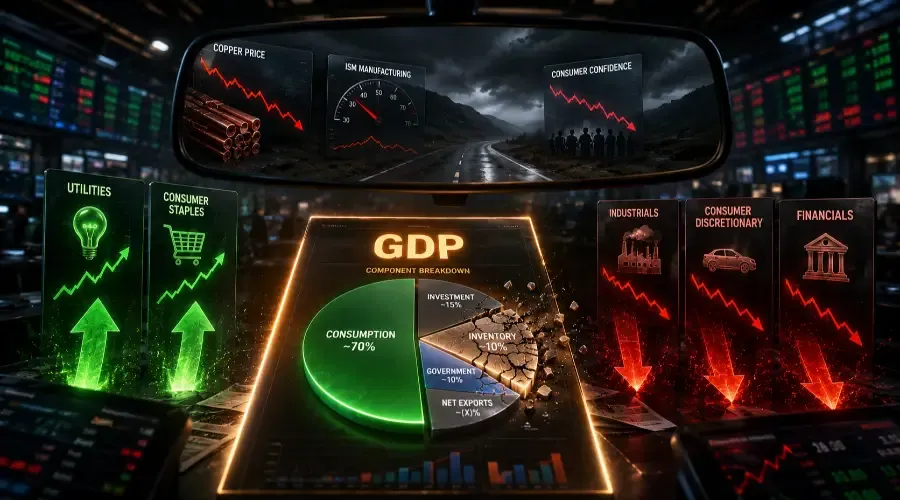
The core issue is timing. GDP measures economic activity that occurred during the prior quarter and is reported with a thirty-day lag. The Advance Estimate — the first release — is based on roughly 65% of actual data, with the remainder estimated. It gets revised twice more over the following sixty days. By the time a sharply negative GDP print makes headlines, sophisticated investors have been positioning for the slowdown for two to four quarters based on leading indicators — copper's decline, credit spread widening, consumer confidence deterioration, and employment data all provide earlier signals than the official GDP number.
The quantitative framing: the threshold between "deceleration" and "signal" for GDP is clear. GDP growing at 1.5% versus a prior quarter of 3.0% is a deceleration that warrants monitoring. GDP turning negative — below 0% — changes the analytical framework entirely. Two consecutive negative GDP quarters meet the technical definition of recession. The FRBSF research on global growth slumps notes that a sharp GDP deceleration in the United States historically produces financial market stress disproportionate to the magnitude of the growth change, because the reversal of growth expectations is often more impactful than the level of growth itself.
What the strongest competing analyses miss is the GDP component decomposition — the breakdown between personal consumption, business investment, government spending, net exports, and inventory changes. Each component produces a different forward signal, a different sector rotation, and a different false-signal risk. Treating GDP as a single number misses the information that determines whether the slowdown is temporary (inventory-driven) or structural (consumption-driven). [LINK: Macro Events Hub]
What This Is Really Saying: The Lagging Confirmation Reframe
GDP is the third tier of a three-signal sequence — and understanding its position in that sequence is the most important reframe in this post.
Tier 1 — Leading (6–9 months ahead):
Copper prices fall, consumer confidence collapses, the yield curve inverts. These signals arrive before any official economic data confirms slowdown. Sophisticated investors rotate defensively based on these signals alone.
Tier 2 — Coincident-to-early lagging (2–4 months ahead):
Steel and iron ore prices fall, Non-Farm Payrolls miss consistently, ISM Manufacturing falls below 50, retail sales disappoint. These signals confirm that the leading indicators were right — the slowdown has begun appearing in real economic activity.
Tier 3 — Lagging confirmation (GDP):
After the leading indicators have been falling for six to nine months and the coincident indicators have confirmed the deterioration, GDP finally records the outcome in official numbers. The GDP print is not a signal you trade to position — it is a signal that validates whether the positions you built on Tiers 1 and 2 were correct.
The forward-looking reframe for GDP is therefore not "what has the economy already done?" but "what will the policy response be, and what does the earnings revision cycle look like from here?" GDP sharply slowing produces three predictable forward sequences that are actionable:
Sequence 1 — Fed Pivot:
A sharp GDP deceleration materially changes the Federal Reserve's policy calculus. If the Fed was in a hiking mode or a pause, a significant GDP slowdown shifts the probability toward cuts. This policy pivot expectation produces the same sector rotation as a rate-cut cycle — XLRE and XLU benefit from anticipated discount rate compression, XLK benefits from multiple expansion expectations.
Sequence 2 — Earnings Revision Cycle:
Every S&P 500 company's revenue model is built on an assumption about the GDP growth environment. When GDP comes in significantly below that assumption, analyst earnings estimates must be revised downward. This revision cycle takes one to two quarters to complete and produces sustained sector underperformance in the most cyclically-exposed sectors during the revision period.
Sequence 3 — Credit Market Stress:
Sharp GDP deceleration raises corporate default risk and consumer credit delinquency expectations. Credit spreads widen. Bank provisioning requirements increase. This credit channel produces XLF underperformance and tightening financial conditions that amplify the initial slowdown into a more sustained economic headwind.
The Lead/Lag Map: What Sharp GDP Deceleration Predicts
0–4 weeks after the GDP release:
The immediate market response is primarily about the Fed pivot expectation — XLRE and XLU move immediately on the rate-cut-coming signal. XLF sells off on credit risk concerns. XLK's response depends on whether the GDP slowdown triggers rate-cut optimism (positive for multiples) or earnings-growth concern (negative for revenue expectations).
1–3 months forward:
Analyst earnings estimate revisions for the most cyclical sectors begin appearing in consensus databases. XLY, XLI, and XLC estimates get cut as revenue growth assumptions are reduced. XLP and XLV defensive earnings estimates are relatively stable. The rotation from cyclicals to defensives accelerates as the earnings revision cycle becomes the dominant market driver.
3–6 months forward:
Corporate capital expenditure plans are revised lower as CFOs respond to weaker revenue outlook. XLI capital goods orders weaken. XLK enterprise IT spending guidance is cut. XLB construction and infrastructure materials orders fall.
6–12 months forward:
If the GDP slowdown was the beginning of a recessionary cycle, credit market stress peaks in this window — corporate bond spreads are at maximum widening, regional bank provisioning is at its highest, and the equity market correction finds its trough. If the GDP slowdown was transient (inventory-driven) or stimulated away (government response), the recovery trade begins building in leading indicators before GDP itself recovers.
Sector ETF Quick Reference
Throughout this analysis, sector performance is discussed using the following representative ETFs. If you're unfamiliar with the tickers, here's a quick guide:
Ticker
Sector
XLRE
Real Estate
XLU
Utilities
XLK
Technology
XLF
Financials
XLE
Energy
XLB
Materials
XLI
Industrials
XLY
Consumer Discretionary
XLP
Consumer Staples
XLC
Communication Services
XLV
Healthcare
Sector Rotation Sequence: Who Moves and In What Order
Real Estate (XLRE) — Positive (Rate-Cut Channel) / Mixed (Recession Channel) — Immediate.
The rate-cut channel is the immediate first mover. As GDP slows sharply, bond markets price in a Fed pivot — lower rates reduce XLRE's discount rate and lift REIT valuations. This rate-cut expectation benefit is real and immediate. However, the recessionary channel creates a competing headwind: lower commercial real estate occupancy as companies reduce space, lower retail REIT revenue as consumer spending falls, lower residential transaction volumes as employment weakens. The net XLRE signal from a sharp GDP slowdown is positive in the first four to six weeks (rate-cut channel dominates), then progressively more mixed as the recessionary channel builds over two to four quarters. Size XLRE positions for the near-term rate-cut benefit with a defined exit before the earnings deterioration becomes visible.
Utilities (XLU) — Positive — Immediate and Sustained.
XLU is the most consistently positive sector from a sharp GDP slowdown — benefiting from both the rate-cut channel (bond proxy repricing) and defensive rotation (inelastic demand for electricity and gas regardless of economic conditions). Unlike XLRE, which faces fundamental headwinds from the recessionary channel, XLU's regulated revenue structure provides earnings stability that makes the rate-cut repricing durable rather than temporary. Expect XLU to outperform SPY by 5–10% over two to three quarters following a sharp GDP deceleration that confirms a recessionary trajectory.
Technology (XLK) — Mixed — 1–3 Months.
The GDP slowdown creates the clearest internal tension within XLK. Rate-cut expectations support multiple expansion for high-multiple technology names. Simultaneously, enterprise and consumer technology spending is correlated with economic growth — CFOs cut IT budgets when revenue outlooks deteriorate. The net XLK response depends on GDP severity: mild deceleration (GDP 1–2%) produces XLK outperformance from the rate-cut multiple expansion; severe deceleration (GDP at or below 0%) produces XLK underperformance as earnings estimate cuts overwhelm the multiple expansion benefit. Identify which GDP severity scenario applies before sizing the XLK position.
Financials (XLF) — Significant Negative — 1–3 Months.
Sharp GDP deceleration is unambiguously negative for XLF through two simultaneous channels. The credit channel: slower growth means higher default rates on corporate and consumer loans, requiring increased provisioning that compresses bank earnings. The rate channel: if the GDP slowdown produces a Fed pivot, NIM compression reduces bank profitability. Both channels work against XLF simultaneously — unlike most macro events where one of the two channels partially offsets the other. Expect 4–7% relative underperformance in XLF during the earnings revision cycle that follows a sharp GDP deceleration. The magnitude scales with the severity of the GDP miss and the unemployment rate trajectory.
Industrials (XLI) — Significant Negative — 1–3 Months.
GDP and XLI have the highest correlation of any sector pair in the S&P 500 because industrial production is one of GDP's primary components. Capital goods orders fall within one to two quarters of a sharp GDP deceleration as companies postpone equipment purchases in response to lower revenue growth assumptions. Construction activity falls as project financing economics deteriorate. XLI transport volumes fall as fewer goods need moving. Expect XLI to underperform SPY by 5–8% over two to three quarters following a sharp GDP deceleration.
Consumer Discretionary (XLY) — Significant Negative — 1–3 Months.
GDP growth and consumer spending (approximately 70% of GDP) are inseparable — a sharp GDP deceleration is almost always accompanied by or followed by consumer spending weakness. Auto sales, restaurant visits, travel, and retail spending all correlate with the economic growth environment with a two to three quarter lag as employment and wage effects accumulate. XLY faces both the near-term revenue growth concern and the longer-term income effect from employment deterioration. Expect XLY to underperform SPY by 5–8% over two to three quarters following a sharp GDP deceleration.
Consumer Staples (XLP) — Mild Positive Relative — Immediate.
Inelastic demand for food, beverages, and household goods provides earnings stability when GDP decelerates. Capital rotates from XLY to XLP within weeks of a sharp GDP miss as investors reduce cyclical consumer exposure while maintaining some consumer sector allocation. The defensive premium in XLP improves relative to SPY and XLY, though absolute XLP returns may still be negative in a severe recession scenario. Expect 3–5% relative outperformance versus XLY over two to three quarters.
Materials (XLB) — Significant Negative — 1–3 Months.
Commodity demand falls with economic growth. Construction materials, industrial metals, and mining revenues are directly tied to the capex and infrastructure investment that slows when GDP decelerates. XLB faces both the demand destruction channel (lower commodity consumption) and the price compression channel (lower commodity prices as demand falls). Copper, steel, and aluminium prices typically follow GDP with a two to three quarter lag — by the time GDP has sharply decelerated, XLB is already reflecting the slowdown. The more important signal is whether the GDP deceleration is deep enough to trigger the commodity price collapse that moves copper through the recession signal levels discussed in the Metals Hub posts.
Energy (XLE) — Moderate Negative — 1–3 Months.
Oil and gas demand is tightly correlated with industrial and consumer activity — both of which slow when GDP decelerates. XLE faces the demand destruction channel more than the pricing channel initially, as oil supply adjusts more slowly than demand. OPEC production responses to GDP-driven demand weakness typically take two to four months to materialise, meaning XLE faces a period of demand-supply imbalance pressure before supply adjusts. Expect XLE to underperform SPY by 3–5% over two quarters following a sharp GDP deceleration.
Communication Services (XLC) — Moderate Negative — 3–9 Months.
Corporate advertising budgets are highly correlated with economic confidence and revenue growth expectations. When GDP decelerates sharply, the CMO is typically one of the first executives to face budget pressure — advertising is the highest-visibility, most deferrable corporate discretionary cost. XLC digital advertising platform revenues correlate with GDP growth with a one to two quarter lag as advertising commitments are made quarterly. Expect XLC to underperform SPY by 3–5% over two to three quarters following a sharp GDP deceleration.
Healthcare (XLV) — Mild Positive Relative — 3–9 Months.
Inelastic healthcare demand provides defensive shelter when GDP decelerates. People require medical care regardless of economic conditions, and pharmaceutical demand is more stable than any other sector's revenue base. The defensive premium in XLV builds over time as the GDP deceleration validates the earnings stability thesis. Expect 3–5% relative outperformance over two to three quarters as defensive positioning accelerates.
Historical Cases That Confirm the Pattern — Focus on the Early Signal
2007–2008 | GDP Confirmed What Copper Signalled Nine Months Earlier
US GDP slowed from 3.8% annualised growth in Q3 2007 to 0.1% in Q4 2007, then turned negative in Q1 2008. By the time these numbers were released (in January 2008 and April 2008 respectively), copper had been falling since May 2007, the housing market had been deteriorating since 2006, and the ABX indices measuring subprime mortgage security performance had been collapsing since early 2007. The GDP data confirmed what every leading indicator had been predicting for six to nine months. The important analytical point: investors who waited for the GDP data to confirm the slowdown before rotating defensively were six to nine months late — buying defensive positions into an equity market that had already partially corrected. The traders who acted on copper's May 2007 turn had the full lead time that GDP offered no part of. Leading indicators can also misfire — copper, for instance, can decline on China-driven demand concerns without a U.S. recession — so they are best used as part of a broader evidence set rather than standalone signals. Lag window: copper lead nine months before GDP confirmed; XLI, XLY, and XLF had already underperformed significantly before the GDP data was released; XLU and XLP had already outperformed.
2015–2016 | The Growth Scare GDP — The Inventory False Signal Case
US GDP slowed to 0.6% in Q4 2015 and 0.8% in Q1 2016 — numbers that looked alarming in isolation and triggered significant market turbulence. The S&P 500 fell approximately 15% from its late 2015 highs to its February 2016 lows. But the GDP component analysis revealed an important false signal: the headline weakness was driven primarily by inventory destocking and net export deterioration from a strong dollar — not by consumption collapse. Personal consumption remained relatively healthy throughout the episode. The St. Louis Fed's 2017 analysis of this period identified the temporary nature of the inventory and trade drag as the reason the "slowdown" did not produce the recession that the headline GDP numbers seemed to predict. XLY and XLP held up relatively well — consistent with stable consumption. XLB and XLE were harder hit — consistent with the China-driven commodity demand weakness that was the actual underlying driver. The GDP recovery in Q2 and Q3 2016 was sharp. Investors who had applied the full defensive rotation playbook based on headline GDP missed the recovery entirely. Lag window: component analysis available same day as GDP release; inventory-driven weakness identified within one week; XLY and XLP held up, confirming the false signal; full GDP recovery within two quarters.
2022 | Technical Recession GDP — When Employment Invalidated the Signal
The most unusual recent GDP case: Q1 2022 GDP came in at -1.6% and Q2 2022 at -0.6% — technically meeting the definition of two consecutive negative quarters (technical recession). Yet unemployment was at 3.5%, a fifty-year low, and was actively falling. Consumer spending remained positive. The GDP weakness was driven by inventory destocking (the post-COVID inventory surge reversing) and a massive trade deficit (imports surging as consumer demand was strong but domestic production was constrained). This case is the definitive illustration of why GDP component analysis is non-negotiable: the headline said "recession"; the consumption and employment data said "strong expansion with supply-side constraints." The NBER — the official arbiter of US business cycles — never declared a recession for this period. XLY actually outperformed in some months during this "technical recession" because consumer spending remained robust. XLRE and XLU underperformed — not from GDP weakness but from the 10-year yield spike and Fed hiking cycle that was running simultaneously. Lag window: component analysis immediately available; employment confirmation (no recession) within weeks; GDP recovered sharply in H2 2022 as inventory adjustment completed.
The False Signal Trap: When to Ignore the GDP Slowdown
GDP generates the highest false signal rate of any indicator in this series because the headline number can be temporarily distorted by three non-structural factors. Before applying any defensive sector rotation to a sharp GDP deceleration, run the component filter.
Inventory Destocking False Signal.
When GDP slows because the "change in private inventories" component is negative — companies are drawing down stockpiles rather than producing new goods — the headline GDP can look significantly weaker than underlying demand warrants. Inventory cycles are self-correcting: once inventories have been reduced to target levels, production must resume to meet ongoing consumer demand. The 2022 case and the 2015–2016 case both had significant inventory components. The filter: access the BEA GDP release's component table (available simultaneously with the headline at bea.gov) and check whether inventory changes account for more than half the GDP shortfall. If yes, the headline weakness is inventory-driven and temporary.
Net Export Volatility False Signal.
When GDP slows because imports surged (strong domestic demand pulling in more foreign goods, which subtracts from GDP) or exports fell from dollar strength, the underlying domestic economy may be healthy. The filter: check whether personal consumption and fixed investment are positive while the GDP miss is concentrated in the net exports line. Strong consumption with weak net exports is the opposite of recessionary GDP weakness — it often signals domestic demand strength rather than weakness.
Government Spending Adjustment False Signal.
Temporary government shutdowns, sequestration-driven spending cuts, or post-stimulus spending normalisation can drag GDP without affecting private sector fundamentals. These are typically one to two quarter effects. The filter: check whether government spending is the primary negative contributor while private consumption and investment remain positive.
The Minimum Confirmation Standard:
Before applying defensive sector rotation to a GDP slowdown, require at least two of the following: consumption component negative (not just inventory or trade), unemployment rate rising (3-month moving average up 0.2%+), ISM Manufacturing below 48 (not just below 50), and corporate earnings estimates being revised downward by more than 3% across the S&P 500.
The Trading Playbook
Before: What to Watch for Early Warning
Monitor the Atlanta Fed GDPNow model weekly (atlantafed.org/cqer/research/gdpnow). GDPNow is a real-time tracking estimate of current-quarter GDP growth, updated continuously as new economic data is released. It allows you to see where GDP is tracking before the official BEA release — often providing a 30-day preview of whether the quarterly number will surprise to the downside. When GDPNow falls below 1.0% with four or more weeks remaining in the quarter, the setup for a below-consensus GDP print is forming.
Track the ISM Manufacturing PMI monthly (ismworld.org, released first business day of each month). The ISM New Orders sub-index is the most reliable monthly leading indicator for quarterly GDP. When ISM New Orders falls below 48 for three consecutive months — well below the 50 expansion/contraction threshold — the following quarter's GDP has historically missed consensus in approximately 75% of cases. (This relationship is derived from historical analysis and, like any statistical pattern, can vary across cycles.) Three consecutive sub-48 ISM New Orders readings is the most reliable GDP weakness signal available monthly.
Monitor the BEA's advance monthly retail sales and personal consumption data (bea.gov, released monthly). Since personal consumption is approximately 70% of GDP, the monthly consumption data provides a running preview of quarterly GDP direction. When real personal consumption spending falls for two consecutive months within a quarter — adjusting for inflation — the quarterly GDP figure will almost certainly disappoint. This data leads the GDP release by thirty to sixty days.
During: Positioning When GDP Sharply Decelerates
Run the component analysis in the first ten minutes after the 8:30am BEA release. The BEA's GDP press release contains the component breakdown — personal consumption, gross private domestic investment, government consumption, and net exports. Access bea.gov simultaneously with the headline number. Identify whether the weakness is consumption-driven (structural, requires full defensive rotation) or inventory/trade-driven (potentially temporary, apply reduced defensive positioning and await confirmation from subsequent monthly data).
For consumption-driven GDP weakness: add XLU and XLP, reduce XLI and XLY within the first trading session. The defensive rotation from cyclical to defensive sectors in response to a genuine consumption-driven GDP slowdown is most profitable when initiated immediately rather than waiting for analyst consensus to catch up — consensus revisions typically lag the GDP data by two to four weeks.
For inventory or trade-driven GDP weakness: add XLU only (the rate-cut expectation channel is still valid) and reduce or maintain the rest of the portfolio rather than making significant cyclical sector reductions. The inventory false signal has a high resolution rate within eight to twelve weeks — subsequent monthly data will either confirm or deny the signal before additional defensive positioning is warranted.
After: The Recovery Signal
Watch the Atlanta Fed GDPNow model for a sustained recovery above 2.0% over three or more consecutive weekly updates as the GDP recovery signal. When GDPNow is tracking above 2.0% and the ISM New Orders has recovered above 52, the GDP slowdown is resolving and the defensive positioning rotation should be reversed.
Monitor corporate earnings estimate revisions through FactSet or Bloomberg consensus databases (FactSet publishes a weekly Earnings Insight report available free at factset.com). For a broader view, many brokerage platforms and free research services like Yardeni Research also track earnings revision trends. When the percentage of S&P 500 companies with upward earnings estimate revisions exceeds 55% for two consecutive weeks — after a period where downward revisions were dominant — the earnings revision cycle has turned and cyclical sector recovery positioning is justified.
Rebuild XLI and XLY positions when ISM New Orders crosses above 52 for two consecutive months — the most reliable signal that the industrial and consumer demand recovery is underway and the GDP deceleration has ended.
The 3 Mistakes Most Retail Traders Make
Mistake 1: Treating GDP as a Leading Indicator and Positioning After the Release
The most analytically costly GDP trading mistake is waiting for the GDP release to confirm a slowdown before building defensive positions. By the time GDP shows sharp deceleration, the equity market has typically already partially or fully priced the slowdown based on the leading and coincident indicators that arrived two to six months earlier. The copper decline, the NFP misses, the consumer confidence collapse, the ISM readings — these all arrived before GDP confirmed their signal. Traders who rotate defensively after the GDP confirmation are buying protection at the most expensive point — after the initial market repricing has already occurred. The edge is in acting on the leading indicators, using GDP as confirmation that the trade was correct, not as the entry signal.
Mistake 2: Skipping the Component Analysis and Trading the Headline
The second mistake is seeing "-1.6% GDP" and immediately applying the maximum defensive rotation without checking whether inventory destocking or trade deficit expansion — rather than consumption collapse — drove the number. The 2022 technical recession produced negative GDP in Q1 and Q2 while employment was at fifty-year lows and consumer spending was positive. Traders who went maximum defensive on the technical recession headline missed the subsequent equity recovery, underperformed significantly, and were positioned incorrectly for the actual 2022 risk (which was inflation and rate hikes, not recession). The BEA component table is publicly available within minutes of the headline release. It determines whether the full defensive rotation applies or only the modest rate-cut-expectation subset.
Mistake 3: Ignoring the Policy Response Channel as a Partial Offset
The third mistake is applying a purely bearish framework to a sharp GDP deceleration without accounting for the Fed's response function. Sharp GDP deceleration does not exist in a policy vacuum — it produces a corresponding reduction in Federal Reserve hawkishness, lower Treasury yields, and eventually rate cuts that partially offset the economic damage. The rate-cut channel benefits XLRE and XLU even when GDP is deteriorating. Ignoring this channel leads to building maximum defensive positions in XLU and XLP while simultaneously being underweight XLRE — missing XLRE's rate-cut-driven recovery even during a genuine GDP slowdown. The net sector positioning from a consumption-driven GDP slowdown should be: long XLU (benefits from both defensive and rate-cut channels), neutral to modest XLU-only exposure in XLRE (rate-cut positive but recession headwind mixed), and reduced XLI, XLY, and XLF (structural fundamental headwinds).
Bottom Line: The One-Sentence Institutional Framework
When GDP sharply decelerates, run the component analysis in the first ten minutes to distinguish consumption-driven slowdowns (requiring full defensive rotation into XLU and XLP with XLI, XLY, and XLF reductions) from inventory or trade-driven slowdowns (requiring only the XLU rate-cut-expectation buy while awaiting monthly consumption data confirmation), and treat GDP itself as a lagging confirmation of what copper, ISM, and NFP have already been signalling for two to four quarters.
This framework works across cycles because GDP is structurally a lagging indicator — its value is not in predicting the future but in confirming the past and triggering the policy response that shapes the future. The sectors that benefit from GDP weakness are those that gain from the guaranteed policy response (XLU from rate-cut expectations), not those that simply avoid economic damage. Understanding GDP's position as Tier 3 in a three-signal sequence — after copper (Tier 1) and ISM/NFP (Tier 2) — determines when to act and what to act on before and after the official number confirms the story.
Run this scenario through the [Breakout Bulletin Ripple Engine](LINK: Ripple Engine Tool) to see the full sector transmission map for a GDP deceleration and compare how the consumption-driven versus inventory-driven component breakdowns produce different sector rotation sequences — the only economic release in the series where the sector rotation depends on reading the full report rather than just the headline number.
FAQ: GDP Slowdown and Market Impact
What does it mean when GDP growth slows sharply?
A sharp GDP slowdown means the economy is expanding at a much slower pace or contracting compared to previous quarters.
Why does weak GDP data move markets?
GDP influences expectations around corporate earnings, Federal Reserve policy, interest rates, and recession risk.
Is GDP a leading or lagging indicator?
GDP is considered a lagging indicator because it measures economic activity that already occurred in the previous quarter.
Which sectors perform best during a GDP slowdown?
Defensive sectors like Utilities (XLU) and Consumer Staples (XLP) often outperform during economic slowdowns.
Which sectors perform worst when GDP slows sharply?
Industrials (XLI), Consumer Discretionary (XLY), Financials (XLF), and Materials (XLB) usually struggle due to weaker economic demand.
Why is GDP component analysis important?
The breakdown between consumption, inventories, trade, and government spending determines whether the slowdown is temporary or structural.
What is an inventory-driven GDP slowdown?
An inventory-driven slowdown happens when businesses reduce stockpiles temporarily, which can weaken GDP without signaling a recession.
How does GDP slowing affect the Federal Reserve?
Weak GDP increases the probability that the Federal Reserve slows rate hikes or considers cutting interest rates.
Can markets rally after weak GDP data?
Yes. Markets sometimes rally if investors believe weak GDP will trigger Federal Reserve rate cuts and lower Treasury yields.
What indicators lead GDP slowdowns?
Copper prices, ISM Manufacturing, consumer confidence, yield curve inversions, and Non-Farm Payrolls often weaken before GDP does.
Mastering the GDP slowdown trading strategy isn't about reacting to the headline. It's about understanding the lagging nature of the data, filtering out inventory false signals, and positioning for the policy response channel that follows. Use component analysis to distinguish between temporary deceleration and genuine recession signals, and you'll be positioned ahead of the crowd - not behind it.
Educational content only. Not investment advice. Past sector performance patterns do not guarantee future results.