
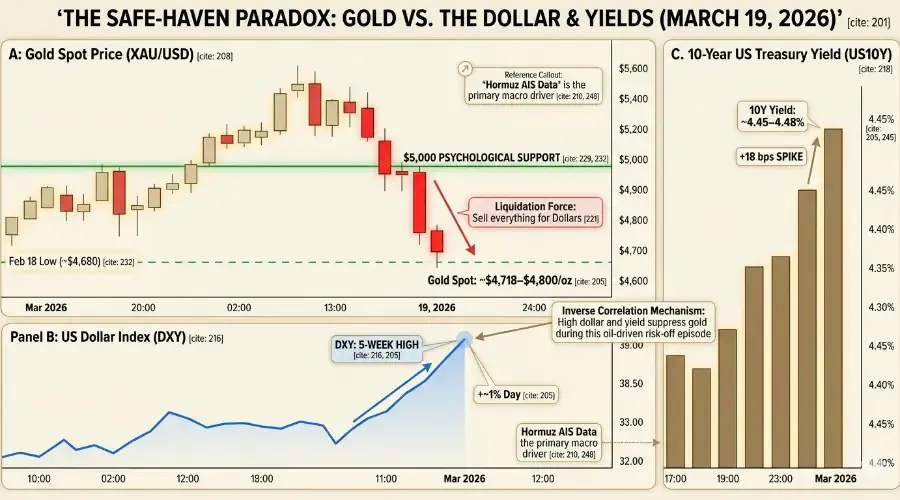
The sharp decline in gold and silver prices is one of the most important macro signals in the current market. Despite ongoing geopolitical tensions, both metals have fallen to one-month lows, breaking the typical safe-haven narrative. This move is not random—it reflects a powerful shift in how markets are pricing inflation, Federal Reserve policy, and global risk conditions.
Key Takeaways
Gold and silver have dropped to one-month lows despite conflict-driven uncertainty. The decline is being driven by four key forces: a stronger US dollar, rising Treasury yields, Fed hawkishness, and crisis-driven liquidation. Gold has recorded a six-session losing streak—the longest since 2024—with $5,000 now acting as resistance. Silver has underperformed significantly, falling 5.5% to 7.7%, indicating additional pressure from industrial demand concerns. The next move depends on the dollar, yields, and whether oil holds above $112.
The key question investors are asking is simple: why are metals falling during a geopolitical crisis? The answer lies in the type of macro environment. Gold protects against financial stress and currency debasement, but it does not behave the same way during an oil-driven inflation shock where the dollar strengthens and the Fed signals it cannot cut rates.
On March 19, 2026, gold and silver extended their losses for a sixth consecutive session. Spot gold traded between $4,718 and $4,800, while MCX gold ranged near ₹1,49,000 to ₹1,50,000. Silver fell more sharply, trading around $71.50–$72.00, with MCX silver between ₹2,45,000 and ₹2,60,000. At the same time, Brent crude remained above $112, the US 10-year yield rose to around 4.35%, and the dollar index climbed to a five-week high. This combination created a structurally negative environment for metals.
The first major driver is dollar strength. Gold is priced in dollars, so a stronger dollar reduces global demand. As the dollar rises, gold becomes more expensive for international buyers, which directly pressures prices.
The second force is rising yields. With the 10-year Treasury yield above 4.3%, investors are increasingly drawn to income-generating assets. Gold, which offers no yield, becomes less attractive as the opportunity cost of holding it increases.
The third factor is Federal Reserve hawkishness. The oil shock, with Brent above $112, is feeding into inflation expectations. As a result, the Fed has shifted toward a more cautious stance. The March FOMC meeting signaled only one potential rate cut in 2026. Fewer rate cuts mean higher real rates, which historically weigh on gold.
The fourth force is crisis-driven liquidation. During high-volatility environments, investors often sell liquid assets—including gold and silver—to raise cash. This “sell everything” behavior has been seen in past crises and is currently adding pressure to metals.
From a technical perspective, gold’s structure has weakened. The break below $5,000 is significant because it was both a psychological and technical support level. Once broken, such levels often turn into resistance. The current price range of $4,718 to $4,800 is being tested as near-term support, with $4,680 to $4,700 acting as the next critical zone. A sustained break below this level would indicate deeper downside.
Silver’s decline is even more telling. Its sharper fall reflects both safe-haven liquidation and concerns about industrial demand. Unlike gold, silver is tied to economic activity. When silver underperforms gold, it often signals that the market is pricing in economic slowdown alongside financial stress.
Looking ahead, traders are watching three key variables. The first is the US dollar. Any weakness in the dollar could provide immediate support to gold. The second is Treasury yields. A decline in yields would reduce the opportunity cost of holding metals and support a recovery. The third and most important factor is oil prices. If oil drops below $105, inflation concerns may ease, allowing the Fed to shift toward a more dovish stance.
Traders are also looking for signs of stabilization in price action. These include lower selling volume, stronger closing prices, and reversal patterns such as long lower wicks. As of now, these signals have not appeared, suggesting the market has not yet found a bottom.
Upcoming catalysts will play a critical role. The EIA oil report will provide insight into supply dynamics, while the next CPI release will indicate whether inflation pressures are spreading. For Indian traders, the INR/USD exchange rate adds another layer, as currency movements can amplify or offset price changes in MCX markets.
The broader question is whether this decline is temporary or the start of a larger correction. If the current drivers—strong dollar, high yields, and Fed hawkishness—ease, gold could recover toward the $4,900–$5,000 zone. However, if these conditions persist, a break below $4,680 could lead to further downside.
Bottom Line
The current selloff in gold and silver is not a failure of the safe-haven thesis but a reflection of a specific macro setup. Dollar strength, rising yields, and Fed policy are currently overpowering geopolitical risk. For traders, the key is to track the chain of signals: dollar movement, yield trends, Fed communication, and oil prices. Each provides real-time insight into where the market is heading. The trader who watches all four gains a clear edge.
Frequently Asked Questions
Why are gold and silver falling despite geopolitical tensions? Because a strong dollar, rising yields, and Fed hawkishness are outweighing safe-haven demand.
What level is critical for gold? The $4,680–$4,700 zone is key support.
Why is silver falling more than gold? Silver is also an industrial metal, so it reacts to economic slowdown fears.
What could reverse the trend? A weaker dollar, falling yields, lower oil prices, or a more dovish Fed stance.
Related Reading - BreakoutBulletin
Defensive Stocks Explained: Why Investors Buy Them When Markets Turn Uncertain
Oil Shock Sector Map: What Happens to Stocks When Oil Hits $90
DISCLAIMER:
This article is for informational and educational purposes only and does not constitute financial, investment, or trading advice. You are solely responsible for your own investment decisions and should consult a licensed financial professional before acting on any information in this post.