
Published: June 3, 2026 | Category: Catalyst Deep Dive | Read time: 5 min
All figures in this post are based on publicly available data as of June 3, 2026. Derived thresholds are labelled as such. Actual outcomes can differ materially.
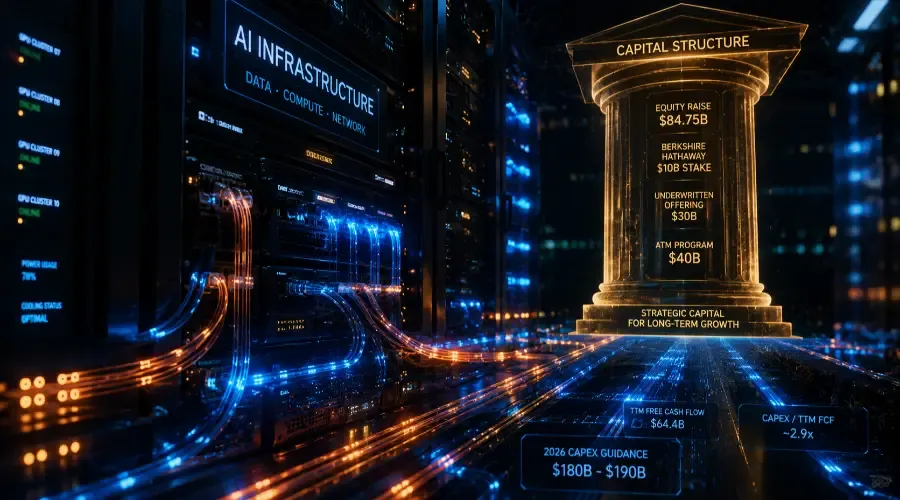
Alphabet ($GOOGL) is executing an equity raise that started as an $80B package and was later upsized to $84.75B, per Bloomberg and Reuters coverage of the June 2 filing. Warren Buffett's Berkshire Hathaway is taking a $10B direct stake. The underwritten component totalled $30B. An additional $40B ATM program rounds out the structure.
Headlines are treating Berkshire's involvement as a validation signal for Google's AI infrastructure strategy. That framing is not wrong – but it is incomplete. The more interesting question is what Berkshire's $10B bet sits alongside: a capital expenditure programme that Alphabet has guided to $180B–$190B for 2026 alone.
The verified numbers
| Metric | Verified figure | Source |
|---|---|---|
| Total equity raise | $84.75B | Bloomberg / Reuters, June 2 2026 |
| Original package size | $80B | SEC filing / press release |
| Berkshire Hathaway stake | $10B | Public disclosure |
| Underwritten offering | $30B | Public disclosure |
| ATM program | $40B | Public disclosure |
| 2026 capex guidance | $180B–$190B | Company guidance |
| TTM free cash flow | $64.4B | Q1 2026 10-Q filing |
| Capex-to-TTM-FCF ratio | ~2.9x | Derived from above figures |
Note: The equity raise was described as having strong demand and was upsized from $80B to $84.75B. A direct oversubscription confirmation from underwriters was not found in available public sources – that specific claim should not be treated as verified.
What Berkshire's stake actually highlights
The media narrative is that Buffett buying $10B of Alphabet validates the AI infrastructure thesis. That reading is probably directionally correct – Berkshire does not make $10B commitments casually.
But the validation framing skips the more important number sitting next to it. Alphabet is guiding $180B–$190B in capex for 2026. Against $64.4B in trailing twelve-month free cash flow, that is roughly 2.9 times annual FCF committed to infrastructure in a single year. The equity raise is partly a function of that capital intensity – the company needs external financing to fund a buildout that exceeds its current annual free cash flow generation by a wide margin.
The capital structure reality
The $84.75B raise breaks into three components with different implications.
The $10B Berkshire block is a long-duration, conviction-driven stake – a signal of confidence in the long-term return on AI infrastructure capital. It is not a signal that near-term FCF pressure is comfortable or manageable without the raise. Berkshire typically holds for years; this is not trading capital.
The $30B underwritten offering represents institutional demand for Alphabet equity at current prices. Strong demand led to the upsize from $80B to $84.75B – that is a genuine market signal about institutional appetite.
The $40B ATM program gives management flexibility to issue shares over time at market prices. This component adds dilution gradually rather than all at once, which is the more shareholder-friendly structure for a large raise.
The capex return question
At a $185B capex midpoint against $64.4B in TTM FCF, Alphabet is spending roughly 2.9 times its annual free cash flow on infrastructure. The returns from that spend will surface over six to eight quarters primarily through Google Cloud revenue acceleration and AI product monetisation.
Google Cloud has been growing at roughly 28% year-over-year. If the infrastructure investment is generating real enterprise demand, that growth rate may accelerate. If it holds flat or decelerates while capex stays elevated, the investment thesis becomes harder to justify at current multiples.
That is the number to watch every quarter – not the equity raise size or Berkshire's involvement.
Three things to monitor
1. Google Cloud revenue growth rate quarterly
This is where capex returns surface first. Acceleration above the recent 28% YoY baseline is the positive confirmation. Deceleration while capex stays elevated raises the return-on-investment question.
2. FCF margin over the next two to three quarters
As the $180B–$190B capex ramps, FCF per share will likely compress. How far it compresses and whether it stabilises tells you how capital-intensive this cycle actually is relative to management's guidance.
3. Any ATM program utilisation disclosure
The $40B ATM component will be disclosed in quarterly filings as shares are issued. The pace of ATM utilisation tells you whether management is drawing on it aggressively or treating it as a backstop.
What this means in practical terms
If you own GOOGL: The equity raise confirms the scale of the AI infrastructure commitment. Near-term FCF compression is likely as capex ramps. The variable to track is whether Google Cloud revenue accelerates proportionally to the spend – that data arrives with each quarterly print.
If you are watching from the sidelines: Berkshire's participation adds a layer of long-term conviction, but the FCF compression over the next two to three quarters may create a better entry point than today's price if the market reacts negatively to near-term earnings pressure. Watch FCF margin trend before sizing a position.
If you hold no position: Note the $185B capex midpoint and $64.4B TTM FCF as your baseline frame. Every quarterly result over the next two years should be evaluated against whether Cloud revenue growth is justifying that capital commitment.
FAQ
Why did Alphabet need such a large equity raise if it already generates $64.4B in free cash flow?
Alphabet's 2026 capex guidance of $180B–$190B is nearly three times its trailing annual free cash flow. Even a company with Alphabet's balance sheet can't fund a spending program of that scale entirely from operations without cutting into reserves or taking on debt. The equity raise – a mix of a direct stake, underwritten offering, and an at-the-market program – gives management the capital to execute the AI infrastructure buildout without over-leveraging the balance sheet.
Is Berkshire Hathaway's $10B investment a buy signal for GOOGL?
Berkshire's involvement is a meaningful signal of long-term confidence. Buffett's firm rarely makes $10B commitments without deep conviction in a company's durable competitive position. That said, it's not a near-term buy signal. The investment sits alongside a capital expenditure program that will pressure free cash flow per share for several quarters. Berkshire can wait years for the AI infrastructure returns to materialise; retail traders need to be aware of the shorter-term FCF compression.
What does a 2.9x capex-to-FCF ratio mean for shareholders?
A ratio of 2.9x means Alphabet is spending nearly three times its annual free cash flow on infrastructure. This typically leads to FCF per share compression in the near term, which can weigh on the stock if revenue growth doesn't accelerate proportionally. Over the long run, if the AI investments generate strong returns in Google Cloud and AI products, the ratio comes down and shareholder value grows. The key number to track quarterly is Google Cloud revenue growth – if it accelerates above its recent ~28% pace, the capital intensity starts to justify itself.
This analysis is for educational purposes only and does not constitute investment advice. All figures are based on publicly available disclosures, Bloomberg and Reuters reporting, and Alphabet's Q1 2026 10-Q as of June 3, 2026. The oversubscription claim was not confirmed from a direct underwriter source and is not stated in this post. The $41.7B FCF compression estimate referenced in prior coverage is a third-party model, not company guidance. Please consult a qualified financial advisor before making investment decisions. BreakoutBulletin does not hold positions in any securities mentioned.