
March 5, 2026 | BreakoutBulletin Macro Intelligence
Educational commentary only. Not investment advice.
The Setup
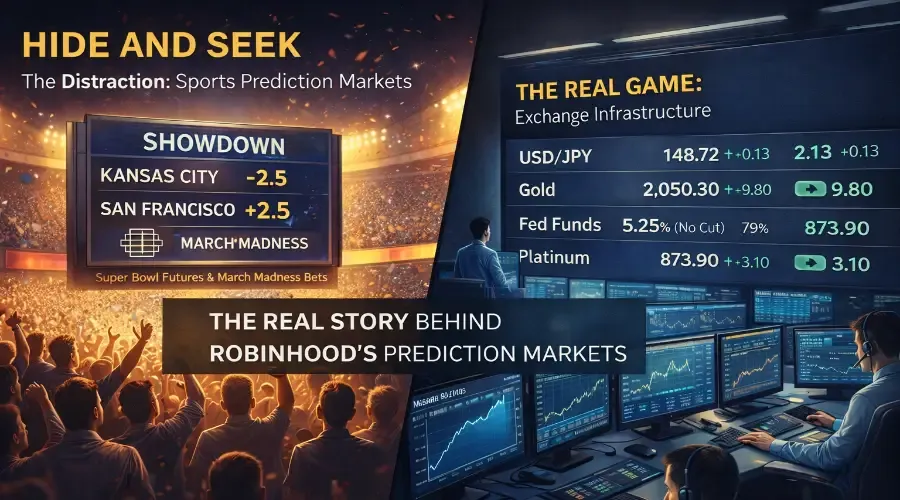
Something interesting is happening in financial markets right now-almost like a quiet game of hide and seek. And most people are looking in the wrong direction.
If you read the headlines about Robinhood lately, the focus is mostly on prediction markets tied to sports. Super Bowl outcomes. March Madness brackets. Things like that. The narrative is simple: Robinhood wants a piece of the sports-betting market dominated by DraftKings and FanDuel.
But that interpretation misses the bigger story.
What actually happened is much more structural. Robinhood quietly shifted its role in the financial system—from being just a distribution platform to owning part of the infrastructure itself.
Back in January 2026, a joint venture between Robinhood and Susquehanna International Group completed the acquisition of MIAXdx (formerly LedgerX, once owned by the now-collapsed FTX). That move gave Robinhood something it had never had before: direct control over an exchange and clearinghouse for derivatives contracts.
Susquehanna, one of the most sophisticated trading firms in the world, stepped in as the initial liquidity provider.
That's not a sports-betting story. That's a market structure story.
Round 1: What Everyone Is Watching (And What They're Missing)
The headline number circulating in financial media is this:
Robinhood's prediction markets are now its fastest-growing revenue product ever.
-
11 billion contracts traded
-
1 million+ customers
-
Estimated $435 million annual revenue run rate
-
8.5 billion contracts traded in Q4 2025 alone
Those numbers are impressive. But they only describe the surface.
Before the MIAXdx acquisition, Robinhood's prediction market business looked like this:
-
Robinhood → distributed contracts
-
Kalshi → operated the exchange and clearing
In other words, Robinhood was essentially a front-end distribution layer sitting on someone else's infrastructure.
After the acquisition, the structure flipped.
Now the joint venture:
-
Owns the exchange
-
Controls contract listings
-
Runs clearing
-
Manages risk
Kalshi is no longer the middle layer.
Think of it this way: before, Robinhood ran the storefront. Now it owns the factory, the warehouse, and the logistics network.
That changes the economics dramatically.
Exchange businesses scale differently from distribution businesses. Once the infrastructure is built, every additional contract traded carries very little incremental cost.
That's why exchanges like CME Group, Cboe, and Intercontinental Exchange have historically generated enormous margins.
Round 2: The Contracts Nobody Is Talking About
Open Robinhood's prediction markets today and you'll see sports contracts front and center.
But if you look a little deeper, something else appears.
Robinhood is offering contracts tied to real financial variables:
-
USD/JPY exchange rate (daily settlement)
-
EUR/USD exchange rate
-
GBP/USD exchange rate
-
Nasdaq-100 settlement price
-
Gold price
-
Platinum and Palladium
-
Federal Funds Rate outcomes
These aren't novelty bets.
They're the same macro variables that professional traders track every day.
Currency desks watch USD/JPY constantly. Portfolio managers watch the Nasdaq. Bond traders obsess over the Fed funds rate.
Now imagine more than a million retail participants trading contracts tied to those variables in real time.
That creates something new: a crowd-driven price discovery layer running alongside traditional markets.
Round 3: The Prediction Market Effect
We've already seen hints of this dynamic.
During the 2024 U.S. presidential election, the offshore prediction platform Polymarket gained attention because its market prices often moved ahead of polling averages.
In several cases, the crowd pricing turned out to be surprisingly accurate.
Why?
Because participants weren't just answering survey questions—they had money on the line.
Prediction markets transform opinions into prices.
Robinhood is now bringing that mechanism into regulated U.S. financial markets.
Contracts can trade for as little as $0.02, and settlement is instant. The barrier to participation is almost zero.
The result is a massive retail crowd expressing views on:
-
interest rates
-
currencies
-
commodities
-
equity indices
That data-if volumes grow-could become an entirely new signal source for traders. Whether the "wisdom of the crowd" that proved adept at forecasting a binary political event will translate to the complex, continuous world of professional FX and rates trading is one of the most interesting unanswered questions. But it's a question that can now be asked.
Round 4: Who Robinhood Is Actually Competing With
Here's another place where the narrative gets misleading.
Many commentators frame this as Robinhood competing with sports-betting companies.
But prediction markets operate under CFTC regulation, not state gaming law.
Which means the real competitors are much closer to the core of financial infrastructure.
| Company | Ticker | What They Control |
|---|---|---|
| CME Group | CME | Futures markets (rates, commodities, indices) |
| Cboe Global Markets | CBOE | Options exchanges |
| Intercontinental Exchange | ICE | NYSE and energy futures |
| Nasdaq Inc. | NDAQ | Equity and derivatives markets |
These exchanges generate revenue through:
-
transaction fees
-
clearing fees
-
market data
Robinhood's new exchange infrastructure places it-at least conceptually-into that same ecosystem.
Now a retail investor who might previously need a futures account and large margin requirements can express a directional view through a low-cost prediction contract.
That doesn't replace traditional futures markets yet. The core advantage of the incumbents—the deep, institutional liquidity that allows a trader to move millions without significantly affecting the price-remains firmly in place.
But it does start to overlap with them, creating a new, parallel layer of price discovery.
Round 5: The Susquehanna Signal
The least discussed part of this story might actually be the most important.
Robinhood's partner is Susquehanna International Group.
Within finance, Susquehanna is known as one of the most advanced quantitative trading firms in the world. They specialize in options pricing, derivatives, and large-scale market making.
Providing liquidity on a new exchange is not a casual decision.
Market makers:
-
manage inventory risk
-
set bid-ask spreads
-
analyze order flow
-
deploy capital across thousands of contracts
If Susquehanna is committing to this role from day one, it suggests they believe:
-
the contract design works
-
the regulatory framework is stable
-
the potential order flow is large enough to justify it
That's a meaningful institutional signal.
Round 6: What This Means for HOOD Stock
For investors watching Robinhood (HOOD), several themes emerge.
Margin Expansion
Moving from distribution to exchange ownership could significantly improve margins.
Exchange businesses historically operate with extremely high profitability once volume scales.
Customer Acquisition
Prediction markets may bring in a different audience—people interested in sports or macro events who later migrate into:
-
stock trading
-
options trading
-
crypto
In that sense, prediction markets act like a gateway product.
Key Risks
Three risks stand out.
-
Regulation – Some states, including Massachusetts, have challenged prediction markets under gambling laws.
-
Liquidity concentration – Day-one liquidity relies heavily on Susquehanna.
-
Product classification – If financial prediction contracts begin to resemble futures substitutes too closely, regulators could revisit their classification.
What to Watch Next
Several signals will determine whether this becomes a major market development.
HOOD Earnings
Investors will want to see:
-
prediction market revenue growth
-
margin expansion after MIAXdx integration
Exchange Incumbents
Listen to earnings calls from:
-
CME
-
CBOE
-
ICE
If prediction markets start showing up in those discussions—specifically in response to analyst questions about new retail-focused competition or the threat to their "micro" futures products—the competitive landscape may be shifting more quickly than expected.
Regulation
The CFTC's stance on event contracts will remain a critical variable.
Contract Mix
If sports contracts dominate forever, the product remains entertainment.
But if FX, interest rate, and index contracts start growing rapidly, the story changes.
The Bigger Picture
Robinhood didn't just launch another product.
It moved deeper into the plumbing of financial markets.
From interface to infrastructure.
From distributing contracts to owning the exchange layer.
Whether prediction markets eventually challenge traditional futures exchanges is still uncertain.
That will take years to play out.
But one thing is clear.
While most people were watching the scoreboard, Robinhood quietly walked into the exchange room—and turned on the lights.
This article is for educational and informational purposes only and does not constitute investment advice. Always conduct your own research before making investment decisions.