
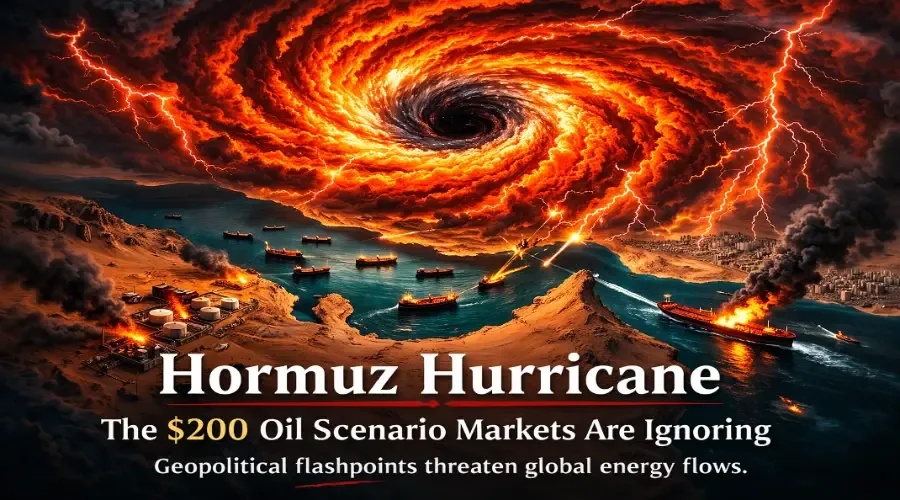
How a 33-mile chokepoint carrying 21% of global oil could trigger the next energy shock-and why markets may be underpricing the risk.
BreakoutBulletin | Oil Shock Series · Special Report
Published: March 19, 2026
Educational commentary only. Not investment advice.
Key Takeaways
- 21% of global oil flows through the Strait of Hormuz
- A full closure could remove 12–16% of global oil supply after mitigation
- Supply-shock models (Hamilton 2009, Kilian 2014) suggest oil could spike toward $175–$220
- Options markets currently price only ~5–8% probability of this scenario
- Our assessment: 15% probability-a meaningful gap worth understanding
A Storm Building in the Oil Market
Oil prices have already climbed above $100 per barrel as tensions rise around the Strait of Hormuz. This narrow waterway between Iran and the Arabian Peninsula carries roughly 20 million barrels of oil per day—approximately one-fifth of global consumption.
If the strait were disrupted, global supply could fall sharply. The result could be one of the largest energy shocks in decades.
This potential shock is what we call the Hormuz Hurricane. It is not the base case. But it is a tail risk scenario that markets may be underpricing.
Why the Strait of Hormuz Matters
The Strait of Hormuz is only 33 miles wide, yet it carries about 20% of global oil consumption. Major exporters using the route include Saudi Arabia (6–7 million barrels/day), Iraq, Kuwait, the UAE, Iran, and Qatar.
There is no infrastructure capable of replacing this route. Existing pipelines can reroute only 30–35% of current flow. If the strait were closed, a large portion of global oil supply would simply vanish from the market.
The Supply Shock Math
If the Strait of Hormuz closed, roughly 20 million barrels per day of supply would initially be disrupted. Mitigation could come from:
- Pipeline rerouting: ~3.5 million barrels/day
- SPR releases: ~2–3 million barrels/day
- Demand destruction: ~1–2 million barrels/day
Even after those adjustments, the net supply shock could still reach 12–16 million barrels per day. That represents roughly 12–16% of global oil supply.
Academic research on oil supply shocks (Hamilton 2009, Kilian 2014) establishes that in the short run—when demand cannot adjust quickly-a 1% reduction in global oil supply produces approximately a 6–10% increase in oil price.
Applying that framework to a 12–16% supply shock produces possible price ranges of $175–$220 per barrel from a $100 baseline.
Three Possible Oil Scenarios
Markets currently appear to price a moderate disruption scenario. But the full range of outcomes is wider.
Scenario A - Diplomatic De-escalation (40%)
Tensions ease. Oil retreats toward $85–$90.
Scenario B - Limited Conflict (45%)
Shipping constrained but strait open. Supply disruption of 3–6 million barrels/day. Oil holds $105–$135.
Scenario C - Full Hormuz Closure (15%)
Iran blocks shipping. Supply shock reaches 12–16 million barrels/day. Oil spikes toward $175–$220 before stabilizing lower.
What Markets May Be Missing
Several indicators suggest markets are not fully pricing the tail-risk scenario.
Options market: Brent crude 3-month implied volatility is 35–40%. This prices approximately 5–8% probability of $150+ oil. Our assessment: 15%. That 7–10 point gap is a quantifiable market inefficiency.
Inflation expectations: Five-year TIPS breakevens sit at 2.71%. A $175–$200 oil environment would push CPI toward 6%, requiring breakevens near 3.8–4.2%. The gap is 110–150 basis points.
Equity valuations: The S&P 500 forward P/E of 19–21x assumes the Fed retains flexibility to cut rates. In a $200 oil scenario with 6% CPI, the Fed would be paralyzed—unable to cut, possibly forced to hike.
How $200 Oil Would Reshape the Economy
A major oil shock would ripple through every sector.
Energy (XLE) moves from outperforming to exceptional outperformance. Every dollar of oil price increase flows directly to the bottom line.
Airlines (JETS) face an existential threat. What was margin compression at $100 oil becomes a survival crisis at $200. Multiple carriers would require government support.
Consumer Discretionary suffers the most direct household impact. The $500 to $600 annual drag at $100 oil becomes a $2,000 drag at $200. That is recession-level consumer stress.
Technology (SMH) sees multiple compression accelerate from 10 to 15 percent to 20 to 30 percent. The Fed cut narrative dies entirely, and long-duration valuations repress sharply.
Defense (XAR) continues outperforming, but the trajectory accelerates. Sustained conflict drives procurement acceleration and budget supplements.
Gold (GLD) transforms from an inflation hedge bid into a major rally. At $200 oil with 5 to 6 percent CPI, gold becomes the stagflation asset of choice, targeting $2,800 to $3,200.
Consumer Staples (XLP) remain defensive but face input cost pressure. Relative outperformers, but margins squeeze.
Financials (XLF) see yield benefits offset by accelerating credit quality deterioration. Loan defaults rise as consumers and businesses struggle.
REITs (XLRE) face a refinancing crisis. Commercial real estate stress becomes acute as rates rise and occupancy softens.
Utilities (XLU) suffer double pressure: higher input costs and yield competition from rising rates.
The household impact: At $200 oil, U.S. gasoline could approach $7 per gallon. The average household would pay roughly $2,000 more annually for fuel—about $170 per month diverted directly from discretionary spending.
The Fed's trap: At $100 oil, the Fed is uncomfortable-can't cut despite weak payrolls. At $200 oil with 6 percent CPI, the Fed faces a policy crisis. Rate cuts become impossible. Rate hikes become discussable. Emergency SPR releases become certain.
The Bottom Line
The Hormuz Hurricane is not a prediction. It is a scenario built on supply-shock math and documented academic research.
If the Strait of Hormuz closes, global oil supply could fall by more than 10% overnight. In that environment, oil moving toward $200 per barrel would not be surprising.
It would be the logical outcome of one of the world's most important energy chokepoints being disrupted.
Markets currently price 5–8% probability of this scenario. Our assessment is 15%. That gap is not a prediction that Scenario C happens. It is a specific, quantifiable observation that the tail risk is underpriced relative to the escalation trajectory.
Smart risk management does not predict storms. It prepares for the possibility that they arrive-and understands the mechanism well enough to act when they do.
Related Reading - BreakoutBulletin Oil Shock Series
- The Complete Sector Map — Oil Shock Impact on All 11 S&P 500 Sectors - https://www.breakoutbulletin.com/article/oil-shock-sector-map-winners-losers-guide
Disclaimer
This analysis is published by BreakoutBulletin for educational and informational purposes only. It does not constitute investment advice, a recommendation to buy or sell any security, or a solicitation of any kind.
The $200 oil scenario presented is a tail risk analysis assigned 15% probability. It is explicitly NOT a prediction or forecast. Probability assignments are illustrative estimates based on qualitative assessment, not quantitative models.
Academic elasticity estimates (Hamilton 2009, Kilian 2014) represent historical consensus—not guaranteed outcomes. Real-world price responses depend on numerous factors not fully captured in elasticity models.
References to specific securities and ETFs are for educational illustration only and do not represent buy or sell recommendations. Trading involves substantial risk of loss.
© 2026 BreakoutBulletin | breakoutbulletin.com | All rights reserved.