
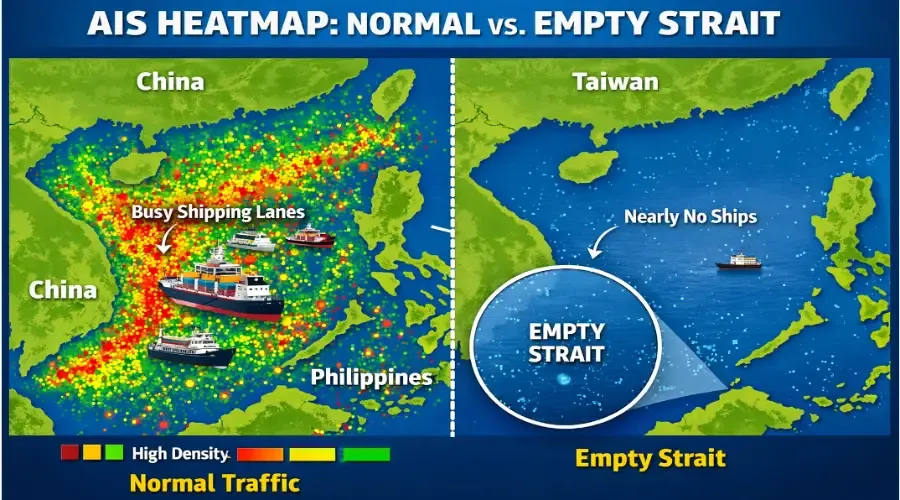
Imagine the world’s busiest energy highway suddenly falling silent. That is exactly what is happening right now in the Strait of Hormuz. For retail investors, this isn't just a headline about geopolitical tension; it is a structural supply shock that is fundamentally remapping the stock market.
If you’ve noticed your petrol prices creeping up or your airline stocks sliding, the primary cause is a 90% collapse in Hormuz tanker traffic. In this guide, we will break down exactly what the data shows, why "dark ships" are a major warning sign, and how you can track this crisis in real-time using the same tools as institutional hedge funds.
What is happening?
Satellite tracking data (AIS) currently shows a near-total halt of commercial tanker movements through the Strait of Hormuz. Since early March 2026, traffic has plummeted by approximately 90–94%.
The Strait typically handles 21 million barrels of oil per day—roughly 20% of global consumption. With traffic frozen, Brent crude has surged past $100 per barrel. The market is pricing in a massive physical supply gap that cannot be easily replaced by pipelines or alternative routes.
Why is it happening? (The Pressure Cooker Analogy)
To understand why this is happening, think of a clogged kitchen sink.
-
The Sink: This is the global energy market.
-
The Water: This is the constant flow of oil needed to keep the world running.
-
The Clog: The Strait of Hormuz is a narrow "pipe." When geopolitical conflict "plugs" that pipe, the water (oil) backs up at the source and disappears at the faucet.
Because the world doesn't have a "second sink" large enough to handle this volume, the price for the remaining "bottled water" (oil from the US or Africa) is skyrocketing. The current disruption is a result of military escalations and tankers bypassing standard maritime protocols to avoid detection (turning off GPS transponders).
Information Gain (The "Dark Ship" Signal)
Most mainstream news focuses only on the price of oil. However, the real signal is the "Voluntary Darkness" of the fleet. When commercial ship captains choose to turn off their AIS transponders, they are signaling that the risk of being targeted exceeds the legal requirement to be visible.
Most investors miss this: This behavior indicates that maritime insurance has likely been suspended for the region. Even if tensions ease tomorrow, it could take weeks for tankers to return because the legal and insurance frameworks must be rebuilt. This suggests that the current "Energy Sector" outperformance is not a "one-day spike" but a structural shift.
What it means for investors
This supply shock creates a massive divergence in the stock market. While the broader S&P 500 sits at -3% YTD, the Energy Select Sector SPDR Fund (XLE) is up 29% YTD, signaling a clear rotation into "Physical Reality" assets.
-
US Shale Producers (The Winners): Companies like Devon Energy (DVN) and ConocoPhillips (COP) are top performers. They produce oil in the US Permian Basin, meaning they get the benefit of $100+ prices with zero exposure to Middle Eastern shipping risks.
-
The Refiner Edge: Valero (VLO) and Phillips 66 (PSX) benefit from widening "crack spreads." As refined products like diesel and jet fuel become scarce, these companies charge a massive premium over the cost of the raw crude they buy.
-
The Pressure Zone: Airlines like Delta (DAL) face a dual headwind: surging fuel costs and a potential drop in consumer travel as petrol prices hit $5–$6 a gallon.
What to watch next
Traders should monitor these three specific "lines in the sand":
-
AIS Resumption: Watch coordinates 55°–58°E. If you see 3+ tankers moving eastbound without military escorts, that is your first de-escalation signal.
-
Inventory Data: Tuesday’s API report (4:30 PM ET). A draw larger than 3.5M barrels confirms the shortage is hitting US soil.
-
Key Levels: Traders are watching $106 on Brent and $100 on XLE as the primary resistance levels for the next leg up.
Featured Snippet: What is the current status of Hormuz tanker traffic? As of March 2026, Hormuz tanker traffic has collapsed by 90–94% due to regional conflict. AIS tracking shows near-zero commercial movements through the Strait, disrupting 20% of global oil supply and sustaining Brent crude prices above $100 per barrel as traders price in a prolonged supply shock.
SGE Summary:
-
Supply Collapse: Hormuz traffic is down ~90%, idling 21 million barrels of daily global oil flow.
-
Market Winners: US Shale (DVN, COP) and Refiners (VLO, PSX) are outperforming; XLE is up 29% YTD.
-
Pro Tip: Monitor MarineTraffic (Coordinates 55°–58°E) for the first sign of traffic resumption-the ultimate de-escalation signal.
Internal Link Suggestions:
· Defensive Rotation: How to Pivot to Defensive Stocks During Geopolitical Uncertainty → https://www.breakoutbulletin.com/article/defensive-stocks-guide-market-uncertainty
· Sector Mechanics: The Relationship Between Commodities and Cyclical Equities → https://www.breakoutbulletin.com/article/why-commodity-booms-lift-cyclical-stocks
FAQs:
Q: Why does a Hormuz closure help US oil stocks? A: US producers (DVN, COP) sell oil at global prices but have no shipping exposure to the Middle East, making them "safe haven" energy plays.
Q: How can I track tankers for free? A: Use MarineTraffic.com, filter for "Tankers" in the Strait of Hormuz, and watch for eastbound traffic gaps.
Q: What is a "crack spread"? A: It is the profit margin a refiner makes by "cracking" crude oil into gasoline or diesel. These margins often widen during supply shocks.
Q: Is XLE a good way to play this? A: XLE provides broad exposure to majors like XOM and CVX, which benefit from higher prices, though individual shale stocks often move more aggressively.
Q: What signal shows the crisis is ending? A: Sustained, unescorted eastbound tanker traffic on AIS trackers is the most reliable lead indicator of de-escalation.
DISCLAIMER:
This article is for informational and educational purposes only and does not constitute financial, investment, or trading advice. You are solely responsible for your own investment decisions and should consult a licensed financial professional before acting on any information in this post.