
Every retail trader knows the feeling: CPI drops at 8:30 AM, the market spikes, then reverses within an hour, and you're left holding a losing position, wondering what the "smart money" saw that you didn't.
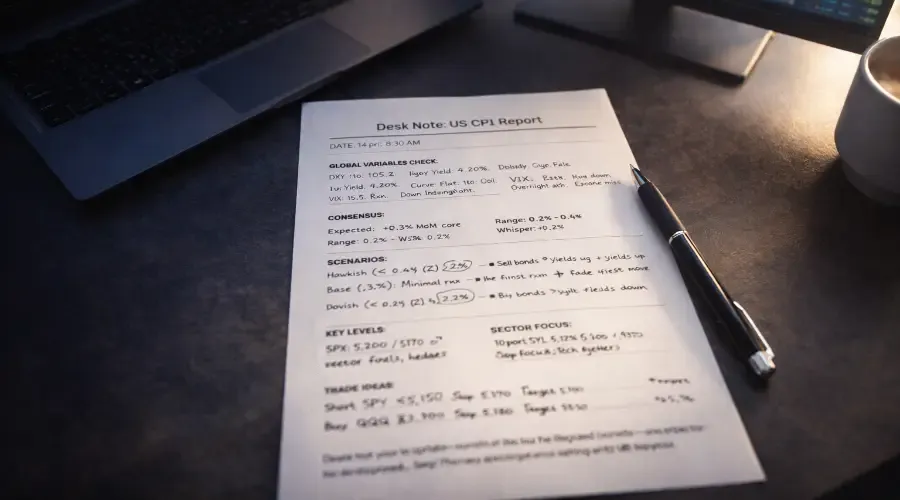
The difference isn't access to faster data - it's a framework. On institutional desks, traders and analysts don't react to data; they prepare for it. They build a desk note - a one-page brief that outlines the scenarios, the trigger levels, and the trades that make sense before the number hits the tape.
This article walks you through the exact methodology professionals use to plan around data weeks. By the end, you'll have a template you can adapt for your own trading.
What Is a Desk Note?
A desk note is a pre-event document that forces clarity. It answers four questions:
What is the consensus? - What does the market expect, and what is already priced in?
What are the scenarios? - For each possible outcome (beat, miss, inline), what is the expected market reaction?
Where are the levels? - What price zones will trigger entries, stops, or reversals?
What is the trade? - Specific setups (long/short/hedge) with predefined risk parameters.
The goal is not to predict the future, but to remove emotion from the moment of impact. When the number prints, you're not thinking - you're executing.
Global Variables to Monitor
Before any data release, professionals check the broader landscape. These variables shape how the market will interpret the data:
The Dollar (DXY)
A rising dollar before data suggests defensive positioning. Strong data with a strong dollar may have muted upside.
A falling dollar signals risk appetite. Strong data could amplify the move.
Yields and the Yield Curve
If the 10-year yield is spiking into data, the inflation trade is already crowded - good news may already be priced.
If the curve is steepening, growth expectations are rising. If flattening, recession fears are creeping in.
Oil (WTI)
Oil above $85 acts as a tax on consumers. Strong retail sales data with oil high may be dismissed as unsustainable.
Oil falling removes a headwind - data surprises have more staying power.
VIX and Options Skew
Low VIX before data signals complacency - markets are vulnerable to a shock.
High VIX means fear is already priced - a benign number could spark a relief rally.
Put/call ratios above 1.2 suggest hedges are in place; markets may fade the initial move.
Global Context
What happened in Asia and Europe overnight? If global markets sold off on the same data (e.g., Eurozone CPI), the US reaction may be muted.
Are there geopolitical flashpoints (oil routes, elections, tariffs) that could override the data?
On a professional desk, these variables are checked before the note is written. They provide the backdrop against which the data will be judged.
Building the Desk Note - Step by Step
We'll use an example: upcoming US CPI report (monthly). Here's how a desk note is constructed.
Step 1: Gather the Baseline
Release date/time: Tuesday, April 14, 8:30 AM ET.
Consensus: Bloomberg consensus expects +0.3% MoM core CPI, +3.2% YoY.
Prior: 0.2% MoM core, 3.1% YoY.
Range of estimates: Street estimates vary from 0.2% to 0.4% MoM.
Markets pricing: Fed funds futures imply a 92% probability of a 25bp cut in June - any deviation from the consensus will repricing rate expectations.
Step 2: Define the Scenarios
Professionals think in three buckets:
Hawkish surprise – Core MoM ≥ 0.4%
Sell bonds → yields up → equities down (especially tech) → USD up.
Inline – 0.3% MoM
Minimal reaction; fade the initial move within 30 minutes.
Dovish surprise – Core MoM ≤ 0.2%
Buy bonds → yields down → equities up → USD down.
But they go deeper: they look at core services ex-housing (supercore), because that's what the Fed watches. A 0.3% headline might be ignored if supercore comes in hot.
Step 3: Identify Key Levels
Before the print, mark reference zones on the charts of:
SPX – recent value area, prior day's high/low, key moving averages.
TNX (10y yield) – technical levels that align with option strikes.
DXY – support/resistance that could break on a dollar move.
For our CPI example:
SPX: 5,200 (pivot from last week), 5,150 (support), 5,250 (resistance).
TNX: 4.20% (psychological), 4.10% (recent low), 4.35% (YTD high).
Step 4: The Trade Ideas
Now, with scenarios and levels, you outline potential trades - not predictions, but conditional setups:
If CPI > 0.4% and SPX breaks 5,150: short SPY with a stop above 5,170, target 5,100.
If CPI = 0.2% and SPX holds 5,200: buy tech (QQQ) expecting yields to fall, stop below 5,180.
If CPI inline: stand aside, or fade the first 15-minute move with a tight stop.
Each idea includes size, stop, and rationale. No trade is a "must do" - it's a menu of possibilities.
Step 5: Write the Note
The final desk note is concise - rarely more than one page. It includes:
Date, time, event.
Consensus and whisper numbers.
Scenario summary.
Key levels (charts optional but helpful).
Trade setups (max 3).
Risk events later in the day (Fed speakers, Treasury auctions).
Sector Focus of the Week
Data doesn't move all stocks equally. Before CPI week, professionals identify which sectors are most exposed.
If inflation surprises to the upside:
Underperform: Long-duration tech (growth stocks), homebuilders, consumer discretionary.
Outperform: Energy, materials, banks (if yields rise on real rates, not inflation expectations).
If inflation surprises to the downside:
Outperform: Tech, real estate, small caps (falling yields support valuations).
Underperform: Energy (demand concerns), consumer staples (defensives lose appeal).
Sector to watch: Regional banks (KRE). They are caught between funding costs (sensitive to yields) and loan demand (sensitive to growth). CPI that shifts rate expectations hits them first.
This sector focus goes into the desk note. It ensures you're watching the right stocks, not just the index.
Economic Calendar Breakdown
A professional desk note doesn't just look at the headline event - it scans the entire week's calendar to understand context and sequencing.
For CPI week, the full breakdown might look like this:
Monday, April 13
No major US data.
Watch: Fed speakers at 1:00 PM and 3:30 PM ET - they may preview the inflation narrative.
Tuesday, April 14 - CPI Day
8:30 AM: CPI (Headline and Core).
1:00 PM: Treasury auction (10-year notes) - demand will reflect inflation conviction.
Market impact potential: High. This is the week's primary driver.
Wednesday, April 15
8:30 AM: Empire State Manufacturing.
10:00 AM: Business Inventories.
2:00 PM: Fed Beige Book.
Market impact potential: Medium. Beige Book may reinforce or soften the CPI message.
Thursday, April 16
8:30 AM: Housing Starts, Building Permits.
8:30 AM: Initial Jobless Claims.
9:15 AM: Industrial Production.
Market impact potential: Medium. Housing data sensitive to rates - will confirm/reject CPI impact.
Friday, April 17
No major data. Options expiration (OPEX) - expect volatility into the close as options roll off.
Why this matters: If CPI is hot but housing data later in the week is weak, the market may reframe the inflation narrative as "peak" rather than "trend." A desk note notes these follow-up data points so you're not trapped in a one-day view.
Why This Works for Retail Traders
Institutions use desk notes because they institutionalize discipline. For a retail trader, the benefits are even greater.
You avoid the "oh shit" moment. When the number surprises, you're not scrambling — you already have a playbook.
You separate signal from noise. The note forces you to focus on what matters: the data point, the levels, the reaction.
You trade with context. You know whether a 0.3% CPI is bullish or bearish relative to what's priced, and you know which sectors are most exposed.
Build Your Own Desk Note Template
Here's a simple template you can copy and fill out before any major data release:
DESK NOTE: [EVENT NAME]
Date: ______________ Time: ______________
GLOBAL VARIABLES CHECK
DXY: ________ Signal: ________
10Y Yield: ________ Curve: ________
Oil: ________ VIX: ________
Overnight action: ________
CONSENSUS
Expected: ________
Range: ________
Whisper: ________ (from X / news)
SCENARIOS
Hawkish (condition): ________ → Expected reaction: ________
Base (condition): ________ → Expected reaction: ________
Dovish (condition): ________ → Expected reaction: ________
KEY LEVELS
SPX: ________ [Ticker you trade]: ________ Yields: ________
SECTOR FOCUS
Outperform if: ________
Underperform if: ________
TRADE IDEAS
Setup 1: __________________________________
Entry: ____ Stop: ____ Target: ____
Setup 2: __________________________________
Entry: ____ Stop: ____ Target: ____
CALENDAR (later this week)
Wednesday: ________
Thursday: ________
Friday: ________
Print it, fill it in, and keep it on your desk. When the number hits, you trade the plan, not the emotion.
Bottom Line
The difference between gambling and trading is preparation. Desk notes are how professionals prepare. By adopting this framework — including global variables, sector focus, and the full calendar context — you stop reacting to headlines and start trading with the same structural advantage as the desks.
The next data point to watch: US CPI, Tuesday, April 14, 8:30 AM ET. Use this template and see how it changes your experience.
Disclaimer: This article is for educational and informational purposes only. It does not constitute financial or investment advice. Past market behaviour does not guarantee future results. Always conduct your own research and consult a qualified financial advisor before making any trading decisions.