
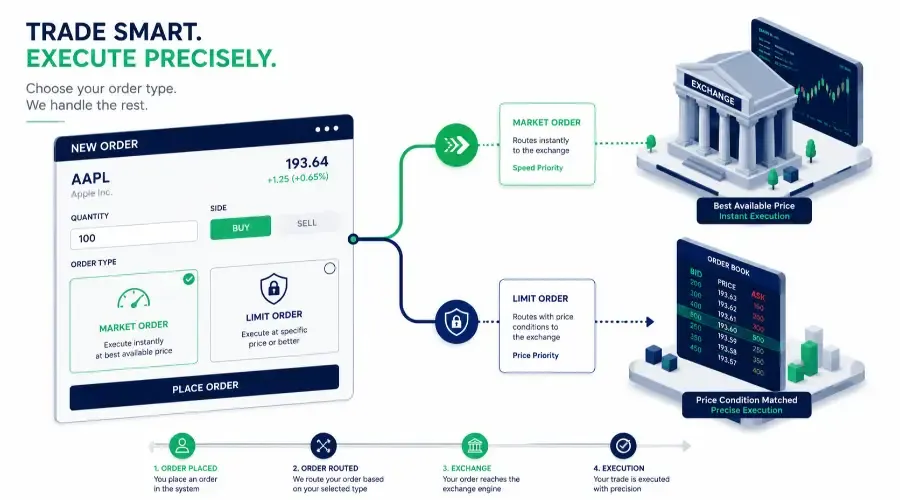
Most brokerage apps make trading look simple: find a stock, tap buy, confirm. The process behind that tap is more structured than it appears – and understanding it helps you avoid the errors that cost new investors money.
The Path of a Trade
When you place a stock order, four parties are involved: you, your broker, the exchange (or a market maker), and the counterpart seller.
You submit the order through your brokerage platform. Your broker routes it – either to the exchange where the stock is listed or to a market maker, a firm that buys and sells securities continuously to facilitate trading. The market maker or exchange matches your buy order with a sell order. The trade executes. Shares transfer to your account and cash transfers to the seller.
The execution typically takes under a second. Settlement – the official transfer of ownership recorded in the clearinghouse – takes two business days (T+2).
The Two Order Types You Need to Understand
Market Order
A market order tells your broker to buy or sell immediately at the best available price. It guarantees execution but not price. If a stock is quoted at $50.00, a market order fills at approximately that price – but the exact execution could be $50.03 or $49.97 depending on what other orders are sitting in the queue at that moment.
Market orders work well when a stock trades actively (high volume, tight bid-ask spread) and you want immediate execution. They carry more risk during volatile sessions or immediately after the market opens at 9:30 AM, when prices swing more widely.
Limit Order
A limit order lets you specify the maximum price you'll pay (if buying) or the minimum price you'll accept (if selling). A buy limit order at $48 on a stock trading at $50 will only execute if the price drops to $48 or below. If the price never reaches $48, the order doesn't fill.
Limit orders trade execution certainty for price control. They're particularly useful for larger trades, volatile stocks, and orders placed during extended hours when bid-ask spreads widen.
Slippage: Why Market Price and Execution Price Differ
Between the moment you submit a market order and the moment it executes, the best available price can shift. This difference – slippage – is usually pennies per share on liquid stocks during regular hours. On thinly traded stocks or during volatile sessions, slippage can be significant.
If you place a market order on a stock during a fast-moving morning session and the quote shifts by $0.50 between submission and execution, your total cost on 100 shares is $50 higher than the quoted price when you tapped buy.
Limit orders eliminate slippage risk at the cost of possible non-execution.
Order Duration
Orders have an expiration setting. Day orders expire at 4:00 PM ET on the day they're placed if they don't fill. Good-Till-Canceled (GTC) orders remain active until they fill or you manually cancel them, usually up to 90 days depending on the broker.
Market orders default to day orders. Limit orders can be set as day or GTC. Forgotten GTC orders occasionally fill weeks later under conditions that no longer apply – worth checking your open orders periodically.
The Opening and Closing Bell Effect
The first 30 minutes of trading (9:30 to 10:00 AM ET) and the last 30 minutes (3:30 to 4:00 PM ET) typically see the highest volume and widest price swings. Large institutional orders execute during these windows, and market orders placed at the open or close are more exposed to rapid price movement.
For smaller trades in liquid stocks, this rarely matters meaningfully. For larger positions or less liquid names, placing limit orders during midday – when volume stabilizes – typically results in tighter execution.
Bid, Ask, and the Spread
Every stock has two prices: the bid (the highest price a buyer is willing to pay) and the ask (the lowest price a seller will accept). When you buy, you pay the ask. When you sell, you receive the bid.
The spread between bid and ask represents an implicit transaction cost. On large-cap stocks like Apple or Microsoft, the spread is often $0.01 or less. On smaller, less liquid stocks, spreads can be $0.20 or more per share – a meaningful cost on small trades.
Commission-Free Trading
Most major retail brokers – Fidelity, Schwab, Robinhood, and others – eliminated commissions on standard stock trades around 2019. You pay only the price of the shares. The broker earns revenue through payment for order flow (routing orders to market makers who compensate the broker) and interest on uninvested cash.
Commission-free doesn't mean frictionless. Spreads still exist. Slippage still occurs. Tax implications on gains still apply. The removal of explicit commissions reduced costs meaningfully – it didn't eliminate them entirely.
This content is for educational purposes only and does not constitute investment, legal, or tax advice. Investing in securities involves risk, including possible loss of principal. Always conduct your own research and consult a licensed financial professional before making investment decisions.
Understanding the path of a trade is the foundation of executing well. The next step is understanding the order types that give you control over price versus execution certainty - and the settlement rules that govern how quickly you can reuse the same capital.
→ How Orders Work → The complete guide to order types, duration, timing, and settlement - www.breakoutbulletin.com/article/how-stock-orders-work-placing-executing-settling-trades
→ Market Order vs. Limit Order → The practical decision between execution certainty and price control - www.breakoutbulletin.com/article/market-order-vs-limit-order-explained
→ Understanding Liquidity → Why the bid-ask spread is a transaction cost that doesn't appear on your confirmation - www.breakoutbulletin.com/article/liquidity-explained-stock-market-for-beginners