
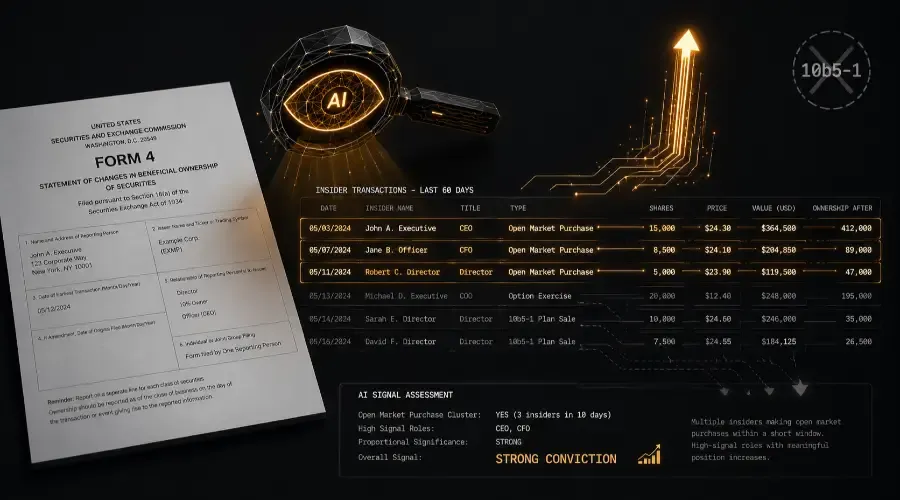
Corporate insiders – executives, directors, and major shareholders – are required by law to report their stock transactions to the SEC within two business days of the trade. Every purchase, every sale, every option exercise gets filed publicly on Form 4.
That creates a public record of what the people who know a company best are actually doing with their own money. Not what they're saying on earnings calls, not what their investor relations team is communicating – what they're doing.
AI organises and interprets that context efficiently when you give it the right data and the right questions. This post covers how to analyze insider transaction data with AI – from how to structure the input, to the prompt that separates genuine conviction signals from background noise.
nsider transaction analysis is one of the supplementary signal layers in the Fundamental Research with AI workflow. It covers the full hub overview and where Form 4 data fits in the research sequence.
What Insider Transactions Are and Why They Matter
When a company executive buys shares on the open market with their own money, they are making a personal financial bet that the stock is going to be worth more than they paid. They have access to non-public information about the company's business that no analyst or retail trader has. They know the pipeline, the cost structure, the competitive environment, the internal projections. They have decided, with all of that information available to them, that the current stock price is an attractive entry point.
That is a meaningful signal – not a guarantee, but a signal that carries information the broader market doesn't have.
The disclosure system exists to ensure that this information advantage doesn't translate into unchecked profit. Insiders must report their trades publicly, and they are prohibited from trading on material non-public information under securities law. The Form 4 filing system creates transparency: what insider transactions happened, when they happened, at what price, and for what quantity.
Form 4 filings are sourced from the same SEC EDGAR system used for 10-K and 10-Q analysis. How to Read SEC Filings with AI covers how to navigate EDGAR, verify filed data against the primary source, and use the 8-K catalyst framework for time-sensitive filing analysis.
For traders who know how to read Form 4 filings, that transparency produces an edge. Not because insider transactions predict stock performance with certainty – they don't. But because the pattern of insider activity provides a signal about management confidence that is grounded in real financial commitment rather than carefully crafted language.
The Difference Between Meaningful Insider Buying and Routine Transactions
This is the most important distinction in insider transaction analysis, and the one that most retail traders get wrong.
Not all insider transactions carry the same signal. The majority of insider transactions are routine – scheduled option exercises, automatic selling program sales, transactions made through 10b5-1 plans that were established months before the trade occurred, and share issuances as part of compensation packages. These transactions tell you very little about the insider's view of the company's prospects. They're mechanical transactions driven by compensation structures and tax planning, not expressions of conviction about the stock.
The transactions worth paying attention to are open market purchases – instances where an insider took personal cash and bought shares on the open market at the prevailing market price, without any structural obligation to do so. This is the core of how to read insider buying signals: filter for open market purchases first, then apply the context layers described below.
Open market purchases are a stronger signal than option exercises. An option exercise followed by an immediate sale is simply monetising compensation – the insider had no choice about when the options vested and may have no view on the stock's near-term direction. An open market purchase is entirely voluntary. The insider chose to spend personal capital at the current market price. That choice carries information.
Three additional factors determine whether an open market purchase is meaningful:
Role – and the critical distinction between operational executives and 10% owners.
A purchase by the CEO or CFO carries substantially more signal than a purchase by a board member or a reported 10% owner. Operational executives – CEO, CFO, COO – have the most comprehensive view of the business's day-to-day performance, internal pipeline, and near-term trajectory. A "10% Owner" is a different category entirely. This designation often applies to passive institutional investors – venture capital firms, private equity funds, or hedge funds – that hold a large position and are required to file Form 4 when they transact. Operational executives always trump institutional 10% owners in signal strength.
Size relative to existing holdings.
Transaction size relative to the insider's existing holdings matters more than the dollar amount alone. An executive who owns five million dollars of company stock buying another fifty thousand dollars worth has increased their position by 1% – a modest incremental addition. An executive who owns two hundred thousand dollars of company stock buying fifty thousand dollars worth has increased their position by 25% – a meaningful commitment of personal capital.
Cluster buying.
Cluster buying – when three or more insiders buy within the same rolling 30-day window – is typically a stronger signal than a single transaction. A single insider buying might reflect personal financial planning, tax strategy, or an individual view. Three or more insiders buying in a tight 30-day window suggests shared conviction across multiple informed participants. If the buying is spread across 90 or 180 days, the cluster interpretation weakens – you're likely seeing individual financial planning rather than a coordinated recognition that the market is mispricing the stock.
What to Paste Into AI
The insider transaction data you paste determines the quality of the interpretation the model can produce. A complete insider transaction input includes six fields for each transaction.
Insider name.
Full name as listed on the Form 4.
Insider role or title.
CEO, CFO, COO, Director, 10% Owner, or other title as reported.
Transaction type.
Purchase (open market buy), sale, option exercise, automatic plan sale (10b5-1), or share grant.
Shares transacted and price per share.
Together these determine the dollar value of the transaction.
Date of transaction.
Enables the clustering analysis.
Shares owned after transaction.
The insider's total holding following the trade.
A properly formatted insider transaction table for AI analysis:
| Name | Title | Type | Shares | Price | Value | Date | Total Owned After |
|---|---|---|---|---|---|---|---|
| [Name] | CEO | Purchase | 15,000 | $24.30 | $364,500 | Jan 8 | 412,000 |
| [Name] | CFO | Purchase | 8,500 | $24.10 | $204,850 | Jan 12 | 89,000 |
| [Name] | Director | Purchase | 5,000 | $23.90 | $119,500 | Jan 15 | 47,000 |
| [Name] | Director | Option Exercise | 20,000 | $12.40 | $248,000 | Jan 18 | 195,000 |
That table gives the model everything it needs to conduct a signal assessment – the role hierarchy, transaction types, proportional significance of each purchase, dollar amounts, and clustering timeline. When copying data from OpenInsider or Finviz, modern AI models handle raw tabular text without issue. The one field to confirm manually is Transaction Type – ensure "Purchase," "Option Exercise," and "10b5-1 Plan Sale" are clearly labelled in whatever you paste.
How to Prompt AI to Assess Signal Strength
The prompt for insider transaction analysis asks the model to evaluate each transaction against the signal hierarchy – open market vs option exercise, role, proportional significance, clustering – and produce a structured assessment of what the collective activity suggests.
Act as a fundamental analyst reviewing insider transaction data for [Company ticker] to assess the signal quality of recent activity.
I've provided a transaction table covering the past 30 to 60 days below.
Transaction data: [paste table]
Based only on the data I've provided:
(1) Identify which transactions are open market purchases and which are option exercises or automatic plan sales – confirm which type carries the most interpretive weight and why.
(2) Assess whether the open market purchase activity meets the cluster buying threshold – three or more insiders buying within a rolling 30-day window.
(3) Evaluate the proportional significance of each open market purchase.
(4) Assess the role hierarchy of the buyers – which roles carry the strongest signal.
(5) State the overall signal assessment–strong, moderate, or weak–and explicitly note if the activity was purely selling-based (which requires higher skepticism) or purchase-based.
Formatting Instructions: Format the entire analysis using clean Markdown headers for each point. Confirm any specific financial figures directly from the material I've provided. Do not introduce external information about the company.
Overall Insider Signal: [STRONG / MODERATE / WEAK] due to [Primary Factor].
What Insider Selling Typically Signals – And When It Doesn't Mean What Traders Think
Insider selling is the transaction that generates the most retail trader anxiety and, frequently, the most misplaced interpretation.
The instinctive read is: if the insider knows the stock is going down, they'd sell. Therefore, insider selling signals that the stock is going down. This logic is almost always wrong. Corporate insiders are wealthy, but their wealth is often heavily concentrated in a single company's stock. A CEO whose net worth is 80% tied to the company they run faces extreme concentration risk – the kind of risk any financial advisor would recommend addressing regardless of their view on the stock's prospects. Diversification selling, tax-planning sales, and sales to fund personal expenditures are routine for insiders and carry no forward-looking signal about the stock.
Additionally, the majority of insider sales are structured through 10b5-1 automatic selling plans – pre-committed schedules established months in advance under SEC rules that protect insiders from insider trading liability.
The insider transactions that merit concern are large, unexpected, discretionary sales – outside of established plans, across multiple insiders, at prices significantly below prior selling activity. Those are rare and worth examining. Routine diversification selling and scheduled plan sales are background noise.
When prompting AI to assess insider selling, include the transaction type field and ask the model specifically to distinguish between 10b5-1 plan sales and discretionary sales. Without that distinction, the model is evaluating noise as if it were signal.
Building Insider Transaction Monitoring Into Your Workflow
Insider transaction monitoring is not a daily task for the full market. It's a periodic check – run when initiating fundamental research on a new company, when re-evaluating a position during a price decline, or when sector rotation analysis identifies a sector worth examining more closely.
Contextualize the "Why":
Insider buying is often most potent when it occurs immediately after a sharp share price decline (a 'panic' bottom) or after a significant earnings miss. A CEO buying at all-time highs is routine confidence; a CEO buying after a 20% sell-off is a strong signal of a mispriced asset.
Best Practice (Avoid "Sentiment Traps"):
Avoid pasting 12 months of transactions into one prompt. Focus on the last 30–90 days. Large, multi-year datasets can lead to "historical noise" where the AI interprets an old buy as a current signal.
For companies on your active watchlist, a weekly insider transaction check takes five minutes per name and ensures you don't miss a significant transaction between deeper research sessions.
The insider transaction signal sits alongside the fundamental research picture – ratio analysis, transcript extraction, filing review – as one layer of evidence about a company's prospects. It is most useful when it aligns with a fundamentally sound business and a technically attractive setup: the convergence of a strong fundamental picture, a constructive technical structure, and meaningful insider buying is among the most complete setup confirmations available in SEC Form 4 analysis for retail traders.
The goal of AI-assisted insider transaction analysis is not to predict stock movement with certainty. The goal is to identify when the people with the deepest operational visibility into a business are committing personal capital at current prices – and whether that activity reflects routine financial management or genuine conviction. When structured properly, insider transaction analysis becomes one of the clearest ways to combine AI pattern recognition with real-world management behaviour. The filings are public. The signal is available. The edge comes from interpreting the context correctly.
Insider transactions and options flow are two complementary windows into what informed, committed capital is doing in a specific stock. How to Analyze Unusual Options Activity and Flow Data Using AI covers how to read the institutional footprints in the options market alongside the Form 4 signals covered here.