
There is no shortage of content telling you what to invest in. There is far less covering the layer underneath that – the practical decisions you have to make before a single trade can be placed. Which broker. Which account type. How to fund it. How to read what you're looking at. What happens when you actually buy something.
This guide covers that entire layer. From choosing your first broker to understanding your account statement, everything here is about building the foundation correctly so that the investing decisions that come after it are made from a position of clarity rather than confusion.
Choosing Your First Broker
Your broker is the company that holds your money and executes your trades. The decision matters more than most beginners realize – not because brokers vary dramatically in their core function, but because the wrong choice can impose fees, restrictions, and tool limitations that compound over years.
What actually distinguishes brokers at the beginner level:
Commission structure is the starting point. Most major U.S. retail brokers – Fidelity, Schwab, Robinhood, and others – eliminated commissions on standard stock and ETF trades around 2019. Commission-free doesn't mean cost-free (spreads still exist, as does payment for order flow), but it removes the most visible cost for new investors. Any broker still charging per-trade commissions for standard stock orders deserves scrutiny.
Account minimums have effectively disappeared at most major platforms. Fidelity and Schwab have zero minimums and offer fractional shares, meaning $10 or $25 buys a proportional slice of any stock regardless of per-share price. Platforms still requiring $500 or $1,000 to open an account are increasingly rare – but worth checking before you start an application.
Fractional shares are worth prioritizing specifically. A platform without fractional share support means you can't buy Amazon, Google, or Berkshire Hathaway Class B until you've accumulated enough for a full share. Fractional support removes that barrier entirely.
Platform quality covers the usability of the web interface and mobile app, the quality of research tools, educational resources, and customer service. For a beginner, an intuitive interface matters more than professional charting tools.
Account verification: Every broker must verify your identity under federal KYC (Know Your Customer) and AML (Anti-Money Laundering) requirements before your account activates. You'll need a government-issued ID, your Social Security Number, and proof of address. The process typically takes minutes online; some accounts require manual review and may take 1 to 3 business days. Having all documents ready before starting the application eliminates the most common delay.
Account Types: Choosing the Right Structure
The account type you open determines what you can trade, how taxes apply, and who legally controls the funds. Getting this wrong creates friction that's awkward to correct later.
Cash Accounts
A cash account restricts you to trading with money you've actually deposited. No borrowing. No leverage. If you have $500 in the account, you can invest $500. The primary constraint is the T+1 settlement rule – proceeds from selling a stock settle in one business day, and using unsettled funds for rapid round-trips in a cash account can trigger Good Faith Violations.
For the vast majority of investors under 30 with no specific income need from their portfolio, a cash account is the correct default. The constraints it imposes are protective rather than limiting.
Margin Accounts
A margin account allows you to borrow from your broker to buy securities beyond your deposited balance. With $2,000 deposited, a 2:1 margin ratio lets you control $4,000 in securities.
The math works symmetrically in both directions. A 25% gain on $4,000 returns $1,000 on your $2,000 – a 50% return on your actual capital. A 25% decline on $4,000 produces a $1,000 loss on your $2,000 – a 50% loss, plus interest on the borrowed amount.
Margin accounts also trigger the Pattern Day Trader (PDT) rule for accounts under $25,000, restricting day trades to three per rolling five-day period. Margin accounts are not appropriate for investors without a clear understanding of leverage risk and a demonstrated track record of profitable trading.
Retirement Accounts (IRAs)
IRAs are tax-advantaged accounts designed for long-term wealth accumulation.
A Roth IRA accepts after-tax contributions. Withdrawals in retirement are completely tax-free – including all growth. For a 22-year-old contributing $500 today at 10% average annual returns, that $500 grows to approximately $4,300 by age 62, tax-free. The 2026 annual contribution limit is $7,000 (or your total earned income, whichever is lower). Roth IRAs require earned income to contribute.
A Traditional IRA accepts pre-tax contributions. You receive a tax deduction now; withdrawals in retirement are taxed as ordinary income. Useful when current income tax rates are higher than expected retirement rates.
For most young investors with earned income, the Roth IRA is the structurally superior choice – decades of tax-free compounding represent a significant long-term advantage over taxable accounts.
Account Minimums
Most major brokers have zero account minimums. A few platforms targeting professional or active traders still impose minimums of $500 to $2,000. The minimum threshold is worth checking before starting any application – not because minimums are difficult to meet, but because a platform still imposing significant minimums in 2024 may reflect other characteristics (higher fees, fewer features) that matter.
Funding Your Account
Once your account is approved, cash must be deposited before any trading can occur.
ACH (Automated Clearing House) transfer is the standard method. You link your bank account, initiate a transfer, and funds arrive in 1 to 3 business days. ACH transfers are free at virtually every major broker. Most platforms offer instant buying power for a portion of an ACH deposit while the full transfer completes in the background – meaning you can trade immediately with a limited amount rather than waiting three days.
Wire transfers move funds the same day but typically cost $15 to $30 per transfer on the sending bank's side. The speed premium rarely justifies the fee for standard account funding.
Check deposit remains available at most platforms but takes 5 to 7 business days to clear. No meaningful reason to use this method when ACH exists.
Verification before first deposit: Most brokers require micro-deposit verification (two small test deposits to your bank, typically $0.01 to $0.10) or instant verification via Plaid before accepting a first ACH transfer. Completing this step during account setup rather than at deposit time saves one to two days.
Setting Up Your Platform
A brokerage account becomes useful when you know how to navigate it efficiently. Most new investors spend their first sessions clicking randomly. Thirty minutes of intentional setup changes that.
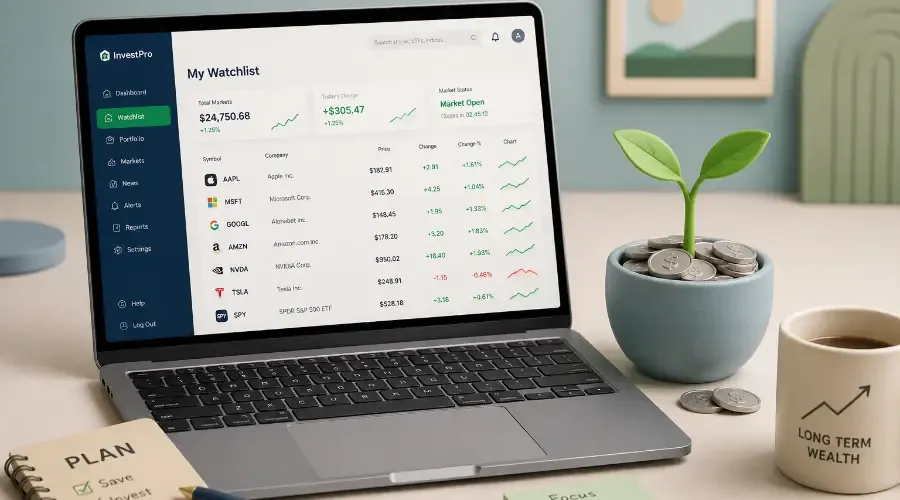
Watchlists are the most immediately useful tool. Create themed lists – companies in sectors you understand, businesses you use regularly, ETFs you're considering – and add tickers before researching. The watchlist becomes your research queue. Most platforms allow multiple lists; building separate lists by category (Technology, Consumer Brands, Index Funds, Learning) keeps the queue organized.
Price alerts are the second-highest-value setup item. A price alert notifies you when a stock reaches a specific level – either a price you're targeting for purchase, or a level that would change your view of a position you hold. Most brokerage apps and financial platforms (Yahoo Finance, Google Finance) support price alerts. Setting them eliminates the need to check prices repeatedly and removes reactivity from the monitoring process.
Mobile app setup extends your access beyond a desktop. Most brokers offer iOS and Android apps with full feature parity for standard account functions. Two things to configure immediately on mobile: biometric login (fingerprint or Face ID reduces the friction of checking your account) and push notifications for order fills and price alerts. Turn off general market news notifications unless you've determined that reading them regularly adds value to your decisions – for most investors it doesn't.
Two-factor authentication (2FA) is non-negotiable. Your brokerage account holds real money, which makes it a target. 2FA requires a second verification step beyond your password – typically a code sent to your phone. Every major broker offers it. Enable it during account setup, not after.
Stock screeners filter the universe of 5,000-plus U.S. listed stocks by criteria you set – sector, market capitalization, price range, trading volume. They're most useful when you have a general idea of what you're looking for but don't know which specific companies to research. Basic filters available free at Finviz, Yahoo Finance, and most brokerage platforms handle most beginner research needs adequately.
Reading What You're Looking At
Once the account is set up and funded, you'll be looking at numbers. Understanding what they represent is the practical precondition to making any investment decision.
Stock Quotes
A stock quote displays a set of data points about a security at a specific moment. The key ones for beginners:
Last price is the price at which the most recent trade executed. It's the number everyone calls "the stock price."
Change and % change show the difference between the current price and the previous day's close – in dollars and percentage terms. The percentage is the more meaningful number; a $5 move on a $10 stock is 50%. The same $5 move on a $500 stock is 1%.
Volume measures how many shares have traded so far today. Average daily volume tells you how many typically trade. Volume well above average on a price move suggests conviction behind the move; volume well below average on a move suggests it may be thin-market noise.
52-week high and low provide context for the current price. A stock at $45 with a 52-week range of $42 to $88 is trading near its low. The same stock at $45 with a range of $44 to $48 is trading near its high. The range doesn't tell you what to do, but it provides context the current price alone doesn't.
Market cap tells you company size – far more informative than share price alone. Apple at $180 per share is a $2.7 trillion company. A stock at $5 per share might be a $10 billion company or a $50 million company, depending on shares outstanding.
Order Confirmations
An order confirmation is your legal record that a trade executed. It contains: the security name and ticker, the number of shares filled, the price per share, the total transaction amount, and the time of execution.
Checking the confirmation against your intended order is the single most important post-trade step. Errors – wrong quantity, wrong ticker, unexpected price – are far easier to address within minutes of execution than hours or days later.
Account Statements
Your monthly account statement is the comprehensive view of your portfolio's activity and current status. The key sections: opening balance, deposits and withdrawals, trades executed during the period, dividends received, ending balance, and current holdings with their market values.
The figure most beginners react to incorrectly is the gain/loss number. This shows unrealized gains and losses – changes in the market value of positions you still hold. An unrealized loss is not a realized loss. Selling converts an unrealized number into a real one. Holding through short-term fluctuations is generally the rational response when the investment thesis is intact.
Managing Your Account Over Time
Unrealized vs. Realized Gains
An unrealized gain is a paper profit. You bought a stock at $40; it's now at $60. On paper, you've made $20 per share. That gain isn't taxable and isn't yours until you sell.
A realized gain is the profit from an actual sale. You sell at $60 having bought at $40: $20 per share in realized gain. This is now taxable.
The distinction matters for two reasons. First, counting unrealized gains as available money leads to overspending and forced sales. Second, realized gains trigger tax events; understanding when you'll have taxable gains allows you to plan for them.
Tax Basics
When you sell a stock for more than you paid, you owe capital gains tax on the profit. The rate depends on your holding period:
Short-term capital gains apply to positions held less than one year. These are taxed at your ordinary income tax rate – the same rate as wages.
Long-term capital gains apply to positions held more than one year. The rate is 0%, 15%, or 20% depending on your income. For most investors in their 20s, the rate is 0% or 15%.
The practical implication: holding a profitable position for at least one year before selling typically results in a meaningfully lower tax bill on the same gain.
Your broker issues a 1099-B form annually showing all realized transactions from the tax year. This document is what you (or a tax preparer) use to complete your tax filing.
Account Security
Your brokerage account requires the same deliberate security hygiene as your bank account.
Use a unique password – not reused from email, social media, or any other service. Password reuse is the single most common vector for brokerage account compromise. A compromised gaming site database containing your email and shared password becomes access to your investment account.
Enable 2FA. The incremental friction (entering a code) is trivially small compared to the protection it provides.
Recognize phishing. Your broker will never email you asking for your login credentials. Unsolicited links to "verify your account" or "confirm a suspicious transaction" go to fraudulent sites designed to capture your password. Go directly to your broker's website – type the address, don't click links.
Review your account activity regularly. Weekly review of transaction history takes two minutes and catches unauthorized activity before it compounds.
FDIC and SIPC Insurance
Cash held in your brokerage account is protected by SIPC (Securities Investor Protection Corporation) up to $250,000. Securities (stocks, ETFs, bonds) in your brokerage account are protected by SIPC up to $500,000 total, in the event of broker failure.
SIPC does not protect against investment losses – it only covers the scenario where your broker fails and assets go missing. If your stocks decline in value, SIPC is not relevant.
Cash in FDIC-insured bank accounts is protected up to $250,000 per depositor per institution.
Advanced Account Considerations
Transferring Between Brokers
If you start with one broker and want to move to another – for better tools, lower fees, or expanded research – the ACATS (Automated Customer Account Transfer Service) process moves your securities without requiring you to sell.
You initiate the transfer at the receiving broker, not the departing one. The receiving broker requests your assets from the current broker. Most transfers complete in 5 to 7 business days. Critically, the transfer preserves your cost basis and holding periods – meaning your tax situation is identical after the transfer as before.
Selling at the old broker and rebuying at the new one triggers tax events on any gains and resets your holding periods. ACATS avoids both.
Margin Account Risks
Leverage amplifies outcomes in both directions. A 2:1 margin ratio on a 30% decline doesn't produce a 30% loss – it produces a 60% loss on your actual capital, plus interest on the borrowed amount.
Margin calls occur when your account equity falls below the broker's maintenance margin requirement – typically 25 to 30% of the total position value. At that point, you must either deposit additional funds or the broker liquidates positions to restore the required ratio, without waiting for your input.
Margin is an advanced tool. Its role in a beginner's account is limited to understanding why you're being asked to choose between cash and margin during account opening – and why the correct default answer is cash.
Options Accounts
Options are contracts that grant the right to buy or sell a stock at a specific price by a specific date. They require separate approval from your broker, granted in levels based on stated experience and financial situation.
Brokers structure this as Level 1 through Level 4 (or 5, depending on the platform), with each level permitting more complex and more risk-intensive strategies. Level 2 – which permits buying calls and puts outright – is available to most applicants, but that accessibility doesn't reflect the actual risk. Options bought outright can expire worthless, producing a 100% loss on the premium paid.
Options are not appropriate for investors who haven't first demonstrated consistent, profitable decision-making in standard equity investing.
International Accounts and Crypto
Most U.S. investors seeking international equity exposure don't need a special international account. International ETFs – funds like VXUS (Vanguard Total International Stock ETF) or EFA (iShares MSCI EAFE ETF) – provide broad exposure to non-U.S. equities through a standard U.S. brokerage account at low cost. Direct trading on foreign exchanges introduces currency conversion fees, foreign tax withholding complexities, and timing differences that ETF structures handle automatically.
Cryptocurrency exchanges are not brokerage accounts and are not covered by SIPC. Most major platforms require users to be 18 or older. Cryptocurrency carries extreme price volatility, limited regulatory oversight, and significant fraud risk – rug pulls, exchange failures, and scams are documented and frequent. For investors under 25 building their first portfolio, the asymmetric risk profile of cryptocurrency relative to diversified equity index funds makes the latter the structurally more appropriate starting point.
The Practical Starting Sequence
The order matters. Each step enables the next.
Step 1: Choose a broker with zero minimums, commission-free stock trading, fractional shares, and strong mobile app support. Fidelity and Schwab satisfy all four criteria.
Step 2: Select the account type. Cash account for standard taxable investing. Roth IRA if you have earned income and want the tax-free growth advantage. Both is an option – many investors maintain a Roth IRA alongside a standard taxable account.
Step 3: Complete account verification. Have your government ID, SSN, and proof of address ready before starting the application.
Step 4: Fund via ACH from your bank. Start the micro-deposit verification during account setup to avoid delays at funding time.
Step 5: Set up the platform. Configure watchlists, enable 2FA, install the mobile app, set your first price alerts.
Step 6: Practice before committing real capital. Most major platforms offer paper trading (virtual money) or demo environments. Use them to practice placing orders, reading quotes, and navigating the platform without financial consequence.
Step 7: Place your first trade when you understand what you're buying and why. A single ETF position in a broad market index fund is a structurally sound first investment – one transaction, immediate diversification, low cost.
This content is for educational purposes only and does not constitute investment, legal, or tax advice. Investing in securities involves risk, including possible loss of principal. Always conduct your own research and consult a licensed financial professional before making investment decisions.