
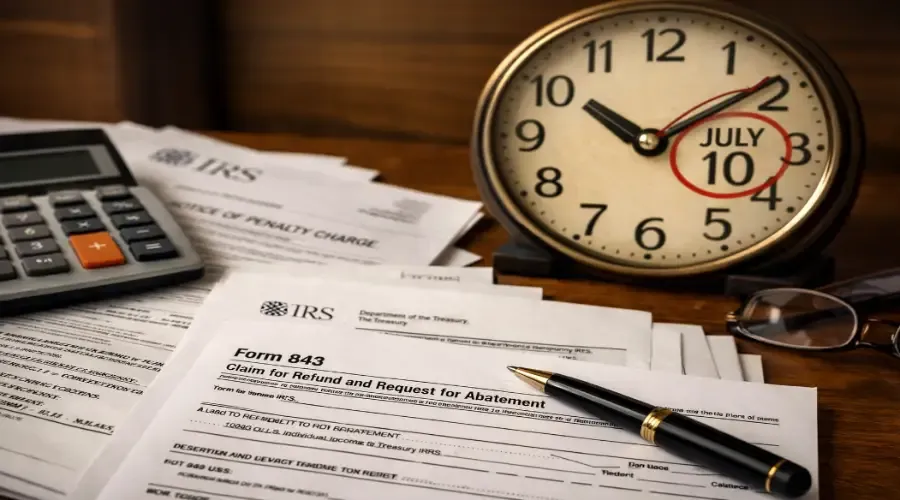
A November 2025 federal court ruling held that the IRS unlawfully assessed penalties and interest during the COVID disaster period. If you or your business paid those charges, you may have a claim — and the window to file it closes July 10, 2026.
Published: March 2026 · Investor Alert · Always consult a qualified CPA or tax attorney before filing any claim · breakoutbulletin.com
IMPORTANT: READ BEFORE PROCEEDING
This article is educational commentary only. It is NOT tax advice, legal advice, or a recommendation to file any claim.
The Kwong v. United States ruling is being appealed by the IRS. Outcome is not guaranteed. Claims may be disallowed.
Every taxpayer's situation is different. The rules around IRC §7508A, eligibility periods, and claim procedures are complex.
You MUST consult a qualified CPA, enrolled agent, or tax attorney before filing Form 843 or making any claim based on this ruling.
BreakoutBulletin is a financial education platform. Nothing in this article constitutes professional tax or legal advice.
Key Timeline
January 20, 2020 - Suspension Period Begins (COVID national emergency declaration)
July 10, 2023 - Suspension Period Ends (per Kwong analysis)
Failure-to-File Penalty - 5% per month (max 25%)
July 10, 2026 - Protective Claim Deadline (approximate - verify with your CPA)
What the Kwong Ruling Actually Said
On November 25, 2025, the United States Court of Federal Claims issued a ruling in Kwong v. United States that directly challenged IRS enforcement practice during the COVID-19 disaster period. The ruling is narrow, specific, and legally consequential - but also contested.
The case turned on a single provision of the tax code: Internal Revenue Code Section 7508A, which grants the Treasury Secretary authority to postpone certain time-sensitive tax actions when a presidentially declared disaster is in effect. The IRS had been treating §7508A as discretionary - meaning it could choose when and whether to apply its deadline-suspension authority. The Court of Federal Claims disagreed.
Judge Eleni Roumel's ruling held that §7508A automatically suspended tax deadlines for the period of the COVID-19 disaster declaration - January 20, 2020 through July 10, 2023. The word "automatically" is the operative legal distinction. If the suspension was automatic and mandatory, then any penalties or interest assessed by the IRS during that period for failure-to-file or failure-to-pay violations were assessed without legal authority.
The practical consequence: taxpayers who paid those penalties or had overpayments applied against them may be entitled to refunds. The IRS, which had issued guidance treating the suspension as limited and discretionary, was found to have exceeded its authority in assessing penalties that the statute prohibited.
The court did not say the IRS made a procedural error. It said the IRS assessed penalties it was legally prohibited from assessing at all during the declared disaster period. That is a meaningfully stronger legal basis for refund claims than a standard abatement request.
Critical caveat: the IRS has appealed this ruling. It is not final law. The appeal introduces genuine legal uncertainty about whether the Kwong interpretation will survive appellate review. Filing a "protective" claim now - before the deadline - preserves your right to benefit if the ruling is ultimately upheld, without requiring you to predict the appeal's outcome.
The Penalty Mechanics - What Was Being Assessed and How Much
To understand the potential refund scope, it helps to understand what the IRS was assessing during the 2020–2023 period and at what rates. Two primary penalties are at issue.
Failure-to-File (FTF): 5% per month (or partial month), capped at 25% of unpaid tax, applied to returns not filed by deadline.
Failure-to-Pay (FTP): 0.5% per month, capped at 25% of unpaid tax, applied to unpaid tax balances.
Underpayment Interest: Federal funds rate + 3%, compounds daily, no cap, applied to unpaid balances.
Combined FTF + FTP: Up to 5% per month combined, reduced to 4.5% FTF when both apply, capped at 25%.
For a business that owed $100,000 in tax and filed and paid six months late during the COVID period, the failure-to-file penalty alone would have reached $30,000 (6 months × 5%), capped at $25,000. Add the failure-to-pay penalty ($3,000 at 0.5% × 6 months) and underpayment interest (approximately $3,000–$5,000 depending on rates), and the total penalty load could have exceeded $30,000.
Multiply this across the three-year COVID period and across the population of taxpayers affected, and the total potential refunds run into the billions.
Who May Be Eligible - And the Honest Caveats
Potentially eligible scenarios include businesses that filed late during January 2020 – July 2023 and paid penalties, individuals who paid late payment penalties, taxpayers whose refunds were adjusted against penalties, entities in installment agreements with penalties accruing during this period, businesses under audit with penalty assessments tied to this window, and taxpayers who received IRS notices such as CP2000, CP14, CP501, or CP503 during the period.
Less likely to qualify are penalties assessed before January 20, 2020 or after July 10, 2023, penalties already refunded, fraud-related penalties, and cases where delays were unrelated to COVID.
Eligibility is not automatic. Each case requires individual evaluation, and outcomes may vary depending on IRS review and the appeal outcome.
How to File a Protective Claim - The Form 843 Process
A "protective" claim preserves your right to a refund before the deadline, even if the legal outcome is uncertain.
Step 1: Obtain IRS account transcripts for 2020–2023 showing all penalties and interest.
Step 2: Calculate the claim amount by identifying penalties, interest, and payment details for each tax period.
Step 3: Prepare Form 843 (Claim for Refund and Request for Abatement), referencing Kwong v. United States and IRC §7508A, and attach supporting documents.
Step 4: File the form with the appropriate IRS Service Center and keep proof of submission. The IRS has six months to respond.
The deadline to file is approximately July 10, 2026, but this should be confirmed with a tax professional.
The Risks - What Could Go Wrong
The IRS appeal could overturn the ruling, meaning claims may be denied. The IRS may also reject claims during the appeal process. Filing errors can result in procedural rejection. Miscalculating the deadline could permanently eliminate eligibility. State tax rules may not follow the same logic as federal rules.
These risks make professional guidance essential.
The Market Angle - What Aggregate Refunds Mean for Capital
If upheld, refunds could return capital to small businesses and individuals. Small businesses, in particular, may benefit from improved liquidity, which historically correlates with performance in small-cap equities. Consumer spending may also increase gradually as refunds are distributed.
Tax preparation and advisory firms may see increased demand due to claim filings.
However, the overall market impact is uncertain, slow-moving, and not suitable as a short-term trading catalyst.
Quick Reference - Key Facts
Ruling: Kwong v. United States (Nov. 25, 2025)
Legal basis: IRC §7508A - automatic suspension of deadlines
Period covered: Jan 20, 2020 - July 10, 2023
Penalties involved: Failure-to-file, failure-to-pay, interest
Claim form: Form 843 (one per tax period)
Deadline: Approx. July 10, 2026
Status: IRS appeal pending
Documents needed: IRS transcripts, payment records
Professional help: Strongly recommended
What to Do Right Now
Download Form 843 from irs.gov/forms.
Request your IRS transcripts from irs.gov/account.
Identify penalties and interest from 2020-2023.
Consult a CPA or tax professional before filing.
FULL DISCLAIMER - PLEASE READ
This article is published by BreakoutBulletin for educational and informational purposes only. It does NOT constitute tax advice, legal advice, accounting advice, or a recommendation to take any action regarding your tax situation. The Kwong ruling is currently on appeal and is not final. Tax law is highly fact-specific and outcomes depend on individual circumstances. You must consult a qualified CPA, enrolled agent, or tax attorney before filing any claim. BreakoutBulletin is not a CPA firm, law firm, or registered advisor. Nothing in this article creates a professional relationship.
© 2026 BreakoutBulletin | breakoutbulletin.com | All rights reserved