
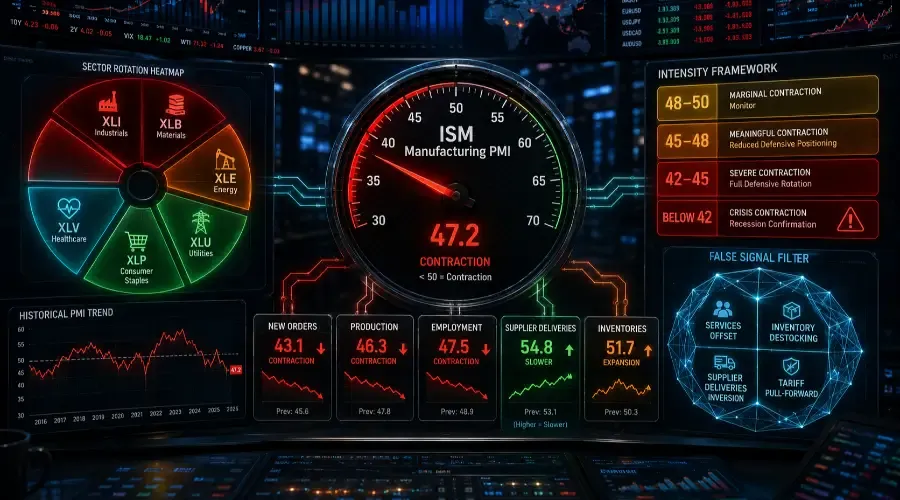
Few economic releases move markets as reliably as the ISM Manufacturing PMI. When the index slips below 50, headlines scream recession risk – but the real trade is far more nuanced. This guide breaks down exactly how to read the sub-components, screen for false signals, and position for sector rotation using the ISM PMI trading strategy that institutional desks actually run.
Reuters documented it on January 5, 2026: the US factory sector slumped to a 14-month low as 2025 ended, according to the Institute for Supply Management's monthly report. The Manufacturer had been tracking how tariff uncertainty was specifically dampening demand and sending the PMI into contraction territory. Haver Analytics published research on what ISM readings below 50 historically mean for economic conditions. Investopedia defines the ISM manufacturing index and its components. Trading Economics tracks it in real time. What none of these sources convert is the sub-50 ISM reading into a sector winners-and-losers framework with timing – because the headline number is the least useful part of the ISM report. The real signal is in five sub-components that each have different lead times, different sector implications, and a false signal filter that has kept investors from panicking unnecessarily through twenty-three consecutive months of below-50 readings that never became a recession.
Why This Matters More Than Most Traders Realize
The ISM Manufacturing PMI is released on the first business day of every month – making it the first major economic data point of each new month, published before NFP, before CPI, and before retail sales. Its release at 10am ET on the first business day gives it the highest information value per calendar position of any economic indicator: it is always the first piece of hard economic data from the prior month.
The index is constructed from a monthly survey of purchasing managers at manufacturing companies – the procurement officers who are literally placing orders for raw materials, components, and supplies. A reading above 50 indicates that more purchasing managers are seeing expanding activity than contracting activity. A reading below 50 indicates the opposite. The threshold is not arbitrary: it represents the boundary between expansion and contraction in the manufacturing sector with a historical accuracy that has made it one of the most closely watched monthly indicators in the Federal Reserve's analysis.
The quantitative context frames the stakes. Manufacturing represents approximately 11% of US GDP and about 8% of employment – smaller than services by a wide margin. But manufacturing's significance as a sector early-warning indicator exceeds its GDP share for three reasons: it is more cyclically sensitive than services, it drives capital goods investment across the broader economy, and its supply chains connect it to every other sector. When manufacturing contracts, the signal propagates through industrials, materials, transportation, and eventually consumer and technology sectors with predictable timing.
What the strongest competing analyses miss is the analytical framework for the five sub-components that make the headline ISM reading useful rather than simply directional. Reuters documented the headline number. The sector-by-sector rotation framework that the headline number implies – and the sub-component analysis that determines whether that rotation is warranted – is the gap this post fills. [LINK: Macro Events Hub]
What This Is Really Saying: The Purchasing Manager Intelligence Reframe
The ISM Manufacturing PMI is built directly from the experience of purchasing officers at manufacturing companies – people who are making real-money decisions about inventory levels, supplier orders, and production schedules right now. That’s what makes it so different from a typical government stat. It’s neither a market price (like copper or Treasury yields) nor a lagging official report. It’s a live intelligence briefing from the factory floor.
The forward-looking reframe works like this: when the ISM PMI drops below 50, purchasing managers are telling you they’ve already started reducing orders, cutting production, and trimming employment – not because they think things might slow down, but because conditions have already weakened enough to force their hand this month. For equity investors, the key point is that the revenue bite from these decisions is still traveling through the supply chain and hasn’t shown up in earnings yet.
Each of the five sub-components tells a different part of that forward story:
New Orders (the most important gauge, roughly a 1–3 month lead on production):
This is the most forward-looking component because orders placed today become production activity over the coming months. When New Orders falls below 45 – well into contraction – future production is being cut and the headline ISM will likely keep deteriorating. When New Orders recovers above 50 while the headline is still below 50, the production recovery is approaching even if current conditions remain weak. Understanding ISM New Orders vs headline PMI is the foundation of everything that follows.
Production (current activity):
Measures what factories are actually making this month – less forward-looking than New Orders, more representative of current economic activity. A production index below 45 signals genuine output cuts.
Employment (lags behind production, roughly a 1–2 month delay):
Manufacturing companies reduce headcount after they reduce production, not at the same time. A falling Employment sub-index tells you that the production weakness documented in prior months was severe enough to require workforce adjustment.
Supplier Deliveries (requires inverted interpretation):
Longer supplier delivery times – a higher number in the Supplier Deliveries sub-index – historically indicate MORE demand pressure, not less: factories are so busy they’re taking longer to fill orders. A rising Supplier Deliveries index while New Orders is rising is a clean demand surge signal. A rising Supplier Deliveries index while New Orders is falling is a supply disruption signal. Understanding this inversion is the most counter-intuitive element of ISM analysis and the source of significant false signals.
Inventories (determines whether the ISM weakness is structural or adjusting):
Rising inventories alongside falling New Orders signal a demand collapse – the company is piling up unsold goods. Falling inventories alongside falling New Orders signal voluntary destocking – companies are deliberately reducing stockpiles and will need to rebuild them once destocking is complete.
One extra dial to watch: the Prices Paid sub-index (not used in the headline PMI calculation) captures what purchasing managers are paying for inputs. While this piece focuses on the activity components, soaring Prices Paid readings can complicate the rate-cut-expectation channel – the Fed may hesitate to ease if cost pressures are building even as activity softens. It’s a useful cross-check for the XLU/rate-cut thesis we’ll cover later.
The Lead/Lag Map: What Sub-50 ISM Predicts and When
All timing estimates below are historical central tendencies, not fixed rules. Lead/lags can widen or compress dramatically depending on concurrent shocks, policy responses, and global demand. Treat them as rough sequencing guides, not precise trade triggers.
Immediately on the release (first business day of the month):
The ISM New Orders sub-component determines the severity assessment. New Orders below 45 warrants defensive XLI positioning. New Orders between 48 and 50 warrants monitored watch position. The ISM Services PMI release – published a few days later – is the confirmation check that determines whether manufacturing weakness is economy-wide or sector-specific.
1–3 months forward (typical, not guaranteed):
Production volumes tend to align with the New Orders signal received in the current ISM. XLI capital goods companies may begin guiding lower on revenue. Supply chain partners (packaging, transport, materials suppliers) could see order reductions arriving. XLB industrial metals demand often begins falling.
3–6 months forward (typical):
Employment index usually catches up to production weakness – companies begin reducing headcount. XLI companies with high manufacturing exposure may start reporting earnings misses. XLE industrial energy consumption could fall as factory output declines. XLF regional banks with manufacturing-concentrated geographic exposure might begin increasing provisioning on commercial and industrial loans.
6–12 months forward (typical):
If the ISM has been below 48 for six or more consecutive months, the consumer economy can begin absorbing the employment and income effects of manufacturing sector weakness. XLY may feel the income effect from manufacturing employment reductions. XLC advertising budgets may be reduced by consumer goods manufacturers facing volume declines. The Fed response – rate cuts in response to manufacturing-driven growth deceleration – could begin producing XLRE and XLU recovery as the easing cycle gains visibility.
Important caveat: This entire transmission chain assumes the rest of the economic environment is cooperating. A simultaneous commodity supply shock, a sudden fiscal expansion, or a global trade war can override some or all of these typical sequences. Never trade the ISM in isolation.
The Intensity Framework: How Far Below 50 Determines the Trade
This is the analytical contribution most absent from competing ISM analysis – and it is the variable that determines whether a sub-50 reading warrants repositioning or simply monitoring.
ISM 48–50 (Marginal Contraction – Monitor, Not Act):
The manufacturing sector is barely contracting. A reading in this range is statistically within the margin of survey sampling variation. Historical analysis shows that ISM readings between 48 and 50 have been associated with positive GDP growth approximately 55% of the time – meaning this range provides less than 50/50 recession signal value. The appropriate response: note the reading, check the New Orders sub-component, and wait for a second consecutive sub-48 reading before adjusting sector allocation. Reuters' January 2026 report on a 14-month low would need to be evaluated against this threshold.
ISM 45–48 (Meaningful Contraction – Apply Reduced Defensive Positioning):
Factory activity is clearly contracting. At this level, XLI underperformance over the following two quarters is historically reliable – approximately 75% of sub-45 ISM readings have been followed by XLI underperforming SPY over the next two quarters. Full defensive rotation (XLU, XLP) is not yet warranted because services sector strength can offset manufacturing weakness. The appropriate response: reduce XLI and XLB to below-benchmark weight, add XLU modestly, wait for ISM Services confirmation before applying broader defensive positioning.
ISM 42–45 (Severe Contraction – Full Defensive Rotation):
At this level, manufacturing weakness is deep enough that the services sector buffer is strained. XLI, XLB, and XLE all face meaningful underperformance. Credit market concerns begin building in XLF. XLRE faces competing forces (rate-cut positive versus industrial real estate demand negative). The appropriate response: underweight XLI, XLB, and XLE significantly; overweight XLU and XLP; reduce XLF to below-benchmark weight.
ISM Below 42 (Crisis Contraction – Recession Confirmation):
Below 42, the historical record shows near-universal recession coincidence. ISM Manufacturing at 40.0 or below has never failed to coincide with an NBER-declared recession. The 2008 crisis low was 34.5. The COVID low was 41.5. At this level, the full recession defensive playbook applies – maximum XLU, XLP, and XLV overweight; maximum XLI, XLB, XLE, and XLF underweight.
Sector Rotation Sequence: Who Moves and In What Order
All magnitude estimates below are historical averages. Actual sector moves can deviate significantly due to valuation starting points, Fed policy paths, and idiosyncratic sector events.
Industrials (XLI) – Significant Negative – Immediate.
XLI is the direct primary victim of sub-50 ISM Manufacturing. Capital goods manufacturers (Caterpillar, Deere), industrial machinery producers, and commercial transportation companies all see revenue expectations revised lower when the ISM signals production cuts. The New Orders sub-index determines the magnitude: sub-45 New Orders produces the most immediate and most severe XLI estimate revisions. Historically, XLI has tended to underperform SPY by a meaningful margin over two quarters when ISM is below 48 for two consecutive months, with the most acute underperformance concentrated in capital goods and industrial machinery names.
Materials (XLB) – Significant Negative – Immediate to 1–3 Months.
Manufacturing companies are XLB's largest customers. When manufacturing activity contracts, materials demand contracts with it. The XLB reaction to sub-50 ISM is both immediate (commodity price compression as demand falls) and sustained (order book reductions working through the supply chain over one to two quarters). The intensity framework applies: ISM below 45 produces the most reliable and most sustained XLB underperformance.
Energy (XLE) – Moderate Negative – 1–3 Months.
Industrial energy consumption falls when manufacturing output contracts. XLE faces the demand destruction channel from ISM weakness with a one to two quarter lag as actual production cuts translate into reduced energy orders. This XLE headwind is the most intensity-dependent in the scorecard: marginal ISM weakness (48–50) produces minimal XLE impact, while severe weakness (below 45) produces meaningful demand destruction.
Financials (XLF) – Moderate Negative – 1–3 Months.
Regional banks with high manufacturing-sector concentration face rising commercial and industrial loan credit risk when ISM signals sustained manufacturing contraction. The XLF impact from ISM weakness is the most geographically concentrated sector impact: national XLF is mildly affected, but regional banks in manufacturing-heavy states face more significant credit quality concerns.
Technology (XLK) – Mild Negative – 1–3 Months.
Capital expenditure in manufacturing correlates directly with manufacturing activity levels. When ISM contracts, CFOs at manufacturing companies defer or cancel equipment purchases – including industrial automation, robotics, and manufacturing technology software. Enterprise technology vendors that serve the manufacturing sector see order flow reduction with a one to two quarter lag. Consumer-facing XLK names are less directly affected. Expect relative underperformance concentrated in industrial technology and automation names within XLK, typically modest in magnitude.
Consumer Discretionary (XLY) – Mild Negative – 3–9 Months.
Manufacturing employment faces headcount reductions when ISM remains below 48 for three or more consecutive months. The income effect from manufacturing workforce reduction feeds into consumer spending with a lag. Additionally, the confidence effect – news of manufacturing sector weakness reducing consumer economic optimism – can affect spending before the actual employment impact arrives. The XLY impact is real but lagged and highly dependent on the depth and duration of the sub-50 reading.
Real Estate (XLRE) – Mixed – 1–3 Months.
Industrial and warehouse real estate faces occupancy headwinds within two to three quarters of a sustained sub-45 ISM. However, the rate-cut expectation channel (ISM weakness → Fed dovish → lower rates → XLRE discount rates fall) creates a partial offset. The net XLRE signal from ISM weakness is approximately neutral to mildly negative, with the industrial REIT sub-sector facing more significant headwinds.
Utilities (XLU) – Moderate Positive Relative – Immediate.
The rate-cut expectation channel and defensive rotation both support XLU when ISM falls below 50. Defensive capital rotates from XLI and XLB toward yield-generating defensive assets. Historically, XLU has seen low-single-digit relative outperformance over two quarters when ISM is below 48 for two or more consecutive months. Note: if the ISM Prices Paid index is simultaneously spiking, the rate-cut thesis may weaken, blunting this tailwind.
Consumer Staples (XLP) – Mild Positive Relative – Immediate.
Defensive rotation from cyclical manufacturing-exposed sectors toward XLP accompanies ISM weakness. The magnitude is modest because ISM manufacturing weakness does not directly threaten XLP revenue. Historically, XLP has delivered a small relative outperformance cushion as capital rotates defensively.
Communication Services (XLC) – Mild Negative – 3–9 Months.
Manufacturing companies represent a meaningful segment of corporate advertising budgets. When manufacturing revenues decline and earnings miss, marketing and advertising budgets are among the first corporate costs reduced. XLC faces advertising revenue headwinds with a lag after significant ISM weakness. The magnitude is mild in the near term and more significant if the ISM weakness sustains and spreads to the broader economy.
Healthcare (XLV) – Mild Positive Relative – 1–3 Months.
Inelastic healthcare demand and defensive characteristics provide relative shelter when ISM signals manufacturing contraction. The positive is relative rather than absolute – capital rotating away from XLI and XLB may find partial destination in XLV alongside XLU and XLP.
Historical Cases That Confirm the Pattern – Focus on the Early Signal
2001–2002 | ISM Reached 42.0 – The Definitive Recession Confirmation
ISM Manufacturing fell below 50 in September 2000 – four months before the NBER officially dated the start of the 2001 recession. By January 2001, ISM had reached 42.0. The New Orders sub-component had been below 48 since October 2000 – the early warning that the headline decline was confirmed and deepening. XLI capital goods companies began guiding lower in Q4 2000 earnings calls, one full quarter before recession was officially recognised. The 10-year Treasury yield fell 100+ basis points from October 2000 to March 2001 as the Fed responded – producing the XLRE and XLU rate-cut benefit alongside the XLI and XLB demand destruction. The case confirms that ISM New Orders leads the headline ISM by one to two months, which leads corporate guidance by one to two quarters, which leads NBER recession dating by several quarters. Lag window: ISM New Orders fell below 48 in October 2000; ISM headline below 50 September 2000; XLI underperformance began Q4 2000; NBER recession started March 2001.
2015–2016 | 23 Consecutive Months Below 50 Without Recession – The Services Offset Case
This is the definitive false signal case for ISM Manufacturing sub-50 readings – and the most important historical lesson for any investor who treats ISM below 50 as automatically bearish for the broad market. ISM Manufacturing fell below 50 in November 2015 and remained below 50 for twenty-three consecutive months through September 2017. Yet the United States did not enter a recession. GDP growth was positive throughout. Employment continued expanding. The reason: ISM Manufacturing was signalling genuine contraction in the manufacturing sector – driven by the collapse in oil sector capital investment and the strong dollar – while the services sector (89% of GDP) remained healthy. ISM Services stayed above 53 throughout the entire period, offsetting the manufacturing drag. XLI and XLB underperformed as the ISM signal correctly predicted. But XLP, XLU, XLV, and broad market consumer spending held up because the contraction was sector-specific, not economy-wide. Lag window: XLI and XLB underperformed for the full 23-month period; XLU and XLP outperformed; broad S&P 500 was approximately flat over the same period – confirming the services offset prevented broad market damage.
2022–2024 | 16 Consecutive Months Below 50 – The Tariff and Inventory Distortion
ISM Manufacturing fell below 50 in November 2022 and stayed below 50 for sixteen consecutive months through April 2024. The episode was driven by post-COVID inventory destocking (companies working through elevated pandemic-era stockpiles) and then by tariff uncertainty affecting capital goods purchasing decisions. The Inventories sub-component was elevated in early 2023 – falling New Orders alongside high inventories, the classic destocking pattern. The correct analytical response: treat destocking-driven ISM weakness as temporary (inventories normalise within two to four quarters) rather than applying maximum defensive positioning. XLI underperformed in the immediate months of sub-50 ISM, but the recovery was faster than 2001 or 2015 because the underlying demand was intact. Lag window: XLI underperformed initially; recovery began when Inventories sub-component normalised and New Orders began recovering.
The False Signal Trap: When to Ignore Sub-50 ISM
ISM Manufacturing sub-50 generates false signals in four documented scenarios.
Services Offset (Most Important Filter).
Manufacturing is 11% of US GDP. When ISM Services – released a few days after ISM Manufacturing each month – remains above 55 while ISM Manufacturing is below 50, the economy-wide signal is not recessionary. The filter: always wait for ISM Services before completing any sector rotation decision based on ISM Manufacturing. If ISM Services is above 55, apply only the manufacturing-specific sector underweights (XLI, XLB, XLE) and skip the broad defensive rotation.
Inventory Destocking False Signal.
When the ISM Inventories sub-component is elevated (above 50) while New Orders is falling, companies are deliberately reducing stockpiles rather than experiencing demand collapse. The filter: compare the ISM Inventories sub-index to the New Orders sub-index. Rising inventories + falling new orders = temporary destocking (lighter defensive positioning). Falling inventories + falling new orders = genuine demand collapse (full defensive positioning).
Supplier Deliveries Inversion Trap.
The Supplier Deliveries component contributes to the headline ISM in an inverted manner: LONGER delivery times (a higher number) actually contributes POSITIVELY to the ISM composite. During COVID, Supplier Deliveries surged while new orders were collapsing (supply disruption) – confusing investors who read the high Deliveries number as a demand surge. The filter: when Supplier Deliveries is high while New Orders is also high, it IS a demand surge signal. When Supplier Deliveries is high while New Orders is low or falling, it is a supply disruption signal – not a demand signal.
Tariff Pull-Forward Distortion.
Tariff uncertainty can cause companies to pull forward orders to beat anticipated tariff hikes, followed by months of depressed new orders after the pull-forward is complete. The filter: when ISM falls below 50 in the months following a period of unusually elevated ISM (above 55 for three or more months), the weakness may reflect pull-forward reversal rather than structural contraction.
The Minimum Confirmation Standard:
ISM below 48 (not just below 50) for two consecutive months
New Orders sub-component also below 48
ISM Services NOT above 55 simultaneously
Inventories sub-component NOT elevated (ruling out destocking)
When all four conditions are met, the sub-50 ISM warrants full sector defensive rotation.
The Trading Playbook
Before: What to Watch for Early Warning
Monitor the ISM New Orders sub-component as the leading indicator within the ISM report itself. When New Orders falls below 48 – even while the headline PMI is still above 50 – the headline deterioration is likely coming within one to two months. Access the full ISM sub-component table simultaneously with the headline at ismworld.org.
Track the Philly Fed Manufacturing Survey (published every third Thursday, free at philadelphiafed.org) as a two-week ISM preview. When the Philly Fed general business conditions index falls below -10 (deep contraction), the national ISM is likely to print below 47.
Watch the S&P Global US Manufacturing PMI (released a few days before the ISM each month). When S&P Global Manufacturing PMI falls below 48 in advance of the ISM release, the ISM is highly likely to also print below 50.
During: Positioning When ISM Prints Sub-50
Step 1 – Read the New Orders sub-component before making any sector decision.
New Orders determines whether the weakness will deepen (New Orders below 46) or is bottoming (New Orders above 48 and recovering). Maximum defensive positioning is only appropriate when New Orders is falling and is below 46.
Step 2 – Wait for ISM Services (released three to five business days after ISM Manufacturing).
If ISM Services is above 55, apply only the manufacturing-specific defensive rotation (XLI and XLB underweight) and skip the broad defensive positioning. If ISM Services is also below 52, apply full defensive rotation.
Step 3 – Check the Inventories sub-component for the destocking false signal.
If inventories are elevated (above 52) while New Orders is falling, wait for one additional month of data before applying full defensive positioning.
When full defensive rotation is warranted (all four confirmation criteria met):
Underweight XLI and XLB immediately. Add XLU for the rate-cut expectation channel. Reduce XLF regional bank exposure. Add XLP modestly for defensive rotation. Do not add XLRE immediately – the competing forces require one to two months of additional data to determine net direction.
After: The Recovery Signal
Watch for ISM New Orders recovering above 50 for two consecutive months as the recovery entry signal. New Orders recovering above 50 while the headline ISM is still below 50 historically precedes the headline recovery by one to two months – and it precedes XLI outperformance by roughly two to three months.
Monitor the Inventories-to-New Orders ratio for destocking completion. When inventories have fallen back below 48 while New Orders is recovering, the inventory correction is complete and production must accelerate to meet orders.
Rebuild XLI and XLB on the first ISM New Orders reading above 52 combined with S&P Global Manufacturing PMI above 51 – the dual confirmation that the recovery is confirmed across two independent manufacturing surveys.
The 3 Mistakes Most Retail Traders Make
Mistake 1: Treating Every Sub-50 ISM as a Recession Signal and Applying Broad Market Hedges
The most common ISM trading mistake is seeing "ISM below 50" in a headline and immediately building broad market hedges – reducing total equity exposure or dramatically increasing XLU and XLP at the expense of all cyclicals. The 2015–2016 case (twenty-three consecutive months below 50 without a recession) illustrates why this destroys return. Manufacturing-specific hedges (XLI and XLB underweights) are appropriate immediately. Broad market hedges require ISM Services confirmation.
Mistake 2: Ignoring the Supplier Deliveries Inversion
The second mistake is misreading the Supplier Deliveries sub-component. Rising deliveries alongside rising New Orders is a demand surge signal; rising deliveries alongside falling New Orders is a supply disruption signal. Investors who read the COVID-era Supplier Deliveries surge as universally positive missed the supply disruption warning.
Mistake 3: Trading the First Sub-50 ISM Without Waiting for New Orders Confirmation
A headline ISM that dips to 49.5 while New Orders remains at 52.0 is a one-month statistical fluctuation likely to reverse. A headline ISM at 49.5 with New Orders at 44.5 is a confirmed deepening contraction. Both produce the same headline number. Only one warrants sector rotation.
Bottom Line: The One-Sentence Institutional Framework
When ISM Manufacturing falls below 48 for two consecutive months with New Orders also below 48, immediately underweight XLI and XLB, wait three to five business days for ISM Services before applying broader defensive rotation (if ISM Services is above 55, skip the broad rotation and apply only the manufacturing-specific underweights), add XLU for the rate-cut channel, and use ISM New Orders recovering above 50 for two consecutive months as the signal to rebuild XLI and XLB positions.
This framework works across cycles because the New Orders sub-component is the most reliable one-to-three-month leading indicator available for manufacturing sector revenue – and manufacturing sector revenue drives capital goods, industrial materials, and manufacturing employment with documented and predictable timing. The ISM Services cross-check prevents the most expensive false positive in manufacturing indicator analysis, and the intensity threshold (below 48, not just below 50) prevents the high-frequency noise trades.
Quick Reference Checklist for Retail Traders
Print this or keep it handy for ISM day (first business day of each month, 10am ET).
🔴 Before the release:
Check Philly Fed (third Thursday prior): sub -10 warns of ISM <47.
Check S&P Global US Manufacturing PMI (a few days prior): sub 48 warns of ISM <50.
🟡 On ISM release morning:
Read New Orders first. <46 means deepening weakness; 48–50 means watch.
Check Supplier Deliveries vs. New Orders to avoid the inversion trap.
Note Inventories: high + falling Orders = destocking (temporary); low + falling Orders = demand collapse (severe).
🟢 A few days later, when ISM Services is out:
If Services >55: apply ONLY XLI and XLB underweights. No broad rotation.
If Services <52: prepare full defensive rotation if the four confirmation criteria are met.
🔵 Full defensive rotation checklist (all must be true):
ISM Manufacturing <48 for two consecutive months
New Orders <48
ISM Services not above 55
Inventories not elevated (not a destocking episode)
🔄 Recovery signal:
New Orders >50 for two consecutive months → start rebuilding XLI and XLB exposure.
Dual confirmation: S&P Global PMI also >51.
Remember: all lead times are approximate. Other major macro shocks (commodity spikes, fiscal changes, geopolitical crises) can override the ISM-driven playbook. Never trade the ISM in a vacuum.
Frequently Asked Questions
What does ISM Manufacturing PMI below 50 mean?
An ISM Manufacturing PMI reading below 50 means more purchasing managers are reporting contraction than expansion in manufacturing activity.
Is ISM below 50 always a recession signal?
No. Manufacturing represents a smaller portion of the US economy, and strong services activity can offset manufacturing weakness.
Why is the New Orders component important?
New Orders is the most forward-looking ISM component because it predicts future production activity and revenue trends.
What sectors are hurt most when ISM falls below 50?
Industrials (XLI), Materials (XLB), and Energy (XLE) are usually the most negatively affected sectors.
Which sectors benefit from ISM weakness?
Utilities (XLU), Consumer Staples (XLP), and Healthcare (XLV) often outperform due to defensive rotation and rate-cut expectations.
What is the ISM Services confirmation filter?
The ISM Services PMI helps determine whether manufacturing weakness is isolated or spreading across the broader economy.
Why are inventories important in ISM analysis?
High inventories with falling New Orders often signal temporary destocking rather than a true demand collapse.
What is the Supplier Deliveries inversion?
Longer supplier delivery times usually signal strong demand unless New Orders are falling simultaneously, which can indicate supply disruptions instead.
How do traders use ISM PMI data?
Traders watch New Orders, Services PMI, inventories, and intensity levels to position for sector rotation and economic slowdown risk.
What ISM level signals severe contraction?
ISM readings below 45 historically signal meaningful manufacturing stress, while readings below 42 often coincide with recession conditions.
Educational content only. Not investment advice. Past sector performance patterns do not guarantee future results.
In short, the ISM Manufacturing PMI below 50 is not a one-size-fits-all alarm. The real edge lies in dissecting New Orders, cross-checking ISM Services, filtering for inventory destocking false signals, and scaling sector rotation to the intensity of the contraction. Master those layers, and you’ll stop reacting to the headline and start trading what the purchasing managers are actually telling you.