
Opening an account and placing a first trade are the visible steps. The less visible work – reading your statement accurately, understanding what your gains actually are, knowing your tax obligations before they surprise you, and keeping your account secure – is what separates investors who build something over time from those who don't.
Reading a Stock Quote
A stock quote is a real-time data summary for a single security. The numbers are straightforward once you know what each one represents.
Last price is the price of the most recent trade. It's what most people mean when they say "the stock price" – though in fast-moving markets it can be stale within seconds.
Change and % change show the difference between the current price and the prior trading day's close. The percentage is always more meaningful than the dollar amount. A $3 move on a $15 stock is 20%. The same $3 move on a $300 stock is 1%.
Volume counts how many shares have traded so far today. Comparing today's volume to the average daily volume tells you whether trading activity is elevated (potential news or catalyst) or below normal (thin market, less reliable price signal).
52-week high and low frame the current price against its range over the past year. A stock at $42 with a 52-week range of $38 to $90 is near its annual low. Context without a decision rule – but context that the price alone doesn't provide.
Market cap is the company's total market value: price multiplied by shares outstanding. It tells you company size. A stock priced at $5 per share might belong to a $500 million company or a $50 billion company – per-share price alone reveals nothing about size.
P/E ratio (price-to-earnings) compares the stock price to annual earnings per share. A P/E of 25 means investors are paying $25 for every $1 of annual earnings. High P/E suggests growth expectations; low P/E may indicate value or pessimism about prospects.
Placing Your First Trade
Placing a trade involves four decisions: which security, how many shares (or what dollar amount for fractional), which order type, and how long the order remains active.
Order types that matter at the beginner level:
A market order executes immediately at the best available price. It guarantees execution but not price – on liquid stocks during normal market hours, the fill typically comes within pennies of the quoted price. During volatile sessions or at open (9:30 AM ET) and close (4:00 PM ET) when spreads widen, the gap between quoted and actual price can be larger.
A limit order executes only at your specified price or better. A buy limit at $47 on a stock trading at $50 only fills if the price reaches $47. It gives you price control at the cost of execution certainty – if the stock never reaches $47, the order sits unfilled.
The practical default: Use limit orders for any stock with a wide bid-ask spread, any trade placed outside regular market hours, or any larger position where a few cents of price improvement across many shares produces meaningful savings. Market orders are fine for liquid large-cap stocks during mid-session trading.
One note on fractional shares: some brokers restrict fractional-share orders to market orders or execute them at scheduled batch times rather than as real-time limit orders. Before placing your first fractional trade, confirm how your specific broker handles fractional execution so you aren't surprised by missing limit options.
| Order Type | Execution Speed | Price Certainty | When to Use It |
|---|---|---|---|
| Market Order | Instant | None (subject to slippage) | Liquid, large-cap stocks during mid-day trading hours |
| Limit Order | Conditional (only if price is met) | Yes (at limit price or better) | Volatile stocks, wide bid-ask spreads, or after-hours trading |
Verifying execution: After placing any order, confirm the execution details in your order history or through the order confirmation notification. Check ticker, quantity, and execution price against your intended order. Errors caught immediately are correctable; errors caught days later may not be.
Understanding Order Confirmations
An order confirmation is the legal record that a trade executed. It contains: the security name and ticker symbol, the number of shares filled, the price per share, the total transaction value, any fees charged, and the timestamp of execution.
The confirmation is not merely administrative. It's the document you use to verify the trade matched your intention and the one that feeds into your cost basis records for tax purposes.
What to check on every confirmation: correct ticker (not a similar-looking one), correct quantity (whole vs. fractional shares), execution price within a reasonable range of the market price at the time you placed the order, and correct direction (buy vs. sell). Trade errors – wrong ticker, wrong quantity – happen infrequently but do happen. The resolution process is straightforward when caught immediately and significantly more complicated when discovered weeks later.
Reading Your Account Statement
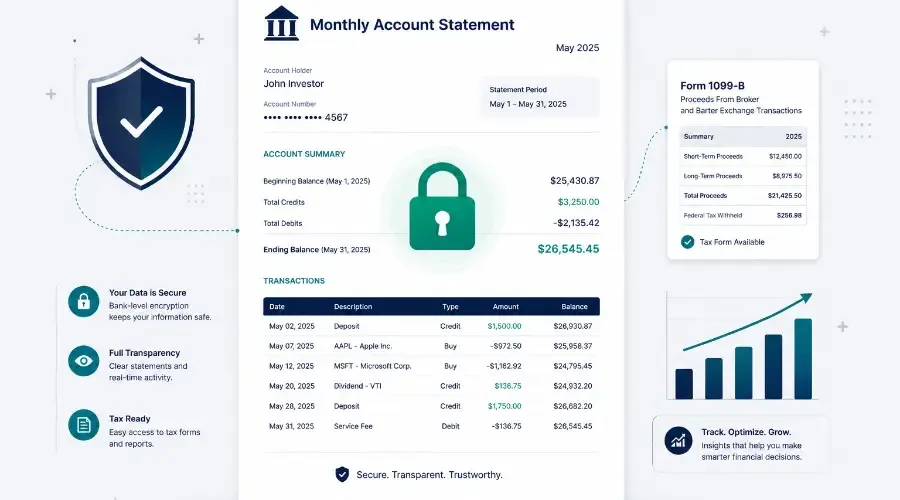
Your monthly account statement provides a comprehensive summary of your portfolio activity and current status. The key sections and what to look for in each:
Account summary: Opening balance, deposits and withdrawals, fees charged, ending balance. The difference between opening and ending balance reflects both market performance and cash flows (deposits and withdrawals). Don't conflate the two.
Transaction history: Every trade, dividend received, interest credited, and fee charged during the period, in chronological order. This is the complete audit trail.
Holdings summary: Each position you hold, showing quantity, cost basis per share, current price, current value, and unrealized gain or loss. This section is what most investors spend time on – and where most misreading occurs.
The unrealized gain/loss number: This shows how your positions' current market values compare to what you paid. A -$240 in the unrealized column does not mean you've lost $240. It means your positions are currently worth $240 less than you paid. That number changes every trading day and only converts to a realized loss when you sell.
Reviewing your statement monthly serves a specific purpose: verifying that every transaction listed was one you authorized, and that the account balance reflects the combination of your deposits, withdrawals, and market returns. It's an audit function, not an occasion for emotional response to unrealized numbers.
Unrealized vs. Realized Gains
This distinction is one of the most practically important in investing and one of the most commonly misunderstood.
Unrealized gain (or loss): The difference between your current position value and what you paid for it, while you still hold the shares. You bought 20 shares at $30 each ($600 total). They're now at $45 each ($900 total). Your unrealized gain is $300. It's a paper number – the market's current assessment, not money you can spend.
Realized gain (or loss): The profit or loss locked in when you sell. You sell those 20 shares at $45: $300 realized gain. Now it's real. It's taxable. It's yours.
The practical implications:
Unrealized gains can evaporate. A stock at $45 can return to $30 – and your $300 paper gain becomes zero – without any action required of you other than holding. Counting unrealized gains as available funds and spending accordingly creates a specific type of problem: forced selling at unfavorable times when the anticipated cash doesn't materialize.
Realized gains trigger tax events. Every sale of a position for more than its cost basis produces a taxable gain. Holding a profitable position for at least one year before selling converts a short-term gain (taxed at ordinary income rates) to a long-term gain (taxed at 0%, 15%, or 20% depending on income) – the same gain, meaningfully lower tax.
Tax Basics for Stock Investors
The tax rules for investment gains are straightforward once you understand two concepts: cost basis and holding period.
Cost basis is what you paid for shares, including any fees. If you bought 10 shares at $25 each, your cost basis is $250. When you sell those shares at $35, your taxable gain is $100 – the difference between what you received ($350) and your basis ($250). Your broker tracks this and reports it on the 1099-B form issued each January for the prior tax year.
Holding period determines the tax rate applied to your gain:
Sold in under one year from purchase: short-term capital gain, taxed at ordinary income rates (10% to 37% depending on income)
Sold after one year from purchase: long-term capital gain, taxed at 0%, 15%, or 20% depending on income
For most investors in their 20s with moderate income, the long-term rate is 0% or 15%. The difference between 22% (short-term, ordinary income rate for many earners) and 15% (long-term) on the same $1,000 gain is $70. The difference between 22% and 0% is $220. Holding period is one of the few genuinely free levers in investing.
The wash sale rule prevents claiming a tax loss on a security you sell and then buy back within 30 days before or after the sale. If you sell a stock at a loss on November 15 and repurchase it on November 20, the loss is disallowed for tax purposes that year.
Security: Protecting Your Account
Brokerage accounts hold real money. They're targets. The most common attack vectors are not sophisticated – they exploit reused passwords and social engineering.
Unique passwords: Every financial account – brokerage, bank, email linked to those accounts – should use a unique password not used elsewhere. Password reuse is the most common cause of account compromise. A gaming site data breach that exposes your email and password becomes immediate access to every account using the same combination.
Two-factor authentication (2FA): Enable it on every financial account. The mechanism – a time-sensitive code sent to your phone or generated by an authenticator app – requires physical access to your device in addition to your password. Even if your password is compromised, 2FA blocks unauthorized login.
Phishing awareness: Your broker will never email you asking for your password, Social Security Number, or full account number. Emails asking you to "verify your account" or "confirm a suspicious transaction" via a link are attempting to capture your credentials. Navigate to your broker's website by typing the address directly – never via an emailed link.
Regular review: Scanning your transaction history weekly takes two minutes and catches unauthorized activity before it escalates. Most brokers allow you to set login and transaction alerts, which provide real-time notification of any account activity.
FDIC and SIPC Insurance
SIPC (Securities Investor Protection Corporation) protects brokerage customers if their broker fails – not if investments decline in value. Coverage limits: up to $500,000 total per customer (including up to $250,000 in cash). If your broker becomes insolvent and your assets go missing, SIPC facilitates the return of securities and cash up to those limits.
SIPC does not protect against: market losses, fraud losses where the broker didn't fail, or cryptocurrency holdings.
SIPC protects the number of shares (or other securities) you hold – but not their market value. If a broker fails and the market declines during the transfer period, that loss is yours, not SIPC's.
FDIC (Federal Deposit Insurance Corporation) protects deposits at FDIC-insured banks – checking accounts, savings accounts, money market accounts, and CDs – up to $250,000 per depositor per institution.
Many brokers offer FDIC-insured cash sweeps, automatically moving uninvested cash into bank deposits where it receives FDIC protection. This is worth confirming with your specific broker, as the coverage mechanism varies by platform.
The practical implication for most beginners: SIPC coverage is adequate for the account sizes typical in early investing. Understanding what it covers (broker failure) and what it doesn't (market losses) removes anxiety that doesn't need to exist while maintaining clarity about what protections are actually in place.
This content is for educational purposes only and does not constitute investment, legal, or tax advice. Investing in securities involves risk, including possible loss of principal. Always conduct your own research and consult a licensed financial professional before making investment decisions.