
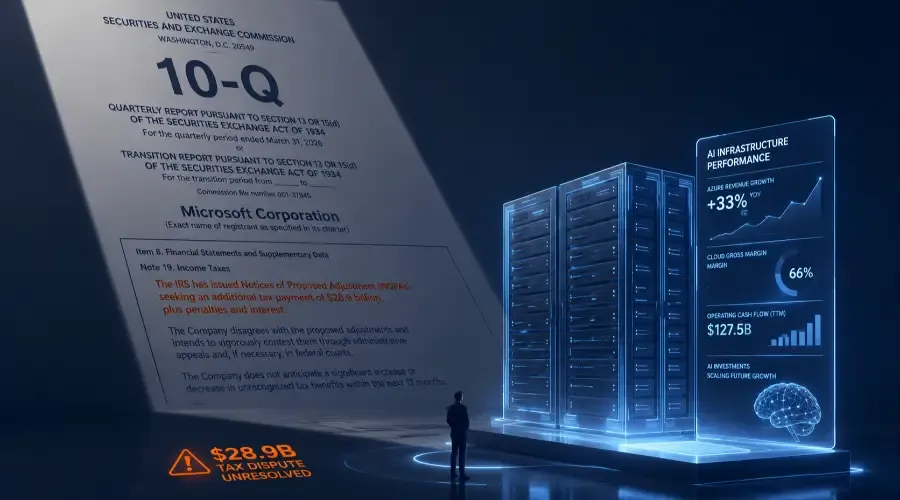
Every time Microsoft posts another quarter of cloud growth, retail attention lands on Azure revenue percentages and AI commentary. The $28.9 billion figure sitting in the tax liabilities section of the same filing receives far less attention at the retail level. That gap matters, because the most material disclosed contingency on Microsoft's balance sheet is not its debt load or capex run rate – it is a transfer pricing dispute with the IRS that remains unresolved with no 12-month resolution expected.
All figures in this post are based on publicly available data. Derived thresholds are labelled as such. Actual outcomes can differ materially.
What the 10-Q Actually Says
Microsoft's FY2026 Q3 10-Q, filed April 29, 2026 with the SEC, discloses that the IRS issued Notices of Proposed Adjustment (NOPAs) seeking an additional tax payment of $28.9 billion plus penalties and interest. The dispute centers on intercompany transfer pricing – specifically how Microsoft allocated profits across jurisdictions during prior tax years.
Microsoft's position, stated in the filing, is unambiguous: the company "disagrees with the proposed adjustments" and intends to "vigorously contest" them through administrative appeals and, if necessary, federal courts. The filing also states that Microsoft does not anticipate a significant increase or decrease in unrecognized tax benefits within the next 12 months.
That last sentence is the one to hold.
It means this dispute does not resolve in the near term.
It also means the $28.9 billion figure is not a settlement number – it is the IRS's opening demand in an active contest.
For context on scale: Microsoft's total cash, cash equivalents, and short-term investments as of March 31, 2026 were $78.3 billion. As a derived comparison, the IRS demand represents approximately 37% of that liquidity position if taken at face value – this is a size reference, not a balance sheet impairment calculation. It is not a rounding error on the balance sheet.
Why the Debt Narrative Gets This Wrong
Retail framing of Microsoft's AI risk tends to anchor on capital expenditure and debt. The actual filing data does not support that framing.
Long-term debt as of March 31, 2026 was $31.4 billion – down 21.2% year-over-year from $40.2 billion at June 30, 2025. Microsoft is retiring debt, not issuing it. Operating cash flow over the nine months ended March 31, 2026 was $127.5 billion, which covered capex, dividends, and buybacks without requiring new debt issuance.
The interest coverage ratio, calculated from the March 2026 quarter, is approximately 49x – operating income of $38.4 billion against interest expense of $778 million for the quarter. That ratio sits well above any threshold associated with balance sheet stress.
The AI infrastructure spending is real. Cloud gross margin declined to 66% in FY26 Q3, with the filing explicitly attributing the compression to "continued investments in AI infrastructure." Operating expenses rose $1.5 billion (9%) from the prior year, driven by compute capacity, AI talent, and data costs. Those are margin pressures, not solvency pressures. The distinction matters when assessing where the actual risk sits.
The IRS dispute is structurally different. It is a contingent liability, not an operating cost. It does not appear in the income statement until and unless Microsoft loses or settles. But it sits on the balance sheet as a disclosed risk, it is large enough to affect liquidity math in an adverse scenario, and it has no resolution timeline.
The Transfer Pricing Mechanics
Transfer pricing disputes arise when the IRS disagrees with how a multinational corporation allocates revenue and costs between its domestic and foreign subsidiaries. The core question is whether Microsoft priced intercompany transactions – licensing intellectual property to foreign units, for example – at arm's length rates that reflect what unrelated parties would negotiate.
Microsoft, like most large technology companies, has historically structured significant portions of its IP ownership and licensing through subsidiaries in lower-tax jurisdictions. The IRS periodically audits whether those arrangements understate US taxable income. When it concludes they do, it issues NOPAs specifying the proposed additional tax.
The $28.9 billion figure covers multiple prior tax years. It is not a single-year adjustment. Microsoft's 10-Q discloses that it has recorded unrecognized tax benefits and other income tax liabilities totaling $29.3 billion – a separate balance sheet line representing management's estimate of probable tax obligations across all open audit years globally, including but not limited to this IRS dispute.
Three figures are in play here and they are related but not identical. The $28.9 billion IRS NOPA demand is the amount the IRS is seeking for this specific dispute, before penalties and interest. The $29.3 billion unrecognized tax benefits (UTB) balance is Microsoft's global reserve across all open audit years and jurisdictions. The $27.9 billion long-term income taxes line on the balance sheet is the portion of that reserve classified as long-term.
At first glance the UTB reserve appears to roughly cover the IRS demand. But because the IRS demand excludes accrued penalties and interest (which could be material), and because the $29.3 billion covers exposures beyond this single dispute, the actual gap between the full IRS exposure and the specific reserve allocated to it is not cleanly determinable from the filing excerpts alone. That uncertainty is precisely what makes the UTB balance the tracking metric to watch.
That gap is what the dispute resolution process will ultimately narrow – through administrative appeals at the IRS Appeals Office, potential Tax Court proceedings, or a negotiated settlement. Each path has a different timeline. Administrative appeals alone can take two to four years. Tax Court litigation can extend beyond that.
What Resolution Scenarios Look Like
Three broad outcomes are possible, with meaningfully different financial impacts.
Scenario A – Microsoft wins or achieves a major reduction.
If the Tax Court or appeals process significantly reduces the IRS's proposed adjustment, the financial impact is limited to legal costs and the opportunity cost of management time. The $27.9 billion already on the balance sheet as long-term income taxes would partially reverse, producing a one-time income statement benefit. This is Microsoft's stated expectation.
Scenario B – Negotiated settlement in the $8–15 billion range.
Transfer pricing cases of this scale frequently settle at a fraction of the original IRS demand. A settlement in that range would be material but manageable against Microsoft's $78.3 billion liquidity position. It would likely reduce cash and short-term investments by 10–20%, affect the quarterly tax rate, and generate a large one-time charge in the settlement quarter.
Scenario C – Adverse outcome near the full demand.
A ruling or settlement close to $28.9 billion plus penalties and interest would represent a cash outflow exceeding 35% of current liquidity. It would not threaten solvency given Microsoft's cash generation capacity, but it would reset the balance sheet narrative and likely force a reassessment of the capital return program in the settlement period.
The following is a hypothetical illustration for educational purposes only and does not constitute a trade recommendation.
For a trader holding MSFT equity shares with a longer-duration thesis: if the dispute moves toward Scenario A or B resolution, the overhang clears and the balance sheet story reverts to the AI growth narrative. If adverse headlines emerge from Tax Court proceedings or if the IRS escalates with new audit cycles, the contingent liability line becomes a more frequent topic in earnings calls, and the valuation multiple may compress as institutional models mark up the probability of a large cash outflow. Equity shares are the instrument commonly associated with this type of multi-year regulatory resolution thesis, given the timeline uncertainty makes shorter-duration options structures expensive to hold.
The Metric Retail Is Not Watching
The standard MSFT bull case focuses on Azure growth rate, AI revenue attach, and operating margin trajectory. All three are visible, frequently reported, and heavily modeled by sell-side analysts.
The IRS contingency is none of those things. Institutional investors and financial press have covered Microsoft's transfer pricing disputes – Bloomberg, Reuters, and the FT reported on the company's prior $13.5 billion IRS settlement covering 2004–2013 tax years. The gap here is more accurately described as a retail-to-institutional information asymmetry. Most retail-facing earnings coverage focuses on the press release metrics. The tax footnotes in the 10-Q require reading the full filing, and that is where this contingency lives.
The specific number to track in future filings: the unrecognized tax benefits balance. Microsoft disclosed $29.3 billion in this category as of March 31, 2026. If this figure increases in subsequent quarters, it signals that additional audit exposure is being recognized. If it decreases sharply, it may indicate either a favorable resolution or a settlement payment. Movement in this line item is an early signal that the dispute is progressing.
The secondary number: the long-term income taxes line on the balance sheet, currently $27.9 billion. A sudden reduction in this figure, combined with a large cash outflow in the investing or financing activities section of the cash flow statement, would indicate a settlement has occurred.
The Ripple Into Sector Valuation
Microsoft is not the only large technology company navigating IRS transfer pricing scrutiny. Microsoft itself reached a $13.5 billion settlement with the IRS in 2022 covering the 2004–2013 tax years – establishing that disputes of this scale do resolve, but on multi-year timelines. Alphabet (GOOGL) and Meta (META) have faced comparable audit cycles targeting similar IP licensing structures in lower-tax jurisdictions.
The precedent mechanism works as follows: an adverse Tax Court ruling for Microsoft would establish judicial standards for arm's length pricing of technology IP that IRS auditors could directly cite in audits of other multinationals. Alphabet and Meta do not disclose their specific IRS exposure with the same granularity, but their UTB balances in recent 10-K filings provide a comparable tracking metric. If Microsoft loses at Tax Court, sell-side models for both companies would likely incorporate a higher probability of large tax settlements, compressing multiples before any actual IRS action against them.
Risk Management: The Line in the Sand
This thesis is built on a disclosed contingent liability with an uncertain resolution timeline. It is not a thesis about imminent financial distress.
This thesis may be invalidated if Microsoft announces a definitive favorable ruling or a settlement well below $10 billion in a single filing or press release. At that point, the contingent liability overhang clears, the long-term income taxes balance sheet line resets, and the IRS dispute no longer represents a material risk factor relative to Microsoft's liquidity position. The setup no longer applies.
Conversely, the thesis strengthens if future 10-Q filings show an increase in unrecognized tax benefits, new NOPAs for additional tax years, or management commentary on Tax Court scheduling in the earnings call.
This analysis is for educational purposes only and does not constitute investment advice. All figures are based on publicly available data as of June 2026. Derived thresholds and hypothetical scenarios are for educational illustration only and do not constitute trade recommendations. Instrument type references are educational context, not personalised financial advice. Please consult a qualified financial advisor before making investment decisions. BreakoutBulletin does not hold positions in any securities mentioned.