
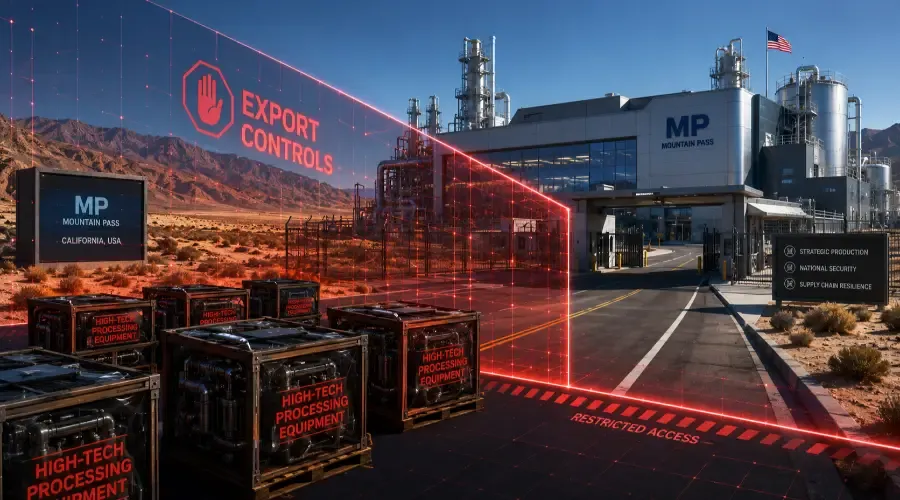
The headline from June 22, 2026 reads cleanly: China blacklists MP Materials, retail assumes bearish. The actual risk for MP (NYSE: MP) is neither the blacklisting nor the revenue impact – MP ceased all sales to China in July 2025 and carries zero China revenue today. The risk is structural and sits one layer deeper. MP is in the middle of commissioning its heavy rare earth separation facility at Mountain Pass, targeting dysprosium and terbium production in mid-2026. China's export controls on dual-use equipment and technology – now extended to MP specifically – tighten the sourcing and qualification window for exactly the category of processing equipment that a separation ramp requires. The blacklisting did not create this problem. Whether it compressed the timeline depends on a single binary question that has not yet been answered publicly: has the critical separation equipment already been delivered to Mountain Pass?
All figures in this post are based on publicly available data. Derived thresholds are labelled as such. Actual outcomes can differ materially.
What MP Is Actually Building
Mountain Pass in San Bernardino County, California is the only active rare earth mine in the United States at commercial scale. MP's operations run across two segments: Materials, which covers mining and oxide separation, and Magnetics, which covers finished magnet production. The company has been executing a mine-to-magnet vertical integration strategy since 2022, moving progressively downstream from raw concentrate to separated oxides to finished NdPr metal and now to magnets.
The next phase is heavy rare earth separation – specifically dysprosium and terbium, two elements that sit in the heavy rare earth category and trade at significantly higher prices than the light rare earths that have been MP's primary revenue base. Per MP's Q3 2025 earnings release, the company planned to begin commissioning its HREE separation facility at Mountain Pass in mid-2026, initially prioritising dysprosium and terbium.
That mid-2026 commissioning window is now running concurrently with China's most aggressive export control posture on record toward MP specifically.
What China's Export Control Actually Restricts
The June 22 listing targets dual-use goods and technologies – items with both civilian and military applications – that Chinese exporters supply to listed companies. The restriction has two layers. Direct exports from Chinese suppliers to MP are blocked. Secondary transfers are also blocked: any third-country supplier cannot re-export Chinese-origin dual-use equipment or technology to MP.
The secondary transfer prohibition is the less-discussed but more operationally significant clause. It means MP cannot route around the restriction by purchasing Chinese-origin processing equipment through a European or Japanese intermediary. If a piece of processing equipment, software, or manufacturing input has Chinese-origin components that fall under the dual-use classification, the path to MP is blocked regardless of which country ships it.
MP's own risk disclosures in its SEC filings warn broadly about trade policy risk, execution timing, and supply chain localisation challenges during its expansion phase. The filings do not name specific equipment with Chinese-origin dependency, so the exact scope of the restriction on MP's 10X program cannot be determined from public documents alone. The strongest version of this thesis is not that MP will be delayed – it is that the market may be underestimating commissioning risk if critical separation equipment is not already on site at Mountain Pass. That distinction collapses entirely if management confirms delivery on the Q2 call. It becomes material if they do not.
The Timing Collision
MP's HREE separation program targets dysprosium and terbium for two reasons. Both elements are critical inputs for high-performance permanent magnets used in defense systems, EV motors, and aerospace. Both are currently sourced almost entirely from Chinese refining operations globally. A domestic US source of separated dysprosium and terbium would represent a genuine supply chain inflection for defense procurement – which is why the Pentagon holds approximately 15% of MP's equity and why the Department of War signed a Price Protection Agreement that floors NdPr oxide at $110/kg.
The commercial case for HREE separation depends on commissioning on schedule. Dysprosium and terbium prices have moved sharply higher in 2026 as China's export controls on rare earth elements and magnets – first imposed in April 2025 – have reduced available supply to Western buyers. A mid-2026 commissioning date positions MP to capture elevated pricing during a supply-constrained window. A delayed commissioning date means the revenue uplift from HREE separation shifts into late 2026 or 2027, and the pricing window may narrow if diplomatic conditions change.
That delay is not a solvency risk. MP's $1.74 billion cash position and DoW price floor absorb a one-to-two quarter slip without threatening the balance sheet. It is a valuation reset risk. MP currently trades at a premium that embeds HREE revenue arriving in H2 2026. If that revenue shifts by two quarters, the path to GAAP profitability extends, near-term earnings estimates compress, and the multiple the market applies to the 2026 revenue base contracts accordingly. The operational question and the valuation question are the same question on a different timeline.
The June 22 blacklisting does not automatically delay the HREE ramp. MP had already been accelerating its de-Sinification of the supply chain precisely because this scenario was foreseeable. But any piece of processing equipment that requires qualification, replacement, or re-sourcing because of the dual-use restriction adds weeks to months to a commissioning timeline that was already ambitious.
What the DoW Partnership Does and Does Not Protect
The Department of War partnership provides MP with three structural supports: a price floor on NdPr oxide at $110/kg, an equity stake that aligns government incentives with MP's operational success, and implicit prioritisation for defense procurement contracts as domestic separation capacity comes online.
Those protections do not directly address equipment sourcing constraints – but the DoW is not simply a financial backer. As a government actor, it has access to the Defense Production Act (DPA), which grants authority to expedite domestic industrial capacity, pressure allied nations to supply critical equipment, and in extreme cases invoke emergency authorities to override normal procurement timelines. If the HREE separation facility is genuinely critical to defense supply chains – and the Pentagon's 15% equity stake suggests it is – the DoW has regulatory and diplomatic tools available that a private investor does not.
The uncertainty is whether those tools get deployed and on what timeline. DPA invocations are not automatic. They require a determination of national security necessity, interagency coordination, and can take months to execute even when the political will exists. The DoW partnership is support, not a guarantee of relief from any specific sourcing constraint. MP management's response on the Q2 call will indicate whether the DoW partnership is being actively leveraged on the equipment sourcing question or whether MP is navigating the restriction independently.
MP's balance sheet provides additional runway regardless. At March 31, 2026, MP held $1.74 billion in cash and short-term investments against $932.9 million in long-term debt. That liquidity supports the capital intensity of the 10X expansion program – MP's multi-year plan to scale downstream separation and magnet production capacity – without requiring immediate equity issuance.
USAR as the Comparison Case
USA Rare Earth (NASDAQ: USAR) was listed alongside MP on June 22. USAR is at an earlier development stage – advancing domestic processing capabilities without a commissioned facility equivalent to Mountain Pass. USAR carries less near-term execution risk from the dual-use restriction because it has less near-term equipment commissioning activity. It also carries less near-term revenue upside for the same reason.
The risk asymmetry between MP and USAR is worth tracking. MP has the most to lose from a commissioning delay because it has the most to gain from an on-schedule ramp. USAR's year-to-date gain of approximately 107% versus MP's approximately 20% reflects different market mechanics – float, short interest, and sentiment – rather than a fundamental assessment that USAR's execution risk is lower. USAR's much smaller float makes it more sensitive to geopolitical news flow. MP's larger, more institutional shareholder base reflects the DoW partnership and makes it less volatile on headlines but more sensitive to quarterly operational data.
Scenario Analysis
The following is a hypothetical illustration for educational purposes only and does not constitute a trade recommendation.
Scenario A – Equipment already delivered, blacklisting operationally irrelevant.
All critical processing equipment for the HREE separation facility was purchased and received at Mountain Pass before the June 22 listing. The dual-use restriction applies only to future exports; equipment already on-site is unaffected. Commissioning proceeds on the mid-2026 schedule. The blacklisting proves symbolic, the retail panic fades, and the stock reprices higher as the market recognises the restriction has no operational impact. This is the full thesis invalidation scenario – and it is the most important question to resolve on the Q2 call.
Scenario B – HREE commissioning proceeds on schedule despite some equipment complexity.
One or more components require re-sourcing or qualification from non-Chinese suppliers, but the substitution is completed within the existing commissioning window. Dysprosium and terbium revenue begins contributing in Q3 2026. The DoW partnership may have facilitated allied-nation equipment supply via DPA tools. The operational delay is minimal and the GAAP profitability trajectory stays on track.
Scenario C – Commissioning delays by one to two quarters.
Equipment sourcing or qualification runs into dual-use restriction complications that cannot be resolved within the mid-2026 window. HREE revenue shifts to Q4 2026 or Q1 2027. Near-term earnings estimates compress. The valuation premium embedded in H2 2026 HREE revenue partially unwinds. MP remains GAAP loss-making through the delay period, supported by the DoW NdPr price floor.
Scenario D – Dual-use restriction triggers a broader re-sourcing requirement.
Multiple separation equipment items or software require full qualification from non-Chinese sources, extending the delay beyond two quarters. HREE revenue does not contribute in 2026. FY2025's $85.9 million net loss extends into 2026. Management discloses the scope of re-sourcing on the next earnings call – a change in commissioning language from "mid-2026" to a range or a deliberate omission is the leading indicator.
The Metrics to Track
The binary question for the Q2 2026 earnings call. The single most important disclosure: has all critical processing equipment for the HREE separation facility already been delivered to Mountain Pass? An affirmative answer renders the dual-use restriction irrelevant to the 2026 commissioning timeline and moves the thesis directly to Scenario A. If management does not confirm equipment delivery status, the restriction's impact remains open.
Commissioning language on the Q2 2026 call. Whether "mid-2026 commissioning" remains the stated timeline or shifts to a range, a later date, or a conditional. A deliberate omission of the timing commitment is the earliest signal that Scenario C or D is unfolding.
HREE revenue line in the Q3 2026 earnings release. The first quarter where dysprosium and terbium revenue appears – or does not appear – in the Materials segment is the binary confirmation event. Absence combined with equipment attribution confirms the delay thesis.
DoW DPA activity. Any public announcement of a Defense Production Act action involving rare earth separation equipment or technology transfer to MP would indicate the government partnership is being actively deployed as a countermeasure to the restriction, supporting Scenario B resolution.
The Q2 2026 earnings call, typically in early August, is the first resolution event. MP's SEC filings are available at sec.gov/cgi-bin/browse-edgar (search MP Materials) for readers wanting the primary risk factor language.
Risk Management: The Line in the Sand
This thesis may be invalidated if MP management confirms on the Q2 2026 earnings call that all critical HREE separation equipment has already been delivered to Mountain Pass and commissioning is proceeding on the mid-2026 schedule. At that point the dual-use restriction has no operational impact, the blacklisting is confirmed as symbolic, and the hidden structural risk angle no longer applies. This is Scenario A – and it is the outcome that resolves the thesis fastest.
The thesis strengthens if commissioning language shifts from a specific date to a range or is omitted entirely, if Q3 2026 shows no HREE revenue contribution with an equipment attribution, or if the next 10-Q risk factors add specific language about dual-use equipment access. Any of those signals indicates the timing collision is real rather than theoretical.
This analysis is for educational purposes only and does not constitute investment advice. All figures are based on publicly available data as of June 2026. Derived thresholds and hypothetical scenarios are for educational illustration only and do not constitute trade recommendations. Instrument type references are educational context, not personalised financial advice. Please consult a qualified financial advisor before making investment decisions. BreakoutBulletin does not hold positions in any securities mentioned.