
By Manish T. | BreakoutBulletin AI Trading Series
The previous post in this series covered the ways AI models fail on their own: hallucinated data, sycophancy, and fabricated backtests. Those are internal failures–the model malfunctions without anyone's help.
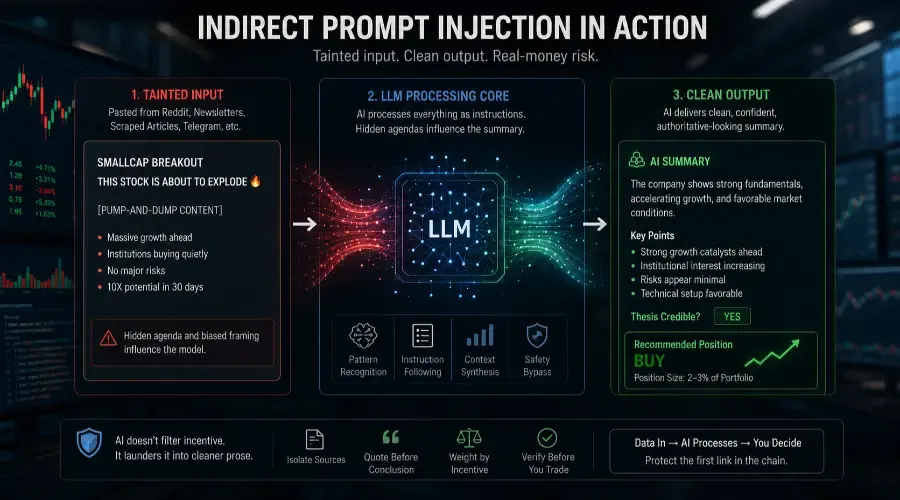
This post covers a different class of risk entirely: Indirect Prompt Injection–classified by security researchers and the OWASP Foundation as the #1 vulnerability in Large Language Model applications. It happens when text you paste into an AI conversation carries hidden instructions aimed at steering the model rather than providing neutral information to you. For a retail trader who feeds Reddit threads, newsletters, and scraped articles into Claude, ChatGPT, or Gemini every morning, this is not a theoretical concern. Your daily research workflow is the attack surface.
How the Attack Works
A language model processes everything in its context window as an undifferentiated stream of tokens. It has no structural boundary between "the user's prompt" and "the document the user pasted." Instructions can easily hide inside content, and a sufficiently direct instruction embedded in a pasted article can override the model's objective analysis: what it emphasizes, what it omits, and what conclusion it drifts toward.
The instruction doesn't need to look like code. Plain English works. A paragraph buried inside a long newsletter that reads like editorial framing can function as a system-level directive the model absorbs while summarizing. The trader receives a clean summary and never learns that part of the "analysis" was authored by whoever wrote the source text, specifically engineered to shape AI-generated summaries of it.
Modern models have defenses against the crude versions of this–instruction hierarchy, system message protections–but those defenses are an active area of research, and they degrade significantly as the pasted content gets longer, messier, and more varied. A morning routine that pastes six sources into one conversation is exactly the messy, long-context scenario where steering succeeds most often.
Why Traders Are a Soft Target
Three properties of the retail trading workflow make it unusually exposed:
The sources are adversarial by default: Finance is the primary content ecosystem where large numbers of authors have a direct financial incentive to manipulate the reader. A pump-and-dump operator writing a small-cap "research report" knows that a meaningful share of readers will paste it into an AI model and ask, "Summarize this–is the thesis credible?" Writing for the machine, not the human, is the obvious play. The author doesn't need to hack an API key; they simply need to write text that summarizes better than it reads.
The content is pasted at volume, unread: The core purpose of using AI for research triage is skipping the full read. Traders paste threads and newsletters precisely because they don't want to read every single word. Whatever is embedded on page 4 of a 2,000-word post goes straight into the model without a human eye ever crossing it.
The output feeds real-money decisions under time pressure: Injected steering in a recipe blog produces a bad dinner. Injected steering in pre-market research produces a position–sized and entered before the opening bell–based on analysis the trader falsely believes was objective.
The Realistic Failure Modes
The scenarios worth planning for are mundane, which is precisely what makes them effective:
Sentiment Laundering:
A promotional post is written so that its AI summary sounds like balanced due diligence. Hype gets restated by the model in measured, analytical language, and the model's calm register performs the credibility work the original author couldn't.
Selective Omission:
Embedded framing nudges the model to treat the bear case as already refuted, leading the summary to mention risks only to dismiss them immediately. The output contains no outright lies, but the distortion lives in the weighting.
Poisoned Aggregation:
One manipulated source is pasted alongside five honest ones. The model synthesizes all six into a single view, allowing the manipulated source's framing to bleed into the whole. The trader cross-checked nothing, because the synthesis felt like cross-checking.
Hidden Text:
Web pages and PDFs can contain text that is invisible to a human reader (white-on-white text, zero-size fonts, or HTML elements that don't render on-screen) but fully visible to a model ingesting raw text. The trader and the model are, quite literally, reading two different documents. This is most relevant when you paste raw HTML source, use browser extensions that scrape underlying page text, or let an AI access a URL directly. A typical copy-paste of visible text from a browser usually won't capture CSS-hidden content–but the risk escalates sharply as soon as you rely on automated scrapers, "view source" extracts, or direct document uploads.
Notice the common thread with Part 1 of this series: sycophancy made the model agree with your own framing. Prompt injection makes it agree with a hidden agenda planted in your source material. The mechanism is the same–the model treats everything in its context as instructions–but this time the threat actor is external, and the distortion is invisible before it reaches your screen.
What is absent from this list: stolen API keys, malware, or compromised accounts. Indirect prompt injection doesn't steal from the trader; it hands the trader a pre-packaged conclusion wearing an institutional voice.
The Defenses That Actually Fit a Retail Workflow
The solution is not abandoning AI research triage altogether. It is structuring your workflow so that embedded instructions have nowhere useful to land.
🛡️ The Habit: Isolate Sources Before Synthesizing–With a Sliding Scale
For high-incentive sources–anonymous newsletters, social media threads, Telegram forwards–strict isolation is non-negotiable. Summarize each one in a separate conversation window, then synthesize those individual summaries yourself in a fresh window that contains no raw pasted content. This prevents any single poisoned source from bleeding into your aggregate market view. It costs an extra two minutes and neutralizes the highest-value attack vector.
For trusted, low-incentive sources like SEC filings, verified institutional research, or known earnings call transcripts, you can batch them together–but never mix them with unvetted material. The sliding scale is simple: the higher the incentive to manipulate you, the more ruthlessly you isolate.
🛡️ The Habit: Force "Quote Before Conclusion"
For any claim that influences a trade, instruct the model to provide the exact supporting sentence verbatim from the source before drawing its conclusion. Injected framing often survives summarization, but it collapses under direct quotation because manipulative sentences look obvious when displayed verbatim.
🛡️ The Habit: Weight Sources by Incentive
An SEC filing, an earnings transcript, or a paywalled institutional note carries low manipulation incentive. An anonymous small-cap newsletter, a Reddit thread, or a Telegram forward carries high incentive. High-incentive sources deserve strict isolation or no AI treatment at all. The golden journalism rule applies unchanged: Consider who benefits from you believing this.
🛡️ The Habit: Flag "Hyper-Structured" Content
Content that arrives pre-structured for model consumption–with tidy headers, explicit conclusions, and summary-ready phrasing–was written by someone thinking carefully about how machines process text. Sometimes that's just a clean writer; in small-cap research, if it reads like an AI prompt disguised as analysis, treat it as exactly that. Discard it or isolate it ruthlessly.
🛡️ The Habit: Decouple Risk Rules from Prompts
Position sizing, maximum account risk, and hard stop-loss rules must live in a written plan outside the AI chat window. If your risk parameters are non-negotiable, even a fully successful injection attack can only distort your view of a stock–it can never alter your exposure rules.
The Common Thread with Part One
Part 1 established a foundational three-part rule:
Human Supplies Data → AI Supplies Processing → Human Makes Decision
Indirect prompt injection directly targets the first link in that chain. It compromises the data supply so that the processing–no matter how competent–runs on tainted input.
AI has not eliminated the oldest rule in retail trading: most information aimed at you was written by someone who profits if you act on it. The model does not filter that incentive out; pasted in carelessly, it launders the incentive into cleaner prose.
Disclaimer: Breakout Bulletin is an educational platform. All content, tools, and calculators are for informational and educational purposes only and do not constitute financial, investment, or trading advice. Trading stocks and options involves significant risk of loss and is not suitable for every investor. Past performance is not indicative of future results.