
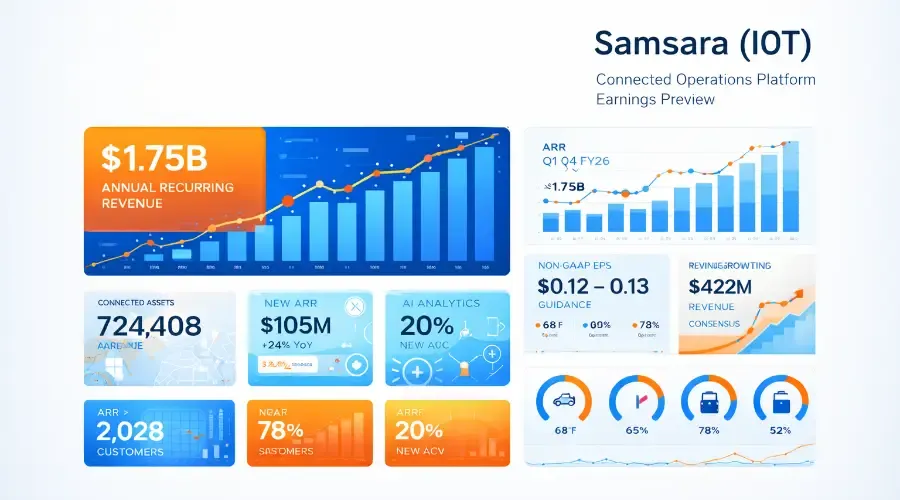
Samsara reports Q4 FY2026 earnings on March 5, 2026 after market close. Here's what actually matters.
TL;DR
Samsara reports Q4 FY2026 earnings on March 5 after the U.S. market close. Consensus expects approximately $0.13 EPS and $422 million revenue.
EPS is not the primary signal for this company. Annual Recurring Revenue growth, enterprise customer expansion, and margin progression are the metrics that drive valuation.
The most important datapoint will be ARR after reaching $1.75 billion in Q3 FY2026, up 29 percent year over year.
Investors are closely monitoring large-customer momentum including accounts generating more than $100,000 and more than $1 million in ARR, which indicates whether enterprise adoption of the connected operations platform continues to scale.
The next valuation catalyst is operating leverage as Samsara transitions from growth-stage SaaS toward durable mid-teens operating margins and consistent GAAP profitability.
The market reaction will likely hinge on FY2027 growth outlook and ARR trajectory, not the reported quarterly EPS.
Why EPS Is Not the Primary Signal
For high-growth SaaS companies such as Samsara, EPS provides limited information about long-term value creation. The firm remains in the early stages of scaling a platform business, meaning accounting earnings are influenced by growth investments rather than underlying demand trends.
Three structural reasons explain why EPS is a secondary metric for Samsara specifically.
First, revenue is largely subscription-based, which means long-term customer value is captured through multi-year recurring contracts. ARR growth therefore reflects underlying demand far better than quarterly earnings.
Second, operating leverage is still emerging. Samsara only recently achieved its first GAAP-profitable quarter in Q3 FY2026. Investors are evaluating how margins evolve as the company scales.
Third, the valuation framework used by institutional investors is primarily enterprise value to sales relative to growth durability, rather than earnings multiples. Samsara currently trades at approximately 14 times forward sales, consistent with other high-growth SaaS platforms. That multiple assumes sustained growth near current levels.
As a result, the earnings release will primarily be evaluated through four metrics: ARR growth and expansion, enterprise customer additions, operating leverage trajectory, and sequential growth momentum. EPS only matters if it signals a change in those underlying drivers.
Metric #1: Annual Recurring Revenue
ARR is the single most important metric for evaluating Samsara's performance.
The company reported $1.75 billion in ARR for Q3 FY2026, representing 29 percent year-over-year growth. That growth rate is notable because it reflects continued demand despite the company's increasing scale.
Investors will focus on three ARR signals in the Q4 report.
First is the absolute ARR level. Any move closer to the $1.9 billion to $2 billion range would indicate that demand remains robust across transportation, logistics, field services, and industrial customers.
Second is the growth rate trajectory. Sustained growth near 30 percent at this stage of scale would reinforce the narrative that connected operations platforms remain in the early adoption phase.
Third is the contribution of new products. In Q3 FY2026, roughly 20 percent of net new annual contract value came from recently launched products such as AI Multicam, Asset Maintenance, Asset Tags, Connected Training, and Connected Workflows. This product expansion matters because it demonstrates that Samsara is evolving beyond fleet tracking into a broader operating system for physical operations.
If ARR growth slows materially below the high 20 percent range, the market may question whether the platform's expansion opportunity is approaching maturity.
Metric #2: Enterprise Customer Expansion
While ARR reflects overall demand, large-customer growth provides the clearest signal about future revenue durability.
At the end of Q3 FY2026, Samsara reported approximately 2,028 customers generating more than $100,000 in ARR and 59 customers generating more than $1 million in ARR.
Enterprise customers are particularly important because they typically deploy multiple modules across fleets, facilities, and equipment. Once integrated into operational workflows, switching costs increase substantially.
Analysts will watch for two trends.
First is continued expansion in the $100,000 ARR cohort, which reflects successful upselling within existing accounts as well as new enterprise wins.
Second is growth in $1 million ARR customers, which indicates that Samsara's platform is becoming embedded in large-scale industrial and logistics operations.
If enterprise adoption continues accelerating, the company could sustain multi-year ARR growth even as smaller deployments mature. Conversely, if large-customer growth slows, investors may infer that the platform's enterprise penetration is plateauing.
Metric #3: Margin Structure and Operating Leverage
Another critical focus area is Samsara's evolving margin profile.
The company has been steadily improving profitability as it scales. Management has guided toward mid-teens non-GAAP operating margins for FY2026, following a roughly 15 percent margin in Q3 FY2026.
The path to sustained profitability is a key driver of valuation. High-growth SaaS companies typically transition through three phases: growth investment phase with negative margins, early operating leverage phase, and scaled profitability phase with strong free cash flow. Samsara appears to be entering the second phase.
If operating margins continue expanding while revenue growth remains above 25 percent, investors may begin to model long-term margins in the 20 percent range, supporting premium valuation multiples.
However, margin pressure would signal that the company still needs elevated spending in sales, marketing, and product development to sustain growth. In that scenario, the market may reconsider the timeline for durable free cash flow generation.
Metric #4: Sequential Growth Trajectory
Momentum matters in high-growth SaaS businesses because changes in growth direction often precede valuation repricing.
The consensus forecast implies Q4 revenue of approximately $422 million, which would maintain the company's strong expansion trajectory.
The key question is whether Samsara can sustain growth in the mid to high 20 percent range as revenue approaches $2 billion annually.
Investors will examine two indicators. The first is sequential revenue acceleration or deceleration relative to prior quarters. The second is ARR growth momentum, which provides earlier insight into future revenue trends.
A stable or accelerating trajectory would reinforce the market narrative that connected operations software remains a large, underpenetrated market. Deceleration would raise concerns about whether growth is normalizing earlier than expected.
Valuation Context
Samsara currently trades at approximately 14 times forward enterprise value to sales. This compares to the company's one-year average of 13 times and the high-growth SaaS peer average of approximately 10 times.
The premium multiple reflects investor expectations for sustained growth near 30 percent and gradual margin expansion. Any material change in those expectations would likely result in multiple repricing.
Sector Read-Through Impact
Samsara operates in the emerging category of connected operations software, which integrates IoT hardware, data analytics, and workflow automation.
While direct public peers are limited, the company's results can influence sentiment across several adjacent segments.
First is industrial digitization, including telematics platforms and fleet management software providers such as Descartes Systems Group and Trimble.
Second is the broader SaaS observability and operations software ecosystem, where investors compare growth durability and margin expansion across platforms.
Third is logistics and transportation technology spending, since Samsara's customers include fleets, logistics operators, and field service organizations.
Strong results could reinforce the thesis that digitization of physical operations remains a long-term secular growth trend. Weak results may instead suggest that enterprise spending on operational technology is becoming more sensitive to macroeconomic conditions.
Guidance Framework
Institutional investors will primarily evaluate the earnings release through the lens of forward guidance.
Bull Case Triggers
ARR growth remains near 30 percent or accelerates. Enterprise customer additions continue expanding. FY2027 revenue outlook implies sustained growth above 25 percent. Operating margins expand beyond mid-teens levels.
These outcomes would likely justify multiple expansion toward 16 to 17 times sales, reinforcing the long-duration growth narrative.
Base Case
ARR growth gradually moderates but remains in the mid-20 percent range. Large-customer growth continues steadily. Operating margins expand modestly as planned.
This scenario would likely support valuation stability near current multiples.
Bear Case Triggers
ARR growth decelerates meaningfully below 25 percent. Enterprise customer additions slow sharply. Margins compress due to increased spending.
In that environment, investors may re-evaluate the sustainability of Samsara's premium SaaS multiple, potentially contracting toward 11 to 12 times sales.
Macro Context Overlay
Several macro forces influence Samsara's demand outlook.
The first is industrial digital transformation. Companies are increasingly deploying connected sensors and software platforms to optimize fleet efficiency, safety, and operational productivity.
The second is freight and logistics activity, which affects technology spending by transportation companies. Investors tracking the Cass Freight Index and purchasing managers index data can gain insight into the demand environment Samsara faces.
The third is capital spending cycles across industrial sectors such as manufacturing and construction.
Management has previously emphasized that Samsara's platform generates measurable operational ROI, which can support adoption even during uncertain economic periods. However, prolonged weakness in industrial activity could eventually influence new customer deployments.
Bottom Line
Samsara's upcoming earnings release is less about quarterly EPS and more about confirming the durability of its growth model.
The most important signals will be ARR expansion, enterprise customer momentum, margin progression, and forward guidance.
If those metrics remain strong, the company could maintain its premium SaaS valuation despite already trading near recent highs.
If growth begins to moderate materially, investors may question whether the connected operations platform opportunity is maturing sooner than expected.
For now, the central question is whether Samsara can sustain high-20 percent growth while continuing to expand margins. That combination would support the long-term investment thesis.
FAQ
Why does ARR matter more than revenue for Samsara?
ARR reflects the recurring value of customer contracts and provides a clearer view of future revenue visibility. Because Samsara operates a subscription model, ARR growth indicates the underlying health of the business.
What is the most important metric in the upcoming earnings report?
ARR growth and large-customer expansion are the primary metrics investors will watch. These indicators reveal whether enterprise adoption of the connected operations platform continues to scale.
How important is operating margin expansion?
Margin improvement signals operating leverage. Sustained growth alongside rising margins suggests that Samsara can generate durable free cash flow as the platform scales.
What could trigger a major stock move after earnings?
Forward guidance for FY2027 growth, ARR trajectory, and margin outlook are likely to drive the stock reaction more than the reported EPS.
How does Samsara influence broader SaaS sentiment?
As a high-growth mid-cap SaaS company focused on industrial digitization, Samsara's results can influence investor confidence in the durability of growth across operational technology and cloud software platforms.
What is Samsara's current valuation multiple?
The company trades at approximately 14 times forward enterprise value to sales, a premium to the broader SaaS peer average reflecting its growth profile.
Disclaimer : This article is for informational and educational purposes only and does not constitute financial, investment, or trading advice. You are solely responsible for your own investment decisions and should consult a licensed financial professional before acting on any information in this post.