
When the Rides Stop Spinning, the Land Never Stops Earning
What the Six Flags Asset Sale Reveals About Operator vs. Owner Strategy
March 5, 2026 | BreakoutBulletin Macro Intelligence
Educational commentary only. Not investment advice. Sources include Six Flags investor communications and industry coverage published March 5, 2026.
SixFlags-EPR-RollerCoasterDeal-…
A Deal That Looks Strange - Until You Look Closer
At first glance, the announcement seemed unusual.
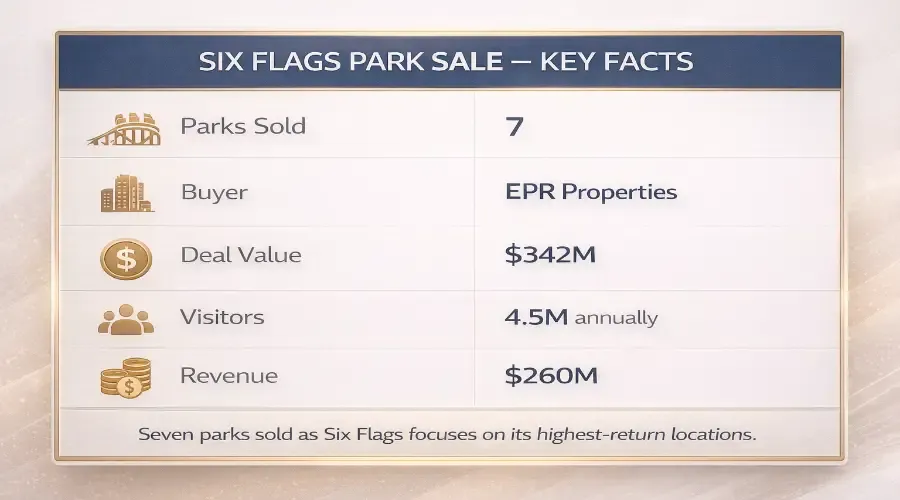
Six Flags Entertainment revealed it is selling seven of its amusement parks for $342 million. But the buyer was not another theme park operator. It was EPR Properties, a real estate investment trust.
That detail changes everything.
The parks themselves - Worlds of Fun, Valleyfair, Michigan’s Adventure, Schlitterbahn Galveston, Six Flags St. Louis, Six Flags Great Escape, and Six Flags La Ronde - attracted roughly 4.5 million visitors last year and generated about $260 million in annual revenue.
Yet the buyer was not interested in operating roller coasters.
It was interested in the land underneath them.
That distinction explains why this transaction makes sense for both sides - even though the headline numbers may initially appear surprising.
The Operator’s Perspective: Focus and Capital Discipline
Running an amusement park is a complex operating business.
There are employees to manage, seasonal attendance swings, ride maintenance, food service operations, and constant capital spending to keep attractions competitive. Revenue depends heavily on weather, tourism trends, and discretionary consumer spending.
Now imagine managing dozens of parks across North America.
That was the situation Six Flags faced after its merger with Cedar Fair in 2024. The combined company inherited a portfolio of 41 parks, each with different attendance trends, cost structures, and growth potential.
Not all parks contribute equally to earnings.
Some deliver strong returns and steady attendance growth. Others operate reliably but produce lower returns relative to the capital required to maintain them.
The strategic challenge becomes clear: management attention and capital are finite.
Six Flags’ new leadership team has made its approach explicit. The company plans to concentrate resources on its highest-return properties and exit assets that dilute that focus.
Selling these seven parks is the first visible step in that strategy.
The parks themselves are not failing businesses. They continue to attract millions of guests each year. But for Six Flags, the capital tied up in those properties could potentially generate stronger returns elsewhere in the portfolio.
That is the core lesson of portfolio management.
An asset does not need to be bad to be sold. It simply needs to be less attractive than alternative uses of capital.
The REIT’s Perspective: A Real Estate Opportunity
Now consider the buyer.
EPR Properties specializes in experiential real estate - properties designed for entertainment and leisure experiences. Its portfolio already includes movie theaters, recreation facilities, and entertainment venues.
From a REIT’s perspective, the operating complexity of amusement parks is not the main attraction.
The real estate is.
These parks sit on roughly 1,600 acres of land across multiple regions in North America. The land itself has enduring value, especially when paired with long-term leases to operators who run the attractions.
This structure shifts the risk profile.
The park operators handle staffing, ride maintenance, marketing, and day-to-day operations. EPR focuses on the underlying property and the long-term lease income generated by the assets.
In other words, EPR is not betting on roller coasters.
It is betting on stable real estate cash flows tied to popular entertainment destinations.
For a REIT built around experiential assets, that fits neatly into its investment model.
Understanding the Transaction Economics
The headline figures provide a useful lens.
Seven parks producing roughly $260 million in annual revenue were sold for $342 million. On the surface, that implies a revenue multiple near 1.3 times annual revenue.
But revenue multiples are not the most relevant metric in real estate transactions.
Real estate investors tend to focus on capitalization rates, which compare annual operating income to the purchase price.
While exact operating income numbers were not publicly disclosed, transactions like this often imply cap rates in the double-digit range.
For a REIT seeking stable long-term income streams backed by tangible real estate, that can be an attractive proposition.
The deal also includes operating partners who will manage the parks going forward, contributing capital and aligning incentives with the real estate owner.
In practical terms, the transaction separates operations from ownership.
Six Flags exits the real estate while focusing on its core parks. EPR acquires the property while leaving operations to specialists.
What It Means for Six Flags
For Six Flags, the sale delivers two immediate benefits.
First, it generates a substantial cash inflow, strengthening the company’s balance sheet. That capital can be used to reduce debt, invest in high-performing parks, or support future growth initiatives.
Second, it simplifies the company’s operating portfolio.
Managing fewer parks allows leadership to concentrate on properties with the strongest growth potential and brand recognition.
The strategic logic resembles what investors often call portfolio pruning - removing lower-return assets so the remaining portfolio can perform better overall.
Whether that strategy succeeds will ultimately depend on how effectively Six Flags redeploys the capital and operational focus gained from the sale.
What It Means for EPR Properties
For EPR, the acquisition represents one of its largest investments in years.
The company already operates across dozens of states and specializes in entertainment-focused real estate. Adding seven established parks expands its exposure to the experiential leisure economy.
That sector has become increasingly important in recent years.
Consumers may shift spending patterns, but demand for in-person entertainment experiences has proven relatively durable. Theme parks, sports venues, and recreation complexes continue to attract visitors even as digital entertainment options expand.
Still, there are risks.
Amusement parks depend on discretionary spending. Economic slowdowns or travel disruptions can influence attendance levels.
EPR’s model mitigates some of that risk through lease structures, but the health of park operators ultimately matters to the long-term success of the investment.
The Bigger Strategic Lesson
Beyond the details of this transaction lies a broader insight about corporate strategy.
The same asset can hold very different value depending on who owns it.
To an operator like Six Flags, a park represents a business requiring staffing, maintenance, marketing, and constant reinvestment.
To a real estate investor, that same park represents land, leases, and long-term income potential.
Neither view is incorrect. They simply reflect different business models and time horizons.
This dynamic appears frequently across industries. Hotels, casinos, warehouses, and retail centers have all seen similar separations between operating companies and real estate owners.
The Six Flags sale is another example of that shift.
What Investors May Watch Next
Several questions remain worth monitoring.
One is how Six Flags deploys the capital raised from the sale. If the company successfully invests in higher-return parks, the strategy could strengthen long-term profitability.
Another is how the newly structured parks perform under their new operators.
Finally, investors will watch how experiential real estate continues to evolve as an asset class. EPR’s acquisition signals confidence in the long-term value of physical entertainment destinations.
That thesis will ultimately be tested by attendance trends, consumer spending patterns, and the broader economic cycle.
The Underlying Insight
Roller coasters may define the guest experience.
But from an investment standpoint, the real value may lie in the ground beneath them.
The Six Flags transaction illustrates a simple but powerful idea: sometimes the most valuable part of an entertainment business is not the ride.
It is the land.
Disclaimer
This article is for informational and educational purposes only and does not constitute financial, investment, or trading advice. Readers should conduct independent research and consult qualified financial professionals before making investment decisions.