
March 3-4, 2026 | BreakoutBulletin Macro Intelligence
Educational commentary only. Not investment advice. All data sourced from Reuters, Charles Schwab Market Update, and Trading Economics as cited.
Opening
The dominant macro driver across the March 3-4 trading sessions was a single geopolitical development with unusually direct transmission into financial markets. U.S.-Israeli strikes on Iranian facilities entered their third and fourth days, disrupting shipping traffic through the Strait of Hormuz and pushing oil prices higher.
For the S&P 500, the significance was not the geopolitical event itself but the macro consequences that followed. Higher oil prices altered the near-term inflation outlook and forced markets to reconsider the Federal Reserve’s policy trajectory while Treasury yields were already elevated.
In practical terms, this was not a typical risk-off session driven by economic data or Fed communication. It was a supply shock, affecting the most systemically important commodity in global trade at a time when equities were already sensitive to restrictive interest rates and stretched growth valuations.
The S&P 500 closed roughly 0.94% lower on March 3, while the Dow Jones Industrial Average declined 0.83% and the Nasdaq Composite fell between 1.02% and 1.10% depending on the reference source. Intraday losses were deeper, with the Dow falling by as much as 1,200 points before partial recovery.
Those closing figures therefore mask the scale of volatility and institutional repositioning that occurred during the session.
Primary Catalyst - Oil Shock and the Inflation Channel
The Strait of Hormuz carries roughly 20-21% of global oil shipments. When traffic through that route is disrupted, markets do not simply reprice oil - they reprice every asset sensitive to energy costs and inflation expectations.
WTI crude rose approximately 3.5% to $72.50, while Brent crude reached roughly $83.90. These moves followed earlier increases that had already introduced a geopolitical premium into energy prices.
What changed here was not just the level of oil prices, but the probability that the premium could persist.
That shift matters because oil feeds directly into inflation expectations. Higher energy prices increase production and transportation costs across multiple industries. If sustained, they slow the disinflation process the Federal Reserve has relied on to justify maintaining its current policy pause.
The result was a market reassessment of rate-cut expectations in early 2026. That reassessment is the transmission mechanism connecting a Middle East conflict to equity valuations in the United States.
Sector performance reflected this logic. Energy and defense stocks outperformed, while rate-sensitive growth sectors weakened. The rotation illustrates how equity markets translate macro shocks into sector-level repricing.
Reinforcing Signals - Intraday Reversal Catalysts
The session did not move in a straight line. Two developments during the trading day briefly reversed market direction before equities ultimately closed lower.
Iran Diplomatic Outreach
Around mid-morning, Reuters reported that Iran had made a confidential diplomatic approach to Washington. The report triggered a temporary rebound in equity futures, pulling the S&P 500 briefly into positive territory.
Oil prices eased slightly and Treasury demand moderated. The reaction demonstrated a key principle of geopolitically driven markets: news flow about the conflict can be as influential as the conflict itself.
U.S. Tanker Escort Proposal
Later in the session, a second catalyst emerged when President Trump announced that the United States would escort oil tankers through the Strait of Hormuz.
The announcement directly addressed the physical supply disruption driving the oil premium. Markets interpreted the pledge as reducing the probability of prolonged shipping disruptions.
Equities recovered part of their earlier losses following the statement, although the recovery was not sufficient to offset the broader repricing that had already occurred.
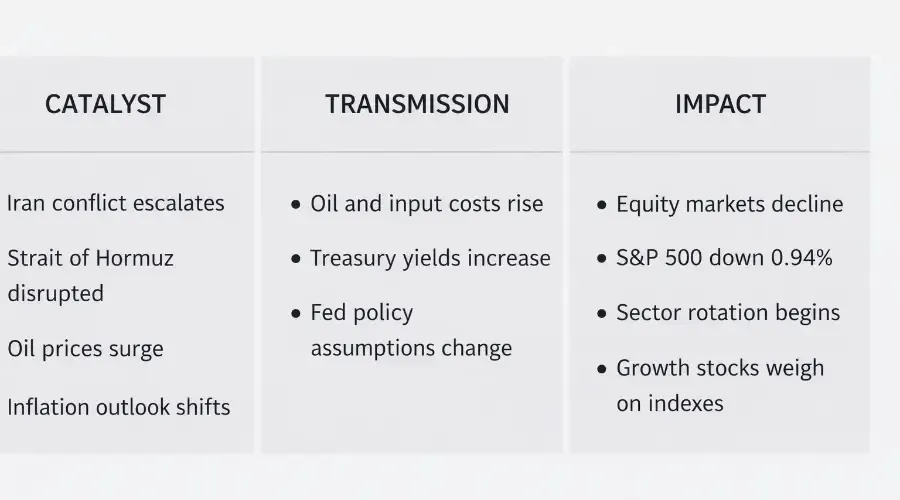
The full transmission chain across the session can be summarized as:
Iran conflict escalation → Oil price spike → Inflation expectations firm → Treasury yields rise → Growth equity multiples compress → Broad equity decline → Diplomatic signals emerge → Oil retreats modestly → Equities partially recover → Markets close lower but stabilized.
The final closing levels therefore represent a reduced escalation risk but a persistent geopolitical premium embedded in asset prices.
Cross-Asset Confirmation
Other asset classes confirmed the macro narrative rather than diverging from it.
Treasury Yields
The 2-year Treasury yield rose 13 basis points to 3.62%, while the 10-year yield increased 8 basis points to 4.05%.
The larger move in the short end suggests markets are adjusting near-term expectations for Federal Reserve policy rather than pricing a long-term inflation surge.
At the same time, the 2s10s yield curve steepened to its widest level since early 2022, marking a transition away from the prolonged inversion that dominated the 2022-2024 period.
U.S. Dollar
The dollar index rose approximately 0.8% to 104.20. Currency markets reinforced the bond market signal: when U.S. yields rise relative to global peers, capital tends to flow toward dollar-denominated assets.
Commodities
Oil and gold moved higher simultaneously. WTI traded near $72.50, Brent around $83.90, and gold approached $2,177.
Oil reflected supply risk. Gold reflected safe-haven demand. Together they reinforced the same geopolitical narrative from different angles.
Volatility
The VIX briefly reached 25.16 intraday, its highest level since November 2025 according to TechFlow data, before closing near 22.19 after diplomatic headlines eased immediate escalation fears.
Divergent Signals Within the Session
Not every data point aligned perfectly with the dominant risk-off narrative.
Two developments stood out as exceptions.
Retail Earnings Strength
Retailers Target and Best Buy both rose sharply after reporting earnings. Target gained approximately 6.74%, while Best Buy increased roughly 5.2%.
These moves reflected company-specific fundamentals rather than the broader geopolitical environment. They suggest that recent consumer activity data remains relatively stable despite macro uncertainty.
Cryptocurrency Resilience
Separate reporting from TechFlow indicated that Bitcoin showed relative resilience during the equity selloff.
Historically, cryptocurrency markets have tended to amplify equity weakness rather than diverge from it. The divergence therefore represents a behavioral signal worth monitoring, even though it does not change the core equity narrative.
Structural Implications
The March 3-4 market behavior is best understood as tactical repricing rather than structural de-risking.
Several indicators support this interpretation.
First, markets reversed sharply on diplomatic headlines within the same session. Structural regime shifts rarely reverse that quickly on a single news item.
Second, sector leadership remained focused on energy and defense, both directly tied to the oil supply narrative. A broader defensive rotation into utilities or staples did not materialize.
Third, ETF flow data indicated broad outflows across multiple sector funds simultaneously, suggesting a shift toward cash rather than targeted sector rotation.
Reuters characterized the behavior as a “dash for cash,” which aligns with the observed flow patterns.
Finally, the 4.05% level on the 10-year Treasury yield has emerged as a key threshold for equity valuation sensitivity. When yields move above that level, the discount rate applied to future earnings rises enough to affect growth equity multiples.
Whether yields stabilize near that level or extend higher will influence how long the current repricing phase persists.
Portfolio Context
Educational framing only. Not investment guidance.
Growth-heavy portfolios face two simultaneous pressures in the current environment. Higher Treasury yields increase discount rates, while geopolitical uncertainty reduces investor tolerance for high-multiple assets.
This combination helps explain the Nasdaq’s underperformance relative to the Dow during the recent sessions.
Energy exposure has moved in the opposite direction. Rising oil prices directly improve revenue expectations for energy companies, making the sector a natural beneficiary of the supply shock.
Balanced portfolios are therefore experiencing a mixed effect, with energy gains partially offsetting weakness in growth sectors.
From a structural standpoint, the primary variable to monitor remains Treasury yield stability near the 4% level.
Bigger Picture
The market activity across March 3-4 does not introduce an entirely new macro environment.
Instead, it intensifies existing tensions already present in the financial system.
Treasury yields were already near 4% before the geopolitical catalyst emerged. Growth equity valuations were already sensitive to interest rates. The Federal Reserve had already paused its rate-hiking cycle.
What the Iran conflict added was a new inflation variable linked to oil supply risk.
If the geopolitical situation stabilizes and oil prices retreat, the premium embedded in yields and equities may ease. If disruptions persist, the inflation outlook could remain elevated and extend the timeline for potential policy easing.
The closing levels across major indices reflect that balance of probabilities. Markets did not collapse, but they did incorporate a measurable geopolitical risk premium.
The result was a session defined less by panic than by measured repricing across multiple asset classes.
Reader Reflection
From a macro perspective, the key question now becomes whether the oil premium proves temporary or persistent.
If the conflict de-escalates, inflation expectations could soften quickly. If supply disruptions continue, energy prices may remain elevated long enough to influence future CPI readings.
Understanding that distinction may determine how markets interpret the next phase of this geopolitical cycle.
Source Reference
This narrative analysis is based on publicly available market reporting and cited sources including Reuters, Charles Schwab Market Update, Trading Economics, and TechFlow data.
GoldmineCluster-MacroNarrative-…
This analysis is produced by BreakoutBulletin for educational purposes only. All market data and news references are sourced from Reuters (March 4, 2026), Charles Schwab Market Update (March 3, 2026), Trading Economics (March 3, 2026), and TechFlow Post (March 3, 2026). Nothing in this analysis constitutes investment advice or a solicitation to buy or sell any security. Markets involve risk. Readers should conduct independent research and consult qualified financial professionals before making any investment decisions.