
Volatility Regime Check
VIX closed at 22.19 on March 4, down 1.38 points (-5.85%) from the prior close of 23.57 on March 3. The decline follows two sessions of elevated volatility driven by geopolitical tensions in the Middle East.
While the one-day decline is notable, the more meaningful signal comes from its position within the recent trading range. Over the past month, VIX has traded between 17.9 and 22.4, with a 20-day average near 20. At 22.19, VIX is now trading at the upper end of that one-month range — a level that has historically corresponded with elevated hedging activity but not acute market distress.
From a structural standpoint, the VIX term structure remains in contango. The front-month VIX at 22.19 trades below VIX3M at 23.54 and VXST (9-day) at 21.85. Contango signals that markets are pricing persistent uncertainty rather than an immediate volatility shock. Traders are paying premiums for protection several weeks out rather than anticipating a near-term volatility spike. The VXST trading below the front-month VIX confirms that immediate-term spike concerns have eased relative to earlier in the week.
Importantly, VIX measures expected volatility, not market direction. A VIX reading above average reflects increased demand for protection but does not itself imply a bearish market forecast.
Put/Call Ratio Analysis
CBOE put/call data today presents a split sentiment picture, which becomes clearer when examined by component. The total put/call ratio at 0.96 suggests balanced options activity. However, the underlying components reveal a more nuanced positioning pattern.
The equity-only put/call ratio sits near 0.72, which is close to historical averages. This implies individual stock options positioning remains relatively neutral. In contrast, the ETP put/call ratio at 1.25 is elevated, indicating a significant skew toward put buying in ETF products such as SPY, QQQ, and IWM.
This divergence is analytically important. It suggests institutional desks are hedging macro exposure through index products, while positioning in individual equities remains comparatively calm. For context, the 5-day average total put/call ratio stands at 0.92, placing today's 0.96 slightly above recent norms but within a range consistent with ongoing geopolitical uncertainty.
Notable Flow Breakdown
Several large block trades across volatility, sector ETFs, and earnings-sensitive equities defined today's options tape.
VIX — Block Call Activity
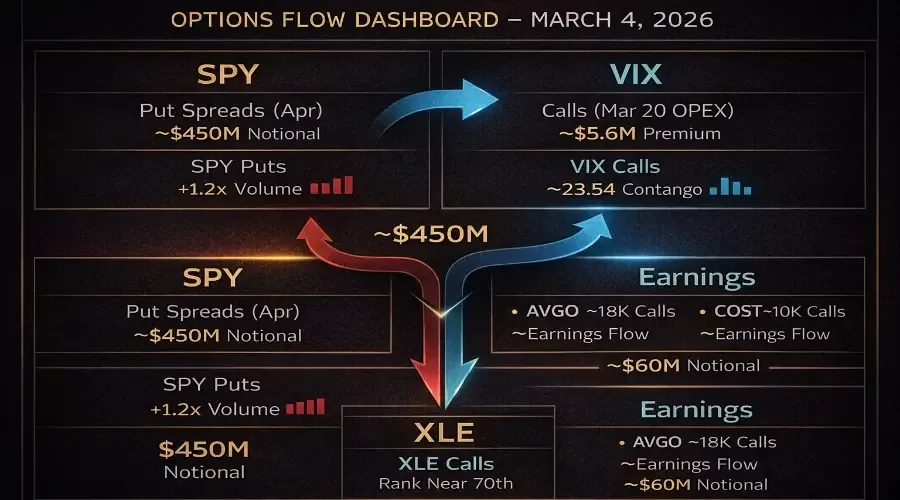
A concentrated block of approximately 40,000 VIX calls traded between 11:00 and 12:00 ET, with tape data suggesting the flow was buyer-initiated. Estimated premium totaled roughly $5.6 million, representing vega exposure near $100 million notional. The volume represented about 67% of existing open interest in that expiry — a significant concentration that signals institutional rather than retail participation.
This type of flow is most consistent with portfolio-level volatility hedging. Institutional investors frequently purchase VIX calls to protect equity portfolios against potential volatility spikes. Because the VIX term structure remains in contango, buying near-term volatility carries a roll cost if volatility does not rise. That cost is effectively the premium paid for insurance.
XLE — Upside Call Block
XLE saw a 25,000-contract call block around 13:15 ET, likely in the April expiry at the $58 strike based on trade logic and open interest patterns. Call volume exceeded existing open interest in the relevant expiry, which typically indicates fresh positioning rather than a rollover of existing trades. Estimated underlying exposure was roughly $225 million.
The timing — shortly after renewed Strait of Hormuz headlines — suggests the flow is tied to the geopolitical premium in energy prices. This flow could reflect directional positioning for continued energy strength. It is also consistent with hedging behavior by energy producers or refiners seeking to cap rising fuel costs.
SPY — April Put Spread
The largest institutional flow of the session appeared in SPY April put spreads totaling roughly 30,000 contracts across both legs, structured as the 5300/5200 put spread based on trade data. The structure — buying the 5300 put while selling the 5200 put — caps protection at the 5200 level but also limits premium cost, making it a common tool for institutional risk managers. Estimated notional protection was roughly $450 million.
The April expiry extends protection beyond the March 20 options expiration, indicating the hedge is intended to cover risk over the coming weeks rather than just the immediate OPEX window. Open interest in the affected strikes increased by approximately 22,000 contracts, confirming new positioning.
AVGO — Pre-Earnings Call Activity
Broadcom (AVGO) recorded 18,000 contracts of call volume, exceeding existing open interest shortly before its earnings release. Tape data suggests the flow was mixed, with both buying and selling interest, but the net effect added approximately 12,000 contracts to open interest.
AVGO's implied volatility rank sits near the 60–70th percentile, with options pricing an expected move of approximately 6.5% in either direction. Two interpretations are possible. The flow may represent a directional bet on a positive earnings reaction, or it may represent a long-volatility strategy designed to profit if the earnings move exceeds the 6.5% implied move.
COST — Earnings Positioning
Costco (COST) also saw elevated call interest near the close. Approximately 10,000 contracts traded around 15:20 ET, shortly before the company's earnings report, with the flow appearing predominantly buyer-initiated.
Implied volatility rank for COST was roughly 55–65th percentile, with options pricing an expected move of approximately 4.2%. Late-session positioning of this type is typical for event-driven strategies, where traders establish exposure shortly before the earnings release window.
Index and ETF Flow
Options flows across major index ETFs showed clear differences in positioning behavior. SPY options activity skewed toward puts, with total volume about 1.2x the 20-day average. The April put spread discussed earlier represents the dominant institutional hedge of the session.
QQQ saw concentrated put activity in the March 20 expiry, consistent with technology sector weakness in the underlying index. IWM displayed mixed activity, including upside call spreads in April. The defined-risk structure suggests cautious positioning rather than aggressive directional exposure.
GLD recorded elevated call activity across April and June expiries, with the flow appearing buyer-initiated. Gold often benefits from geopolitical uncertainty, and longer-dated call activity suggests expectations that the risk narrative may persist beyond the immediate news cycle. TLT saw modest call buying as some traders positioned for potential stabilization in Treasury yields near the 4% level.
OPEX Mechanics Education
The next standard monthly options expiration occurs on March 20, 2026, approximately two weeks away. Understanding OPEX mechanics helps explain certain market behaviors.
Max pain estimates currently place SPX near 5,300 and QQQ near 480. Max pain refers to the theoretical price level where the largest number of options contracts expire worthless. However, with expiration still several weeks away, this influence remains limited.
Gamma exposure (GEX) analysis indicates positive dealer gamma in the SPX 5,250–5,350 range, with the highest concentration near 5,300. When dealers are long gamma, they tend to sell into rallies and buy into declines, which dampens market volatility. This structural dynamic can produce range-bound trading behavior when prices remain within the gamma band.
Because the SPY put spread extends into April, the dominant hedge today appears tied to longer-term risk management rather than OPEX mechanics alone.
Implied Volatility Environment
Implied volatility across major indices remains moderately elevated but not extreme. SPX volatility skew remains positive, meaning out-of-the-money puts carry higher implied volatility than calls. This is the typical configuration reflecting persistent institutional demand for downside protection. The current 25-delta put skew stands at approximately 1.25, near the 60th percentile of the past year.
For earnings names such as AVGO and COST, the current IV environment suggests above-average uncertainty but not panic-level pricing. Following earnings announcements, implied volatility typically declines sharply — a phenomenon known as IV crush. If AVGO implied volatility is 45% pre-earnings and drops to 30% post-earnings, that 15-point decline represents the crush.
Because current IV levels are only moderately elevated, the post-earnings volatility compression is likely to be meaningful but not unusually severe.
DISCLAIMER :
This article is for informational and educational purposes only and does not constitute financial, investment, or trading advice. You are solely responsible for your own investment decisions and should consult a licensed financial professional before acting on any information in this post.