
What Moved the Tape
Geopolitical tensions remain the central macro driver.
U.S.-Israeli strikes on Iranian facilities have now entered their fourth day, while shipping traffic through the Strait of Hormuz has reportedly remained halted for the same duration. Oil markets continue to reflect the supply disruption risk premium associated with that development.
Brent crude added roughly 1% during the session, according to Reuters. That gain follows a much larger move earlier in the week, when oil prices rose about 7% before stabilizing at a higher baseline.
A notable data point emerged from the American Petroleum Institute. U.S. crude inventories increased by approximately 5.6 million barrels, compared with expectations around 2.3 million barrels.
In practical terms, an inventory build of that magnitude would normally weigh on oil prices. The fact that Brent remained positive suggests that geopolitical supply risk is currently absorbing otherwise bearish supply data.
The S&P 500 traded modestly lower during the session, down roughly 0.4-0.6% intraday.
Treasury yields remained stable. The 10-year Treasury yield held near 4.05%, with little additional movement after the prior two sessions saw a repricing of +8 basis points on the 10-year and +13 basis points on the 2-year.
Reuters summarized the broader positioning shift with the headline: "Investors make a dash for cash as Iran crisis upends markets."
Sector flow data appears consistent with that characterization.
Where the Money Is Moving
ETF flow data reveals a clear pattern. Outflows are broad-based rather than sector-specific.
Financials - Capital Leaving Despite Yield Tailwind
Financial sector ETFs saw the largest confirmed outflow.
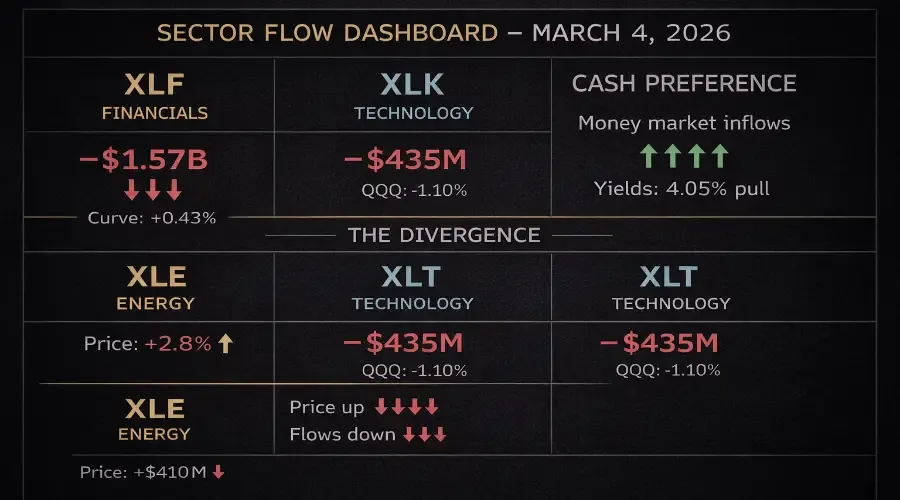
XLF recorded approximately -$1.57 billion in weekly net outflows, the largest among SPDR sector funds.
From a macro standpoint, the current yield curve environment should be supportive for banks. The 2s10s spread near +0.43% is structurally positive for bank net interest margins.
Yet capital is leaving the sector.
From a positioning standpoint, this suggests investors are reducing overall equity exposure rather than rotating away from financials based on a sector-specific thesis. Notably, the flow trend began before the latest escalation in geopolitical tensions.
Technology - Duration Sensitivity Driving Outflows
Technology flows align with recent price performance.
XLK recorded roughly -$435 million in weekly ETF outflows, according to ETFAction.
At the same time, QQQ declined about 1.10% on March 3, underperforming the broader market.
The mechanism is straightforward. When the 10-year yield holds above 4%, the discount rate applied to long-duration earnings increases. Technology companies, whose valuations rely heavily on future earnings streams, are particularly sensitive to this shift.
Portfolio managers often reduce exposure to the highest-multiple and highest-duration names first during such adjustments.
Energy - Price Strength Without ETF Inflows
Energy flows present the most analytically interesting divergence.
XLE recorded approximately -$410.75 million in weekly outflows, even as the sector led equity performance.
Energy stocks rose 2.8% on March 3, with additional gains in early trading on March 4.
Two interpretations are consistent with the data.
Existing energy positions may simply be appreciating without attracting new ETF allocations.
Alternatively, tactical positioning may be occurring through energy futures and options, where Reuters reports record trading volumes.
If the latter explanation holds, energy sector strength is currently being expressed through derivatives rather than through ETF-level capital inflows.
That distinction matters because derivatives-driven positioning can unwind more quickly than traditional long-only equity allocations.
Other Sectors
Flow data for utilities (XLU), healthcare (XLV), and industrials (XLI) was not clearly disclosed in the available sources.
Price performance data exists for these sectors, but confirmed flow figures were not independently verified. As a result, they are excluded from the quantitative flow analysis.
Cash Preference Across Markets
When outflows occur simultaneously across financials, technology, and energy, the simplest explanation is not sector rotation.
Instead, the pattern suggests capital moving toward cash or money-market instruments.
This aligns with the Reuters characterization of a "dash for cash."
The correlation between the Iran-related geopolitical shock and the cross-sector ETF outflows is strong. However, individual investor motivations cannot be fully inferred from flow data alone, and causation remains uncertain at a granular level.
Tactical Framework
This section uses conditional language only.
The most important development to monitor is the divergence between energy prices and ETF flows.
Energy stocks are outperforming, yet XLE flows remain negative.
If oil prices hold above $75 per barrel and XLE continues to outperform despite ongoing ETF outflows, it may suggest that the geopolitical premium is being expressed primarily through futures and options markets.
In that case, positioning could remain tactical rather than structural.
A different signal would emerge if XLE flows shift from outflow to inflow while oil prices remain elevated. That would indicate institutional capital committing to energy equities rather than simply maintaining existing exposure.
Conversely, if geopolitical tensions around the Strait of Hormuz ease and oil prices retreat toward $72-73, the current energy premium could compress relatively quickly. Without strong ETF inflows, there may be less structural buying support to absorb that adjustment.
Structural Context
Current flow behavior appears consistent with tactical risk-off positioning rather than long-term allocation shifts.
Several observations support that interpretation.
First, the ETF outflow pattern has lasted approximately five trading days. Institutional strategists typically require multi-month trends before classifying a rotation as structural.
Second, Reuters reported record energy futures and options trading volumes. Such activity is more typical of hedging and tactical positioning than long-duration equity allocation.
Third, volatility indicators show limited escalation. The VIX recently traded near 22.83, declining slightly even as equities remained weak.
That combination - elevated but stable volatility alongside active options hedging - often signals uncertainty rather than directional conviction.
Taken together, the evidence suggests a tactical repositioning driven by geopolitical risk rather than a durable reallocation of capital across sectors.
Technical Reference Levels
Technical levels are provided as context and require independent validation.
SPY
The most recent confirmed close is $538.10 on March 3, representing a decline of approximately -0.94%.
Intraday trading on March 4 places the ETF roughly between $535 and $537.
A previous high near $545 in late February now functions as the primary overhead reference level. The gap between current levels and that high reflects the geopolitical discount applied to equities during the past several sessions.
QQQ
The most recent confirmed close is $476.00, down -1.10%.
Technology continues to underperform the broader market.
Recent highs in the $485-490 range represent the near-term recovery threshold.
These levels are sourced from historical ETF data and are not independently validated for intraday precision.
This article is for informational and educational purposes only and does not constitute financial, investment, or trading advice. You are solely responsible for your own investment decisions and should consult a licensed financial professional before acting on any information in this post.