
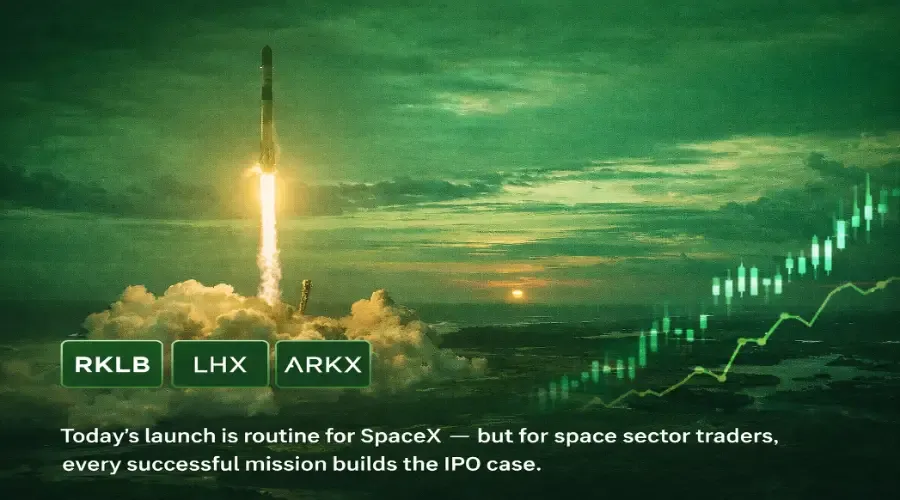
29 satellites. 7:28 AM EDT targeted launch. 11th flight for the booster.
SpaceX’s latest Falcon 9 launch adds another data point to the most closely watched IPO pipeline in global markets. The company is targeting a St. Patrick’s Day mission from Space Launch Complex 40 at Cape Canaveral, carrying 29 Starlink satellites into low Earth orbit. The launch window opens at 6:26 AM EDT and runs through 10:26 AM EDT, with 7:28 AM as the targeted time.
The booster supporting today’s mission is flying for the 11th time, with a planned landing on the droneship A Shortfall of Gravitas. Reusable launch economics remain the core of SpaceX’s structural advantage, enabling higher cadence and lower cost per launch relative to any current competitor.
Why Retail Traders Watch SpaceX Launches
SpaceX is not publicly traded, but its operational cadence directly influences sentiment across listed space and defense names. Each successful mission reinforces confidence in the broader ecosystem tied to launch, satellite infrastructure, and downstream applications.
Rocket Lab (RKLB) acts as a small-launch competitor and often benefits from increased sector attention. The stock has recently moved sharply higher amid renewed interest in the space theme.
L3Harris (LHX) provides indirect exposure through satellite systems and defense integration, positioning it within the infrastructure layer of the ecosystem.
ARK Space ETF (ARKX) offers a broader basket approach, capturing flows across suppliers, contractors, and adjacent technology players.
Historically, Rocket Lab has seen modest post-launch sympathy moves, typically in the 1–2% range, as attention rotates into the sector. The effect is less about fundamentals and more about visibility and narrative reinforcement.
The IPO Narrative — What Changed
What matters is not the launch itself, but what repeated success signals. SpaceX’s private valuation is widely discussed near $1.5 trillion, with mid-2026 frequently cited as a potential IPO window in market conversations.
Key operating estimates suggest $15–16 billion in revenue, ~$7.5 billion in EBITDA, and a rapidly expanding Starlink subscriber base approaching 9 million+ users. A potential IPO could involve a raise in the range of $50 billion, making it one of the largest offerings in history.
Each successful mission strengthens the operational track record required for a public listing of this scale. In practical terms, reliability is not just engineering execution — it is valuation support. A consistent launch cadence reduces perceived risk across both Starlink growth and future Starship commercialization.
At the same time, the valuation debate remains open. A $1.5 trillion pricing assumes sustained dominance in launch, continued subscriber growth, and successful scaling of next-generation systems. Any delays in execution — particularly around Starship — could challenge that narrative.
How Traders Are Positioning Around It
Today’s launch is unlikely to trigger immediate market moves, but it fits into a broader positioning framework.Traders are not reacting to a single event — they are tracking a sequence of confirmations.
In practical terms, positioning remains observational rather than reactive. Market participants are watching RKLB and ARKX for sentiment-driven flows, while monitoring any incremental developments tied to IPO timing or strategic commentary.
This is a slow build in conviction, not a one-day catalyst. The signal emerges from repetition.
📡 Watch Live + What to Track Post-Launch
The launch will be streamed live on spacex.com, typically beginning around 15 minutes before liftoff.
In the immediate aftermath, attention tends to focus on price action in RKLB and LHX, broader sector sentiment shifts, and any indication of technical anomalies, which are rare but can influence short-term positioning.
Upcoming launches also matter, as cadence itself is part of the thesis.
The Bigger Picture — A Structural Shift
Space is increasingly becoming a convergence trade across defense, AI infrastructure, and communications. Unlike semiconductors or cloud computing, the space sector still lacks a dominant publicly traded pure-play.
That gap is what makes SpaceX structurally important. Its eventual IPO would not simply add another listing — it would reshape how capital flows into the sector.
From a structural standpoint, Starlink is evolving into global communications infrastructure, launch systems are becoming a scalable logistics layer, and defense integration is accelerating demand visibility. These are not isolated themes — they are converging into a unified investment narrative.
Bottom Line
Today’s Falcon 9 launch is operationally routine but strategically relevant. It does not move markets in isolation, but it adds another layer of validation to SpaceX’s scale, reliability, and IPO readiness.
For traders, the opportunity remains indirect — through names like RKLB, LHX, and ARKX, and through tracking the evolving IPO narrative rather than reacting to individual launches.
The next real catalyst remains any formal signal around IPO timing or structure. Until then, each successful mission incrementally strengthens the case rather than defining it.
Disclaimer: Educational commentary only. Not financial advice. References to RKLB, LHX, ARKX, and SpaceX are for illustrative purposes only. Trading involves risk of loss. Consult a licensed financial advisor. BreakoutBulletin is not a registered investment advisor. · © 2026 BreakoutBulletin | breakoutbulletin.com