
By Manish T. · July 25, 2026
On Friday evening, SpaceX put on the cleanest Starship test flight of the program so far. On Monday, the market may still be trading the stock like the launch never happened. That gap between engineering progress and share price is the real story for anyone holding, shorting, or just watching $SPCX right now – and it's a useful lesson in why "good news" and "good tape" are not the same trade.
Let's separate what the flight proved from what the market is actually pricing.
What Flight 13 actually delivered
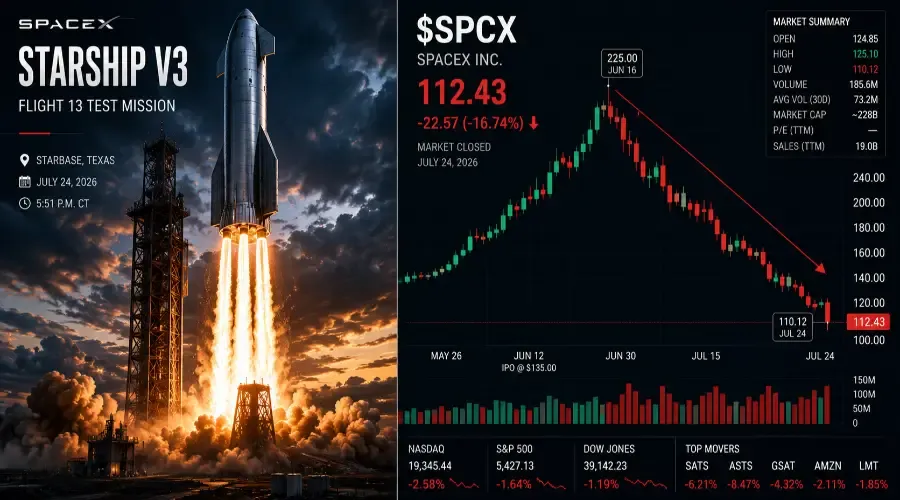
Starship lifted off from Starbase, Texas at 5:51 p.m. CT on July 24 – its thirteenth test and the second flight of the larger V3 vehicle. All 33 Raptor engines fired on the Super Heavy booster, the rocket set a new max-dynamic-pressure record on the way up, and the upper stage completed a full ascent burn before deploying its payload.
The headline: for the first time, Starship carried real Starlink V3 satellites rather than mass simulators. All 20 released cleanly through the "PEZ-dispenser" slit, and SpaceX said it made contact with every one of them using both radio-frequency and laser links. The upper stage then relit an engine mid-coast, survived reentry, and executed what the company called its "softest splashdown" ever in the Indian Ocean – settling into the water intact and still transmitting.
Now the asterisk, because it matters for how you read the follow-through. The Super Heavy booster attempted its landing burn but not all engines relit, producing a harder-than-planned splashdown in the Gulf. And this was an intentionally suborbital flight: the satellites reenter roughly 20 minutes after deployment. So Flight 13 validated the deployment mechanism, the satellite hardware, and the heat shield – it did not add operational capacity to the constellation. It's a strong data-gathering win, not a revenue event.
Why Starlink V3 is the part investors should care about
Strip away the spectacle and the investment case for Starship runs through one number: cost per gigabit in orbit.
Starlink V3 satellites are built to move data at up to 1 terabit per second – a large step over the V2 fleet – and they lean harder into direct-to-device connectivity. The catch is that they're too big and heavy to launch efficiently on Falcon 9. Starship is the vehicle that makes V3 economically deployable at scale. Proving the dispenser works and that the satellites phone home is the first real evidence that SpaceX can eventually batch-deploy this generation cheaply.
That's the margin-expansion thesis in one line: cheaper deployment lowers cost per gigabit, which widens the margin on Starlink's recurring subscription revenue. It's the clearest path from "impressive rocket" to "durable cash flow." Friday was a step toward it – not the arrival.
The tape tells a very different story
Here's where a lot of the celebratory coverage goes quiet. As of late last week, SPCX was a broken IPO – trading below its $135 offer price after a brutal July.
The stock debuted June 12 at $135, ran to an all-time high near $225 on June 16, and has largely bled lower since, dropping roughly 27–31% in July alone and touching a post-IPO low around $110–120. More than a trillion dollars of market cap evaporated from the peak, briefly pushing SpaceX out of the top handful of U.S. companies by value.
Several forces are stacked against the price at once:
Valuation. Even after the drawdown, the company carries a valuation on the order of 85x sales against roughly $19 billion in revenue, with heavy capex and no profits yet. It's priced for a future that still has to show up.
Short interest. Bearish positioning ballooned from about 40 million shares to roughly 185 million – around 29% of the tradable float – an unusually crowded short setup for a stock this large.
The lockup cliff. SpaceX's staggered lockup structure has an expiry landing right around its Q2 report in early August. More sellable shares plus earnings in the same window is a real supply-and-sentiment risk.
The AI overhang. SpaceX now houses xAI – Grok, the Colossus data center, and X – so the stock trades partly as an AI-infrastructure bet during an AI-sector wobble, not as a pure space play.
Related: The $700B AI Capex Reality Check
Analyst caution. HSBC opened coverage with a Hold and a $115 target below the IPO price, even after baking in a premium for Musk's track record.
Against that backdrop, one good test flight is a catalyst, not a cure. It can improve the narrative and squeeze crowded shorts on a strong day – but it doesn't reset the valuation, unwind the lockup, or change the August earnings math.
Related: The AI Bubble Debate Has Become a Portfolio Construction Problem
The read-through: proxies and adjacent names to watch
If you're tracking the ecosystem rather than the single name, the launch reshuffles a familiar set of tickers. Treat these as observations, not signals:
Equity-stake proxies – $SATS (EchoStar), $DXYZ (Destiny Tech100). EchoStar's reported SpaceX exposure has made it move on SpaceX headlines, and Destiny holds private-market space names. These trade as sentiment expressions of the SpaceX story.
LEO / direct-to-device competitors – $ASTS (AST SpaceMobile), $GSAT (Globalstar), $AMZN (Project Kuiper). A working V3 with stronger direct-to-cell capacity is competitive pressure here, not tailwind. Watch whether the narrative tightens SpaceX's lead.
Defense primes and Artemis partners – $LMT, $BA, $NOC. NASA is counting on a Starship-derived lunar lander for Artemis. Each successful flight modestly de-risks that timeline, which matters to milestone-linked contractors.
What to actually watch next
The next two weeks decide whether Flight 13 becomes a turning point or a footnote. The Q2 earnings print in early August, arriving alongside the lockup expiry, is the stress test – that's where fundamentals, insider supply, and sentiment collide. Beyond it, the questions are the same ones institutions are asking: Can SpaceX turn one clean flight into a repeatable launch cadence? Does V3 deployment scale into Starlink revenue? And does any of that arrive fast enough to justify the multiple?
Bottom line
Flight 13 was a genuine engineering milestone and a real step toward the Starlink V3 economics that underpin the bull case. But the market isn't trading the rocket – it's trading valuation, short positioning, a lockup cliff, and an earnings date. Until the price stops making lower lows and clears the supply overhang, the honest observation is this: the flight de-risked the technology, not yet the stock.
Further reading: Dark Side of Claude - 7 AI Trading Failure Modes
This article is for educational purposes and reflects observations on publicly reported information. It is not investment advice or a recommendation to buy or sell any security. Do your own research and consider your own risk tolerance.