
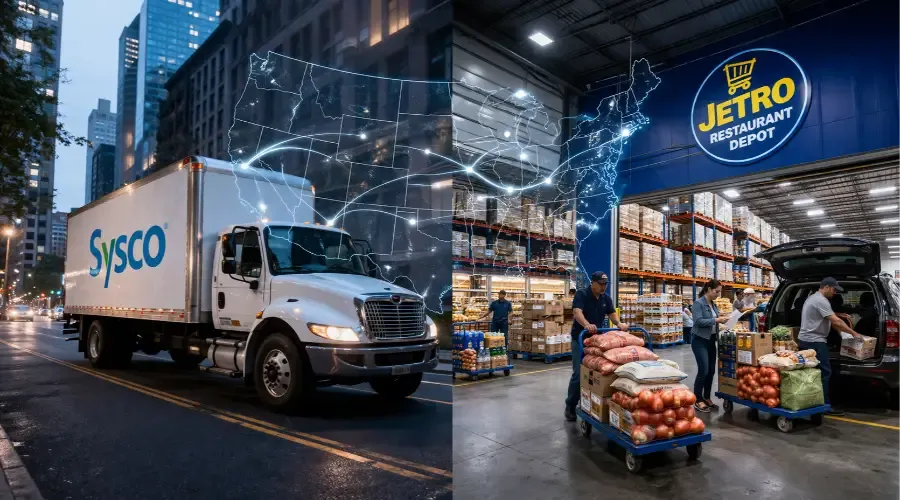
The largest food distribution merger in a decade redefines scale-but markets are skeptical.
By Breakout Bulletin
March 31, 2026
In what could be the most significant consolidation move in U.S. food distribution since the 2010s, Sysco (NYSE: SYY)announced a $29.1 billion agreement to acquire Jetro Restaurant Depot, a privately held cash-and-carry wholesale giant. The deal-one of the largest in the sector’s history-aims to transform Sysco from a traditional delivery-focused distributor into a hybrid powerhouse that also operates a network of 166 warehouse clubs serving independent restaurants.
Investors, however, reacted swiftly and negatively. SYY shares fell as much as 13% intraday, shedding over $5 billion in market value within hours. The sell-off reflected deep concerns about debt, integration risk, and regulatory hurdles.
But beneath the market’s initial panic lies a strategic bet that could redefine the food supply chain for small restaurants—or become a cautionary tale of overreach.
Deal Snapshot
Acquirer: Sysco Corporation (SYY)
Target: Jetro Restaurant Depot
Deal Size: ~$29.1 billion (including assumed debt)
Structure: Cash-and-carry wholesale expansion
Expected Close: Around Q3 FY2027 (subject to regulatory approvals)
Sysco will fund the acquisition through a combination of new debt and existing cash reserves, with no equity component disclosed at this stage. The combined entity would serve more than 725,000 customers across delivery and warehouse channels, cementing Sysco’s position as the undisputed leader in U.S. food distribution.
What This Deal Really Means
Sysco has long dominated the delivery side of food distribution-supplying restaurants, hotels, hospitals, and schools with pre-ordered goods delivered on scheduled routes. Jetro, by contrast, operates a network of 166 cash-and-carry warehouses where customers (primarily independent restaurant owners) walk in, select inventory, and pay immediately.
By merging the two models, Sysco aims to create a hybrid platform reminiscent of Amazon’s fulfillment network combined with Costco’s warehouse experience.
Cross-selling: Delivery customers can now access cash-and-carry for emergency supplies or bulk purchases, while warehouse customers gain access to delivery for routine replenishment.
Efficiency: Cash-and-carry generates immediate cash flow, lower logistics costs per transaction, and higher inventory turnover than traditional delivery.
Defensive positioning: Food distribution is a consumer staples sector—recession-resilient. Expanding the warehouse footprint strengthens Sysco’s grip on the independent restaurant segment, which historically has higher margins than institutional foodservice.
Jetro’s current owners will exit with an estimated $24–$26 billion in cash, depending on final adjustments.
Market Reaction: Why the Stock Sold Off
Despite the strategic rationale, Wall Street reacted with a sharp sell-off. SYY opened down roughly 5–8% and fell as low as 13% intraday, before trimming losses.
The primary drivers of investor skepticism:
Debt load: The deal adds ~$21 billion in new debt, pushing leverage to levels not seen since the 2008 financial crisis.
Interest expense: With rates still elevated, annual interest costs will rise by $1–$1.5 billion, compressing near-term earnings.
Integration risk: Sysco has never operated a large-scale cash-and-carry business. Merging two distinct operating cultures, 166 warehouses, and 725,000 customers creates execution risk.
Equity dilution: If Sysco issues equity to reduce debt, existing shareholders will face dilution.
The sell-off reflects a classic market reaction to a high-risk, transformational deal, where future synergies are overshadowed by immediate balance sheet concerns.
The Risk Side: Three Critical Threats
Leverage Risk
Sysco’s net debt/EBITDA ratio is expected to surge from roughly 2.5x to 4.5–5.0x post-close. While manageable for a defensive business, it leaves limited room for error. Any disruption could force reductions in dividends or capital expenditure.
Integration Complexity
Jetro’s warehouse model differs fundamentally from Sysco’s delivery network. Inventory systems, labor structures, and customer relationships must be aligned. Failure to retain key management and customers could turn this into a value-destructive integration.
Regulatory Overhang
The combined entity could control 30–35% of the U.S. foodservice distribution market, likely attracting scrutiny from the FTC and DOJ. Regulators may demand divestitures or impose conditions that impact deal economics.
Key Catalysts to Watch
Regulatory process: Any FTC “second request” or extended review timeline will signal deeper scrutiny.
Earnings calls: Updates on synergy targets, debt reduction plans, and margins will shape investor confidence.
Integration progress: Early signals around customer retention and cross-selling success will be critical indicators.
The Trade Angle
Panic selling often creates opportunity-if the market’s fears are overblown.
For short-term traders, the 10–13% drop reflects a sharp reaction to debt and regulatory uncertainty.
Watch for a bounce if:
- The deal progresses without major regulatory hurdles
- Management outlines a credible deleveraging roadmap
- Early integration signals are positive
Risk signal: Failure to reclaim the $60–$62 pre-announcement range may indicate structural weakness.
Positioning insight: This is a volatility-driven setup, not a conviction long-term trade—until execution clarity improves.
Why the Market Might Be Wrong
The current pricing assumes worst-case outcomes: debt stress, integration failure, and regulatory pushback.
However:
Cash-and-carry generates immediate free cash flow, with payment collected upfront-reducing receivables and improving liquidity.
Sysco has prior experience integrating acquisitions, including the Brakes Group deal, suggesting operational capability.
Regulatory concerns may be overstated, as this represents channel expansion rather than direct consolidation.
Market activity also indicates two-sided conviction, with institutional buyers stepping in alongside retail selling.
Sector Impact: Ripples Across Consumer Staples
The deal reshapes the competitive landscape across food distribution and consumer staples.
XLP (Consumer Staples ETF): May benefit from increased defensive allocation.
USMV (Low Volatility ETF): Stability narrative strengthened.
Peers such as US Foods (USFD) and Performance Food Group (PFGC) could see re-rating potential amid consolidation expectations.
Strategic Insight: The Breakout Angle
Nothing is random.
This deal reflects a long-term strategy to dominate a fragmented, high-margin segment.
If successful:
- Dual-channel dominance
- Greater supplier leverage
- Improved cost efficiency
If unsuccessful:
- Elevated debt burden
- Integration friction
- Long-term performance drag
The Killer Line
Sysco didn’t just buy warehouses - it bought control of how small restaurants survive.
Investor Takeaway
Short-term: Expect continued volatility driven by sentiment and headlines.
Medium-term: Regulatory clarity and execution updates will guide direction.
Long-term: This remains a binary outcome-success leads to re-rating, failure leads to prolonged underperformance.
Final Thought
Size gives power. Execution decides survival.
Sysco just got bigger. Now the market waits to see if it also gets better.
Stay ahead of market-moving M&A with Breakout Bulletin.
Disclaimer: This article is for informational and educational purposes only. It does not constitute financial advice. Always conduct your own research before making investment decisions.