
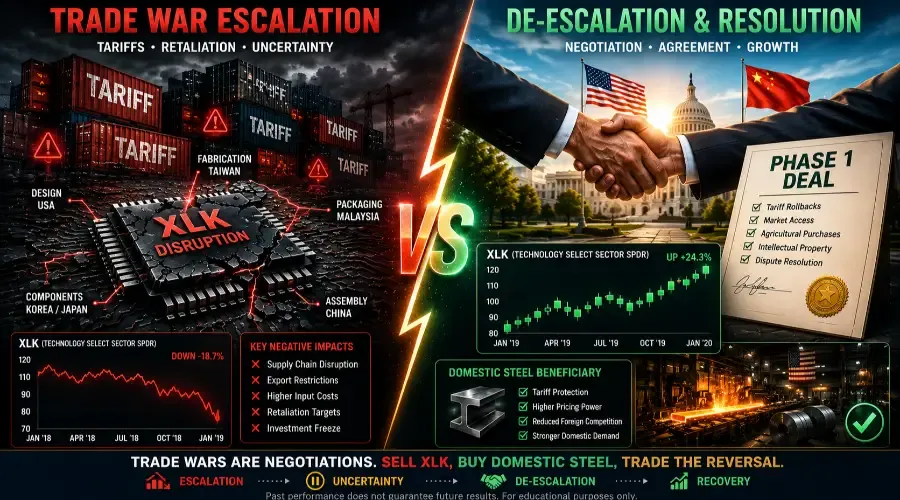
When tariffs hit the tape, the instinct is to sell materials and industrials – the stuff that moves on physical goods. But the real trade war impact on the stock market runs through a different channel entirely: global supply chains. That’s the framework the BBC, Britannica, Investopedia, Grant Thornton, and the OECD don’t give you. And it’s why the XLK vs XLB trade war call – knowing when semiconductors collapse faster than steel – is the entire analytical edge.
BBC tracked it as it unfolded. Britannica defines what a trade war means and how escalation works. Investopedia covers the mechanics. Grant Thornton analyses the implications for businesses. The OECD discusses the macroeconomic consequences. Every source correctly identifies that escalating tariffs raise costs, disrupt supply chains, weaken trade volumes, and increase recession risk. None converts a trade war into the sector-by-sector framework that tells traders which ETFs to buy, which to sell, and why the sector that most retail investors assume is the primary victim – XLB steel and aluminium – is actually sometimes a winner in the early phases of tariff escalation while XLK semiconductors are the most immediately damaged sector regardless of which country initiates the tariffs.
Why This Matters More Than Most Traders Realize
Here’s what makes trade war escalation unique among the policy events in this series: it hits through four channels simultaneously. Each channel pulls different sectors in different directions, sometimes with opposite signs. Miss even one, and you’ll get your sector rotation call wrong.
Channel 1 – Input Cost Channel
Tariffs on imported goods raise the cost of any US company that uses those goods as inputs. Steel tariffs raise the cost of manufacturing. Electronics component tariffs raise the cost of consumer goods assembly. Raw material tariffs raise the cost of everything downstream.
Channel 2 – Retaliation Channel
Every tariff US the government imposes invites a retaliatory tariff from the affected trading partner. China's response to 2018 US tariffs specifically targeted US agriculture (soybeans, pork), US energy (LNG exports), and US autos – deliberately chosen to maximise political pain in swing states rather than maximise economic damage. Understanding what the retaliation targets tells you which sectors face the export revenue collapse.
Channel 3 – Supply Chain Disruption Channel
Modern manufacturing supply chains cross borders multiple times before a finished product reaches the consumer. A semiconductor chip may be designed in the US, fabricated in Taiwan, packaged in Malaysia, assembled into a device in China, and sold globally. Any tariff on any step of this chain raises costs, delays production, and creates procurement uncertainty. XLK is the most supply-chain-complex sector in the S&P 500 – and therefore the most vulnerable to tariff-driven disruption regardless of which goods are specifically targeted. That semiconductor supply chain disruption is the first domino to fall.
Channel 4 – Uncertainty Channel
Separate from the direct tariff cost, the unpredictability of trade war escalation creates an investment freeze. CFOs defer factory investment, procurement officers lock in supply agreements defensively, and M&A activity slows as deal valuations become uncertain. This uncertainty discount falls on every sector but is heaviest in the capital goods and technology sectors where investment cycles are longest. [LINK: Central Bank Hub]
Historical Trade War Events and Sector Returns
The table below summarizes the most significant modern trade war episodes, the key sector reactions, and the pattern of escalation followed by negotiation-driven recovery.
Date / Episode
Tariff Action
Key Sector Moves
De-Escalation Signal
Mar 2018 – Section 232 steel & aluminium tariffs
25% steel, 10% aluminium tariffs on most trading partners → Domestic steel producers outperformed (Nucor, Steel Dynamics) over subsequent quarters; XLK fell on supply chain uncertainty
Exemptions granted to key allies within months
Jul–Sep 2018 – China Section 301 tariffs (List 1–3)
$250 billion in tariffs on Chinese goods, escalating in tranches → XLK (especially semiconductors) fell significantly; XLY retail with Chinese sourcing underperformed; soybeans fell ~20% on Chinese retaliation
Xi-Trump meeting at G20 (Dec 2018) triggered 90-day truce and initial de-escalation rally
Dec 2019 – Phase 1 deal announcement
Tariff rollback on some goods; China agreed to purchase US agricultural products → XLK and semiconductor stocks recovered sharply; SMH (semiconductor ETF) gained ~5% in two weeks
Deal signing Jan 2020, full de-escalation into early 2020
2025 – Broad multi-partner tariff escalation
Wide tariff package across multiple trading partners; precise scope still evolving → Preliminary pattern mirrors prior episodes: XLK underperformance, domestic metals relative strength, retaliation hits agricultural exports
Leadership-level meetings remain the primary de-escalation trigger; events still developing
Sources: USTR notices, S&P sector ETF data, CBOE, Federal Register. Past performance does not guarantee future results.
Regime Change: Trade Wars Are Negotiations, Not Permanent Policies
Trade war escalation is a regime change – but uniquely, it is a regime designed to produce a negotiated resolution. Unlike a Fed rate hike cycle (which ends when inflation is controlled) or a tax hike (which is permanent until reversed by legislation), trade wars are inherently tools of negotiation. Tariffs are imposed to extract concessions; they escalate when negotiations stall and de-escalate when agreements are reached.
This negotiation character creates the most important structural feature of trade war positioning: the de-escalation reversal trade is as predictable and as large as the escalation trade. When a "Phase 1 deal" or preliminary framework is announced, the sectors that fell most during escalation recover most sharply – often within days of the announcement. The trader who holds escalation positions through the de-escalation announcement gives back a significant portion of gains.
The regime also features a specific communication dynamic unique to the Trump trade war period: single tweets, press conference statements, and anonymous official leaks moved markets dramatically – making the news monitoring requirement for trade war positioning more intensive than any other policy event. The "phone call between presidents" signal – consistently the market's preferred de-escalation indicator – is the earliest and most reliable reversal trigger.
Three phases define every modern trade war episode:
Escalation Phase
New tariff announcements → market selloff → retaliatory announcement → second selloff. The dominant sector motion is down for XLK, XLY, and export-exposed XLI names.
Uncertainty Plateau
After initial salvos, a standoff period where tariffs are active but no resolution is imminent. The uncertainty discount persists. Capital investment freezes. The sector performance in this phase is driven by which companies can most rapidly adjust supply chains versus which are most structurally dependent on the tariffed trade flows.
De-Escalation
Preliminary agreement, truce, or Phase 1 deal. Sharp reversal in XLK and XLY. The speed and magnitude of the reversal are typically compressed – markets recover a substantial portion of escalation losses in the first two weeks of a credible de-escalation signal.
Sector Scorecard
Technology (XLK) – Significant Negative – Immediate.
XLK is the primary trade war victim – not because technology products are specifically tariffed more than other goods, but because technology supply chains are the most globally distributed of any sector. Apple's iPhone supply chain involves components from seventeen countries. Semiconductor fabrication depends on Dutch lithography equipment, Taiwanese fabrication, Korean memory, and Chinese assembly. Tariffs on any link in this chain raise costs and create substitution pressures that are expensive and slow to resolve. XLK also faces direct export restriction risk – specifically, US semiconductor companies' ability to sell to Chinese customers is the most politically sensitive export control issue in any trade war with China. The combination of supply chain disruption and export restriction risk makes XLK the first-mover in any trade war escalation.
Consumer Discretionary (XLY) – Moderate Negative – 1–3 Months.
Consumer goods with Asian manufacturing – electronics, clothing, footwear, and household products – face the direct tariff cost impact within one to two quarters as existing inventory buffers are consumed and new orders at tariff-elevated prices are placed. Retailers with the highest percentage of Chinese-sourced inventory face the steepest margin compression. Auto manufacturers face supply chain cost increases from steel and aluminium tariffs as well as retaliatory tariffs on their vehicles sold in affected markets. Target, Nike, and the auto manufacturers are the clearest XLY trade war victims – each has explicitly quantified tariff impacts in their earnings disclosures during trade war episodes.
Materials (XLB) – Mixed – Immediate.
The most counterintuitive sector call in trade war analysis: domestic steel and aluminium producers initially benefit from Section 232-type tariffs that protect them from foreign competition. Nucor, Steel Dynamics, and US Steel typically outperform XLB broadly in the early months of US metal tariff implementation, though the immediate weeks after an announcement often see only modest moves, with the real outperformance accumulating over subsequent quarters. However, this domestic protection benefit is time-limited: as downstream manufacturers face higher steel input costs, they reduce volume orders; and as trading partners retaliate against US steel exports, the international market shrinks. The net XLB signal is positive for domestic-facing producers in the first two to three months and increasingly negative as the broader trade war reduces global industrial activity.
Industrials (XLI) – Mixed – 1–3 Months.
XLI contains both winners and losers from trade war escalation – making it the sector requiring the most granular internal analysis. Defence companies (Lockheed Martin, Raytheon, General Dynamics) are largely insulated – their government contract revenue is not trade-dependent and their domestic supply chains are US-sourced. Domestic manufacturers competing with Chinese imports benefit from tariff protection. Export-oriented capital goods companies (Caterpillar, Cummins) face retaliatory headwinds in their international markets. The net XLI signal depends on this internal composition; the defence sub-sector overweight versus the export machinery underweight is the most specific XLI trade war positioning.
Consumer Staples (XLP) – Mild Negative – 1–3 Months.
The retaliation channel hits XLP through US agricultural exports. China's deliberate targeting of soybeans, pork, and other agricultural products in the 2018-2019 trade war reduced US food export revenues and food producer margins. Additionally, packaging and logistics cost increases from steel, aluminium, and chemical tariffs raise XLP input costs. The magnitude is mild – consumers continue buying XLP products regardless of trade war headlines – but the retaliation targeting makes the agricultural sub-sector of XLP more specifically vulnerable than the sector's defensive characteristics would suggest.
Energy (XLE) – Mild Negative – 1–3 Months.
China specifically targeted US LNG exports in 2018 retaliation – reducing the addressable export market for US energy producers. Additionally, trade war uncertainty reduces global growth expectations, which reduces forward oil demand forecasts. The dollar strengthening that often accompanies US trade war escalation (as higher tariffs attract capital inflows) further compresses dollar-denominated energy prices. The net XLE signal is mildly negative from multiple overlapping channels.
Health Care (XLV) – Moderate Negative – 1–3 Months.
Pharmaceutical supply chains have significant China exposure – generic drug ingredients (APIs) are substantially manufactured in China and India. Tariffs on pharmaceutical precursors raise domestic drug manufacturing costs. Medical device manufacturers with complex Asian assembly operations face similar input cost headwinds. The XLV tariff risk is less visible than XLK's but more structurally impactful than casual analysis suggests – particularly for generic pharmaceutical producers.
Financials (XLF) – Mild Negative – 1–3 Months.
Trade war uncertainty reduces M&A activity (cross-border deals face political risk), reduces trade finance volumes (letter of credit and export credit business falls with trade volumes), and increases commercial credit risk for trade-dependent borrowers. Investment banking revenue faces deal volume headwinds; corporate banking faces trade finance headwinds. The XLF impact is modest in absolute terms but consistent across every trade war episode.
Real Estate (XLRE) – Approximately Neutral.
Domestic real estate, particularly the residential and commercial property REITs within XLRE, has minimal direct trade war exposure. Tariffs on building materials like steel and lumber can marginally raise construction costs, but the effect is small relative to the interest-rate drivers that dominate the sector. XLRE does not benefit from trade war escalation, but it does not face the export, supply chain, or retaliation risks that hit other sectors.
Utilities (XLU) – Approximately Neutral.
Regulated domestic utilities have no meaningful trade war exposure – they earn domestically, source most inputs domestically, and face no export revenue risk from retaliation. XLU benefits only modestly from the relative defensive premium that accrues when cyclical and trade-exposed sectors are under pressure. It is the closest thing to a sector safe haven in a trade war episode.
Historical Cases
2018–2019 US-China Trade War – The Definitive Modern Case
The US imposed tariffs beginning March 2018 – initially on steel and aluminium under Section 232, then escalating to $360 billion of Chinese goods across multiple rounds. XLK fell sharply on each escalation announcement, particularly semiconductor names with China revenue exposure. Apple’s stock fell approximately 38% from its October 2018 peak to its January 2019 trough as the trade war combined with China demand concerns and broader market volatility. Domestic steel producers initially benefited from the Section 232 announcement – Nucor and its peers delivered substantial outperformance over the following quarters as tariff protection improved pricing and margins. China's retaliation specifically targeted soybeans (falling 20% in price) and US LNG exports. The Phase 1 deal announced in December 2019 and signed January 2020 produced an immediate XLK recovery – semiconductor and technology stocks rallied, with the semiconductor ETF (SMH) gaining roughly 5% in the two weeks following the announcement, recovering a significant portion of trade-war losses. The full round-trip confirmed both the escalation and de-escalation positioning opportunity.
2025 Tariff Escalation – A Developing Chapter
The 2025 tariff escalation – documented by BBC and involving a broad tariff package applied across multiple trading partners – represents a wider tariff coverage than 2018-2019. Preliminary sector patterns are consistent with historical precedent: XLK semiconductors and XLY consumer goods with Asian manufacturing face the most immediate disruption, domestic steel names show relative strength, and agricultural exports remain a retaliation target. The broader coverage creates more diffuse supply chain uncertainty than the concentrated 2018 China-focused episode, making sector-specific positioning more complex. Full historical market impact data remains incomplete as this episode continues to evolve. The framework described here – XLK underweight on escalation, domestic metals beneficiary, de-escalation reversal triggered by leadership-level meetings – remains the guiding structure for assessing unfolding events.
The Trading Playbook
Before
Monitor the Office of the United States Trade Representative (USTR) docket at ustr.gov. Tariff investigations and Section 301 actions are published in the Federal Register before announcement – creating a weeks-long pre-announcement window for positioning. When a Federal Register notice opens a tariff investigation on specific goods, the affected supply chains begin pricing disruption risk within days of the notice publication, weeks before any formal tariff announcement.
Rank sectors by supply chain complexity using corporate disclosure documents. 10-K annual reports disclose geographic revenue and sourcing information. The sectors with the highest percentage of cross-border supply chain exposure are XLK (most), XLV pharma ingredients (second), and XLY consumer goods manufacturing (third). This ranking determines the sequence and magnitude of tariff escalation positioning.
During
Immediately reduce XLK on any tariff announcement affecting technology goods, semiconductors, or Chinese manufacturing – these names have the most complex supply chains and face both direct cost impact and export restriction risk simultaneously. The XLK underweight should be sized for a two to three quarter holding period, assuming tariffs stay in place.
Add domestic XLB steel producers and domestic-focused XLI defence names as the relative beneficiaries of US tariff protection – sized for a one to two quarter holding period before the secondary demand destruction from higher input costs begins counteracting the protection benefit.
Reduce XLF investment banking exposure within two to three months as deal pipeline data confirms the trade uncertainty-driven M&A slowdown.
After – The De-Escalation Reversal
The single most important trade war trade signal: A confirmed leader-level phone call or in-person meeting between US and counterpart negotiators. Every significant trade war de-escalation in the modern era has been preceded by a publicly announced direct engagement between heads of state or senior trade officials. When this announcement is made, begin rebuilding XLK immediately – the technology supply chain reversal trade is the fastest and largest sector recovery in any trade war de-escalation.
Monitor USTR announcements for tariff suspension, reduction, or exemption lists. Specific product exclusions are published on the USTR website and signal which supply chain disruptions are being resolved – allowing more targeted sector rebuilding than a broad de-escalation announcement provides.
The 3 Mistakes Most Retail Traders Make
Mistake 1: Treating Steel Tariffs as Uniformly Negative for XLB.
The 2018 Section 232 steel and aluminium tariffs initially benefited domestic steel producers by pricing foreign competition out of the US market. Investors who sold XLB broadly on steel tariff announcements sold the domestic steel producers that were the primary beneficiaries. The correct positioning disaggregates within XLB: domestic steel names (Nucor, Steel Dynamics) are early-phase beneficiaries; globally-exposed mining and chemical companies within XLB face the retaliation and demand destruction headwinds. Sector-level ETF positioning misses this critical internal divergence.
Mistake 2: Holding Escalation Positions Through De-Escalation Announcements.
The de-escalation reversal is rapid – a substantial portion of escalation losses typically recovers within the first two weeks of a credible trade deal announcement. Holding XLK underweights through a Phase 1 deal announcement or leaders' summit confirmation gives back most of the gains from the escalation positioning. The trade war is a negotiation; the deal announcement is the reversal signal. Setting a standing alert for USTR deal announcements and leader-level engagement news allows the reversal to be acted on quickly rather than being caught positioned against the recovery.
Mistake 3: Ignoring the Retaliation Targeting Logic.
The third mistake is positioning sector underweights based on which US sectors import tariffed goods, without considering which US sectors will be targeted by retaliatory tariffs from the affected trading partner. China's 2018 retaliation specifically chose US agricultural exports because they were politically targeted to maximise pressure on the administration's rural political base – not because they were the most economically logical retaliation target. Understanding the retaliation logic (political pain maximisation, not economic optimisation) tells you which US export sectors face headwinds that raw trade flow analysis would not predict.
Bottom Line: The One-Sentence Institutional Framework
When tariffs escalate, immediately reduce XLK for supply chain disruption and export restriction risk, add domestic XLB steel producers and XLI defence names as protected beneficiaries, reduce XLY consumer goods with Asian manufacturing, and use a confirmed leader-level negotiation meeting as the de-escalation signal to reverse all positions – because trade wars are negotiations, and the reversal trade is as large as the escalation trade.
This framework works across cycles because the supply chain complexity ranking – which makes XLK the most vulnerable and domestic producers the most protected – is a structural feature of how US companies have globalised their operations. It does not change between the 2018-2019 episode and the 2025 episode. The retaliation targeting logic also repeats: trading partners consistently target politically sensitive US exports rather than economically optimal retaliation – making US agricultural and energy exports the consistent retaliation victims regardless of which US industry initiated the tariff.
Run this scenario through the [Breakout Bulletin Ripple Engine](LINK: Ripple Engine Tool) to see the full sector transmission map for tariff escalation – and compare how the supply chain disruption channel, the retaliation channel, and the uncertainty channel each activate at different rates across all twelve sectors.
Frequently Asked Questions
What happens to stocks during a trade war?
Trade wars typically increase costs, disrupt global supply chains, reduce trade volumes, and create uncertainty for businesses. Technology and globally integrated sectors usually fall first, while some domestic industries may temporarily benefit.
Why is XLK the biggest loser during trade wars?
XLK is highly dependent on global supply chains involving semiconductors, manufacturing, assembly, and exports across multiple countries. Tariffs and export restrictions disrupt these chains immediately.
Do steel tariffs help XLB initially?
Yes. Domestic steel and aluminium producers inside XLB can initially benefit because tariffs reduce foreign competition. However, broader trade war effects can later weaken industrial demand.
Which sectors usually suffer most during tariff escalation?
The most vulnerable sectors are:
XLK (Technology)
XLY (Consumer Discretionary)
XLI (Industrials with export exposure)
What is the “de-escalation reversal trade”?
When governments announce negotiations, trade deals, or tariff reductions, the sectors hit hardest during escalation often rebound rapidly. Technology and semiconductor stocks usually recover the fastest.
Why are semiconductors so vulnerable during trade wars?
Semiconductor supply chains are globally distributed. Chips may be designed in the US, fabricated in Taiwan, packaged in Malaysia, assembled in China, and sold globally. Tariffs or export controls at any stage disrupt the entire chain.
What sectors are defensive during trade wars?
XLU is generally considered defensive because utilities operate domestically and are less exposed to global trade disruptions.
This post is part of the BreakoutBulletin "What Happens When" series. [LINK: Central Bank Hub] · [LINK: Series Pillar Page]
Educational content only. Not investment advice. Past sector performance patterns do not guarantee future results.