
March 4, 2026 | BreakoutBulletin Macro Intelligence
Educational commentary only. Not investment advice. Sources include TradingView, StockInvest, Phemex Academy, BeInCrypto, Seeking Alpha, and FASB ASU 2023-08 documentation.
What Happened Today
Strategy Inc. (NASDAQ: MSTR) is up roughly 9.27% on March 4, 2026, moving from a March 3 close of $132.68 to an intraday high of $144.80, before settling near $144 in afternoon trading.
Two developments are getting most of the headlines.
First, the company purchased more than 3,000 additional bitcoins, pushing its total holdings to 720,737 BTC, now valued at roughly $54 billion at current prices.
Second, the Strategy World 2026 conference introduced updates around enterprise analytics and AI initiatives, adding another narrative layer to the stock's move.
Most coverage stops there. Fresh Bitcoin purchase, conference optimism, stock up.
But the deeper analytical question is more interesting.
How does a company whose entire Bitcoin treasury is sitting roughly at break-even manage to rally almost 10% in a single trading session?
The answer lies in what many investors misunderstand about Strategy's structure.
The Numbers Behind the Story
Start with the basic data points.
Strategy's 52-week high sits at $457.20, while the 52-week low is $104.17. With the stock closing at $132.68 on March 3, it remains about 71% below its peak and only 27% above its annual low.
Bitcoin tells a similar story.
BTC reached nearly $126,000 in October 2025 before falling about 47%, settling in the mid-$60,000 range by early 2026. Currently, Bitcoin trades near $67,200, reflecting a modest recovery tied to geopolitical uncertainty.
Strategy's average acquisition price is approximately $66,385 per Bitcoin.
In other words, the company's massive 720,737 BTC treasury is hovering close to its cost basis.
Years of capital raises, convertible notes, and equity issuance have produced a treasury that is currently roughly flat in mark-to-market terms.
Yet Strategy just bought more Bitcoin.
That decision is the real analytical center of the story.
What Strategy Actually Is
To understand Strategy's stock behavior, you have to step back and look at the company's architecture.
On paper, Strategy runs two businesses.
One is its enterprise analytics software platform, recently expanded into AI products such as Strategy One and Strategy Mosaic, which aim to help organizations extract insights from large datasets. That business produces revenue.
But the market does not price Strategy primarily as a software company anymore. It prices it as a leveraged Bitcoin vehicle.
The difference matters.
Unlike owning Bitcoin directly or through a spot ETF, Strategy finances its Bitcoin purchases through convertible debt, preferred equity, and stock issuance. The company currently carries around $8.2 billion in convertible notes, alongside multiple preferred stock series used to raise additional capital. These instruments typically carry interest rates or dividend obligations that must be serviced regardless of Bitcoin's performance.
This structure amplifies Bitcoin's moves.
When Bitcoin rises, MSTR tends to rise more. When Bitcoin falls, MSTR usually falls harder.
The Leverage Loop
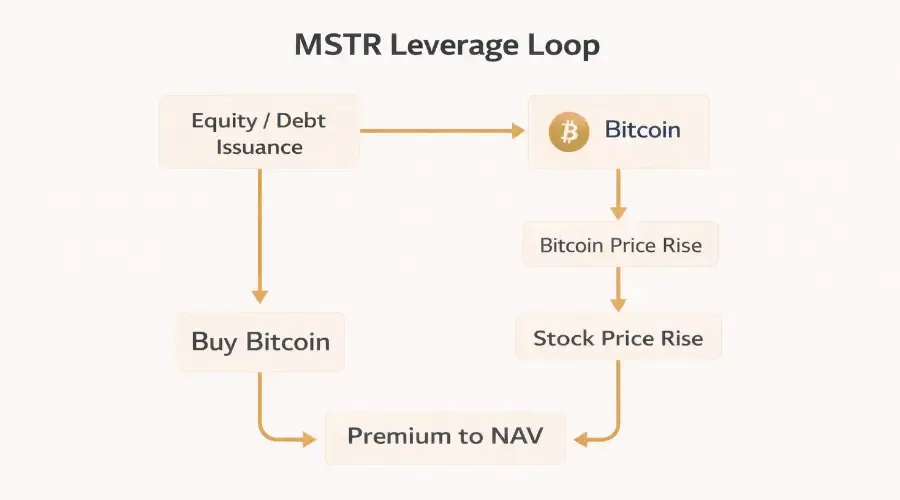
The core financial mechanism behind Strategy's model is often described as the leverage loop. Here is how it works.
| Step | Mechanism | Effect |
|---|---|---|
| 1 | Issue equity or convertible debt | Raises capital, dilutes existing shareholders |
| 2 | Purchase Bitcoin | Increases BTC holdings per share |
| 3 | Bitcoin price rises | NAV increases, stock price appreciates |
| 4 | Stock trades at premium to NAV | Enables more equity issuance at favorable terms |
| 5 | Repeat cycle | Leverage amplifies returns (and losses) |
Strategy issues equity through its at-the-market (ATM) program and raises additional capital through convertible debt or preferred securities. Those funds are then used to purchase more Bitcoin.
If Bitcoin rises, the value of Strategy's holdings increases. That appreciation tends to lift the company's stock price as well. If the stock trades above the value of its Bitcoin holdings, Strategy gains the ability to issue additional equity at a premium. That new capital can then fund further Bitcoin purchases. And the cycle repeats.
The ATM program still had about $8.1 billion of capacity remaining as of February 1, 2026, meaning the mechanism remains active. However, each ATM issuance dilutes existing shareholders — a trade-off the market accepts when Bitcoin is rising. When Bitcoin is flat or falling, the dilution becomes a hidden tax on shareholders.
The Metric That Matters: mNAV
Professional investors evaluating Strategy often focus on one key metric.
mNAV, or the market capitalization to net asset value ratio. It measures how much investors are paying relative to the value of Strategy's Bitcoin holdings.
mNAV is calculated as: Market Capitalization ÷ (BTC Holdings × Current BTC Price)
When mNAV is above 1.0, the stock trades at a premium to its Bitcoin assets. When it moves toward 1.0, the premium disappears.
Currently, Strategy trades around 1.08 mNAV, meaning the stock carries roughly an 8% premium to the value of the Bitcoin it holds. At $67,200 BTC and 720,737 BTC, the Bitcoin treasury is worth approximately $48.4 billion. With a market cap near $52.3 billion, the 1.08 ratio reflects the modest premium investors are currently willing to pay.
That is a dramatic shift from the past.
During the Bitcoin rally of 2024 and early 2025, Strategy traded at 2x to 3x mNAV. Investors were paying well above the underlying Bitcoin value for several reasons:
-
Leverage exposure to BTC
-
Confidence in Michael Saylor's strategy
-
The "first institutional Bitcoin treasury" narrative
-
Optional upside from the software business
Today, most of that premium has disappeared.
At mNAV 1.08, investors are essentially paying 8% above the price of the Bitcoin they indirectly own, while also assuming the company's leverage obligations. That compression is arguably the most important signal in the entire story.
Why Earnings Numbers Look So Strange
Strategy's most recent earnings report included a staggering –$42.93 per share result, compared with an estimate of –$0.08.
At first glance, that looks catastrophic.
But the figure is largely an accounting artifact.
A rule change known as FASB ASU 2023-08 requires companies holding crypto assets to mark those assets to fair value each reporting period. That means Bitcoin price swings now flow directly into the income statement.
Strategy's $12.4 billion net loss in Q4 2025 was almost entirely an unrealized accounting loss driven by Bitcoin's price decline. It was not a cash loss.
For a company holding 720,737 BTC, even small price movements can produce enormous accounting swings. A $1,000 change in Bitcoin's price creates roughly $720 million in accounting impact — larger than the annual revenue of many S&P 500 companies.
Traditional earnings metrics therefore tell investors very little about Strategy's underlying position.
The Hidden Signal in Preferred Dividends
One detail in recent filings deserves closer attention.
Strategy increased the STRC preferred dividend to 11.50% for March 2026, up from 10.75% in February, marking the seventh consecutive increase.
That matters.
Preferred securities function like interest-bearing capital. Investors receive dividends in exchange for providing funding that Strategy deploys into Bitcoin purchases. Raising the dividend repeatedly suggests that attracting capital has required progressively higher incentives.
At 11.50%, the preferred dividend now sits far above the 10-year Treasury yield near 4.05% — a spread of more than 700 basis points that represents a meaningful cost of capital.
If Bitcoin prices fail to rise meaningfully from current levels, those preferred obligations could weigh on the equity.
Why the Stock Is Up Today
The immediate driver behind today's rally appears linked to Bitcoin itself.
Bitcoin has rebounded around 4–5%, partly tied to geopolitical uncertainty related to the Iran conflict. Gold has also moved higher, approaching $2,177, reinforcing the narrative that some investors view Bitcoin as a digital store of value during periods of global tension.
Strategy amplifies that move.
When Bitcoin rises by several percentage points, MSTR often moves twice as much because of its leverage structure.
Today's chain looks something like this:
Geopolitical tension → Bitcoin recovery → leveraged exposure through Strategy → amplified stock move.
The conference narrative and additional Bitcoin purchase helped reinforce the move, but the core driver remains Bitcoin itself.
Three Structural Features That Make Strategy Different
Strategy stands apart from most publicly traded companies in three important ways.
First, it behaves less like a traditional stock and more like a leveraged Bitcoin instrument. Revenue from software operations exists, but the company's valuation is primarily driven by Bitcoin price movements.
Second, reported earnings can be misleading. Because Bitcoin holdings must be marked to market each quarter, accounting results often reflect crypto volatility rather than operational performance.
Third, dilution is part of the model. Strategy regularly issues equity to fund additional Bitcoin purchases. If Bitcoin does not appreciate enough to offset that dilution, shareholders can lose relative ownership value. For example, a 10% Bitcoin gain with 5% dilution leaves shareholders with only 5% net benefit. If Bitcoin is flat, dilution creates immediate value destruction.
What Investors Are Watching Now
Several signals will determine how the Strategy story evolves from here.
First, Bitcoin's price relative to the company's $66,385 cost basis. Sustained prices above $70,000 would push the treasury back into unrealized profit territory.
Second, the mNAV ratio. A move back toward 1.3–1.5 would suggest the market is again willing to pay a premium for Strategy's leverage structure.
Third, the preferred dividend trajectory. Continued increases could signal rising capital costs for the company's funding model.
Fourth, the Strategy World AI narrative may matter more than it appears today. If the enterprise analytics and AI products begin generating meaningful revenue growth, they could provide a second valuation pillar beyond Bitcoin. Currently, the software business is likely valued at $2–3 billion, representing only 5–10% of Strategy's market cap — a reminder that Bitcoin remains the dominant driver.
The Bigger Picture
Today's 9% rally in MSTR illustrates a broader principle about financial markets.
Structure often matters as much as fundamentals.
Strategy's capital structure amplifies Bitcoin movements. When Bitcoin rises, the stock tends to respond with greater intensity. When Bitcoin falls, the same mechanism works in reverse.
Understanding that architecture makes the stock's behavior far easier to interpret.
The key variables remain straightforward:
-
Bitcoin price
-
mNAV premium
-
Cost of leverage
Everything else flows from those three numbers.
-
Attachment Title
MSTR Leverage Loop: Key Metrics Summary -
Attachment Content
Current Snapshot (March 4, 2026)
-
MSTR price: $144 (intraday high) | +9.27%
-
52-week range: $104.17 – $457.20
-
Bitcoin price: $67,200
-
MSTR cost basis: $66,385 per BTC
-
BTC holdings: 720,737 | Value: ~$48.4B
-
Market cap: ~$52.3B
-
mNAV: 1.08 (8% premium to BTC holdings)
Leverage Structure
-
Convertible notes: ~$8.2B
-
ATM capacity remaining: ~$8.1B
-
STRC preferred dividend: 11.50% (7th consecutive increase)
-
10-year Treasury: 4.05% (spread: 745bps)
What to Watch
-
Bitcoin price vs. $66,385 cost basis
-
mNAV ratio (current 1.08, historical peak 3.0)
-
Preferred dividend trajectory
-
Software business valuation ($2-3B, 5-10% of market cap)
The Leverage Loop
Issue equity → Buy Bitcoin → BTC rises → NAV up → Stock premium → Issue more equity → Repeat
Disclaimer: This article is for informational and educational purposes only and does not constitute financial, investment, or trading advice. You are solely responsible for your own investment decisions and should consult a licensed financial professional before acting on any information in this post.