
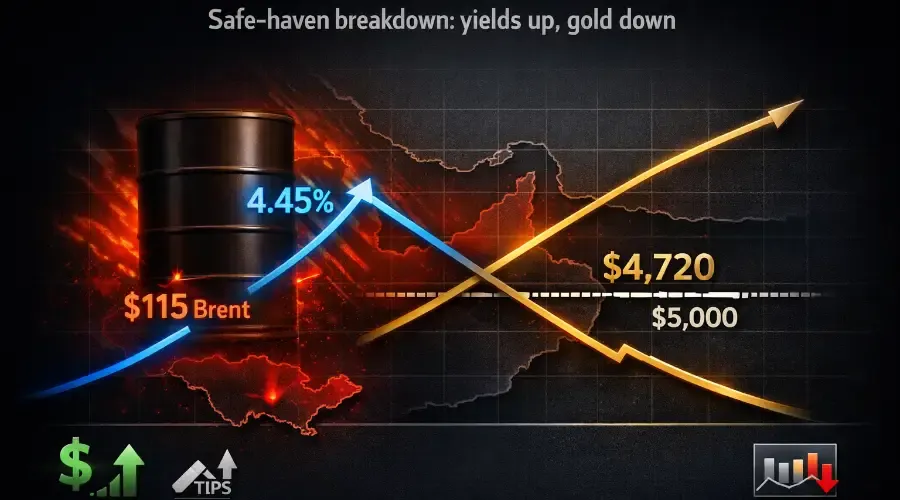
The rise in Treasury yields to 4.45% and the simultaneous decline in gold is not a typical risk-off pattern-it is the direct result of an oil-driven inflation shock that is forcing a repricing of Federal Reserve policy expectations. Brent crude sustaining above $115 has altered the inflation outlook, and more importantly, has removed the market’s expectation of near-term rate cuts. This shift is now transmitting across fixed income and commodities, reshaping how traditional safe-haven assets behave.
What changed in this environment is not just price direction, but the breakdown of the conventional safe-haven framework. Instead of bonds and gold rallying during uncertainty, both are declining together. This reflects a macro regime where inflation risk dominates over financial stress, and where real yields and dollar strength become the primary drivers of asset performance.
Quick Hits: The Yield-Gold Breakdown - Key Questions
Why are gold and bonds falling together during a geopolitical crisis?
In an oil-driven inflation shock, rising inflation expectations erode real returns for bonds, while dollar strength and higher real yields increase the opportunity cost of holding gold.
How far did gold prices fall in this session?
Gold fell 3.2% to $4,720, marking a one-month low and breaking through the critical $5,000 support level during a six-session losing streak.
What happened to Treasury yields following the March FOMC projections?
The 10-year yield rose 22 basis points to 4.45% as the market adjusted to the Fed projecting only 0.75 cuts in 2026, down from three in December.
What is the “duration unwind” mentioned in the market narrative?
It is the mechanical compression of valuations for long-duration assets (like tech stocks and long-term bonds) that occurs when the discount rate (yields) rises sharply.
Why did Royal Gold (RGLD) rise while gold spot prices fell?
Royal Gold gained 4.2% because its royalty streaming model provides revenue based on production volumes rather than direct spot price exposure, insulating it from short-term commodity volatility.
What Changed This Week - The Catalyst
The defining catalyst remains the oil shock, with Brent crude holding above $115 following the Qatar LNG infrastructure strike and continued Iran-Hormuz disruption. This has extended the inflation impulse beyond crude into natural gas, broadening the impact across global energy markets.
In practical terms, this matters because inflation expectations are no longer theoretical-they are being priced into bond markets in real time. When energy prices rise sharply, they feed directly into CPI projections, which in turn influence Federal Reserve policy expectations.
That shift matters because the Fed is now constrained. With inflation risks rising, the ability to cut rates is reduced. This forces bond markets to adjust upward in yield, which directly impacts both fixed income valuations and gold prices.
Why Treasury Yields Are Rising
The rise in yields is a direct reflection of Fed rate-cut repricing under inflation pressure. As oil prices increase, inflation expectations move higher, and the probability of near-term easing declines.
The 10-year Treasury yield moving to 4.45% represents a significant adjustment in market expectations. Earlier in the year, yields had reflected a scenario where multiple rate cuts were expected in 2026. That assumption is now being removed.
As yields rise, bond prices fall. This is the mechanical relationship driving losses in fixed income markets. More importantly, real yields are increasing, which has broader implications for other asset classes. The duration unwind mechanism-where longer-dated assets see the sharpest valuation compression-is now actively weighing on both bonds and equity sectors like technology that trade on extended earnings horizons.
Gold’s Breakdown - When the Safe Haven Fails
Gold’s decline to $4,720, breaking below the psychologically important $5,000 level, is the most notable aspect of this environment because it challenges conventional expectations. During geopolitical stress, gold typically rises. However, in an oil-driven inflation regime, different forces dominate.
The combination of higher real yields and a stronger dollar creates a negative environment for gold. As yields rise, the opportunity cost of holding gold increases. At the same time, a stronger dollar reduces demand from international buyers.
This is why gold has declined despite ongoing geopolitical tensions. The safe-haven function is not broken—it is simply being overridden by stronger macro forces. Interestingly, gold miners and royalty companies have diverged: while spot gold fell, Royal Gold (RGLD) rose 4.2% after an earnings beat, highlighting the difference between production-based business models and direct commodity exposure. Meanwhile, silver industrial demand concerns are compounding pressure on the broader precious metals complex.
Cross-Asset Confirmation - A Consistent Signal
The yield and gold moves are not isolated-they are part of a broader cross-asset pattern. Equities are declining, yields are rising, and the dollar has reached a five-week high. This combination reflects a unified repricing across markets.
What is notable is that traditional diversification is not working. Bonds are not providing protection, and gold is not acting as a hedge. The 60/40 portfolio diversification failure is now evident, as both equity and fixed income allocations have declined simultaneously. Instead, cash and short-duration assets are becoming relatively more stable in this environment.
This shift reinforces the idea that the current regime is driven by inflation rather than financial stress.
Non-Obvious Insight - The Real Driver
What makes this episode structurally different is that inflation is not only rising-it is doing so in a way that tightens financial conditions simultaneously. Oil is acting as both an inflation driver and a constraint on monetary policy, accelerating the repricing process across all asset classes.
This dual effect explains why both bonds and gold are declining together. It is not a contradiction-it is a reflection of the dominant macro force.
What the Market Is Watching Now
1. Real Yield Direction
If real yields begin to stabilize or decline, gold may find support. Current real yields (10-year TIPS) have moved above 2.10%, a level historically associated with gold weakness.
2. Dollar Strength
A reversal in dollar strength from its five-week high could ease pressure on commodities, including gold and silver. The dollar index (DXY) is currently at 104.8, up 2.3% over the past month.
3. Oil Price Path
If oil prices decline, inflation expectations may moderate, allowing bond yields to stabilize. A drop below $110 Brentwould likely trigger a partial reversal of the recent yield spike.
These variables form the core framework for interpreting market direction in the coming sessions.
The Bigger Picture
The current environment represents a clear shift into an inflation-driven macro regime. In this regime, traditional safe-haven relationships break down, and asset performance is dictated by inflation expectations and policy constraints.
The rise in yields and decline in gold are not anomalies-they are logical outcomes of this shift. Understanding this framework is essential for interpreting market behavior, especially as the duration unwind continues to pressure long-duration assets and the 60/40 portfolio faces one of its most challenging tests in years.
Bottom Line
The rise in Treasury yields to 4.45% and the decline in gold to $4,720 are part of the same macro story. Oil-driven inflation is forcing a repricing of Federal Reserve policy, which is in turn reshaping asset valuations across markets.
For market participants, the focus should remain on the core transmission chain:
Oil → Inflation expectations → Fed policy → Real yields → Asset prices
As long as oil remains elevated, the market remains in an inflation-constrained regime where traditional safe havens may not behave as expected.
Engagement Question
With gold breaking below $5,000 and yields pushing to 4.45%, are we witnessing a structural shift where real yields permanently replace geopolitics as the primary driver of gold?
Structured Data (FAQPage Schema)
Frequently Asked Questions (FAQ)
Why are gold and bonds falling together during a geopolitical crisis?
In an oil-driven inflation shock, rising inflation expectations erode real returns for bonds, while dollar strength and higher real yields increase the opportunity cost of holding gold.
How far did gold prices fall in this session?
Gold fell 3.2% to $4,720, marking a one-month low and breaking through the critical $5,000 support level during a six-session losing streak.
What happened to Treasury yields following the March FOMC projections?
The 10-year yield rose 22 basis points to 4.45% as the market adjusted to the Fed projecting only 0.75 cuts in 2026, down from three in December.
What is the 'duration unwind' mentioned in the market narrative?
It is the mechanical compression of valuations for long-duration assets (like tech stocks and long-term bonds) that occurs when the discount rate (yields) rises sharply.
Why did Royal Gold (RGLD) rise while gold spot prices fell?
Royal Gold gained 4.2% because its royalty streaming model provides revenue based on production volumes rather than direct spot price exposure, insulating it from short-term commodity volatility.
Related Reading - BreakoutBulletin
Oil Rally Persists as Geopolitical Premium Overrides Supply Data
The $100 Oil Reality: Hormuz Tanker Traffic Collapse
Hour Zero: What Happens When the Strait of Hormuz Closes
What Happens If the Strait of Hormuz Closes Tomorrow: Hour by Hour
Disclaimer
This article is for informational and educational purposes only and does not constitute financial, investment, or trading advice. You are solely responsible for your own investment decisions and should consult a licensed financial professional before acting on any information in this post.