
What Happens When a US Government Shutdown Occurs
Brookings explains what a government shutdown is and why we keep having them. USAFacts covers everything you need to know. The Bipartisan Policy Center documents what happens if the government shuts down. NAACP LDF addresses the human impact. Penn State researchers provide expert analysis. Every source correctly identifies furloughs, delayed services, and temporary economic drag. None provides the equity market framework – and more importantly, none provides the most important insight for traders: a US government shutdown is the most over-hyped, most media-amplified, and most consistently over-traded policy event in the entire fiscal and monetary policy calendar. The trades worth making around shutdowns are narrower, shorter, and more counterintuitive than the defensive rotation most investors instinctively apply.
Why This Matters More – And Less – Than Most Traders Think
Government shutdowns trigger wall-to-wall media and genuine anxiety – federal workers miss paychecks, national parks close, passport processing grinds to a halt, and political dysfunction dominates every front page. But the real government shutdown stock market impact is a lot narrower and shorter-lived than the headlines imply. Sector rotation during a shutdown tends to be targeted and temporary, not the kind of broad defensive shift that works in a recession.
The key quantitative context: the 2018–2019 government shutdown – the longest in US history at 35 days – reduced GDP growth by an estimated 0.1–0.2 percentage points per quarter, for a total drag of about 0.3% of annual GDP spread across Q4 2018 and Q1 2019, according to the Congressional Budget Office. When the shutdown ended and back-pay was distributed, the impact reversed almost entirely. The critical market data point: the S&P 500 fell 2.7% on December 24, 2018 – the first trading day after the shutdown began – then rallied over 10% for the remainder of the 35-day closure. That drop wasn’t a shutdown story – it was the broader Q4 rate-hike panic driving the market. Untangling shutdown-specific equity weakness from everything else that’s going on is the most important analytical skill for shutdown positioning.
The mechanism: government shutdowns halt appropriated discretionary spending – approximately 30% of the federal budget – while mandatory spending (Social Security, Medicare, Medicaid, debt interest) continues automatically. Essential government functions continue with essential personnel working without pay. The affected economic channels are narrower than the headline coverage suggests. [LINK: Central Bank Hub]
The Critical Distinction: Shutdown vs Debt Ceiling – Do Not Conflate Them
If you’re doing shutdown market analysis, this is the step that counts – and it’s the one most sources skip. A government shutdown and a debt ceiling crisis are completely different animals, and confusing them leads to badly sized trades.
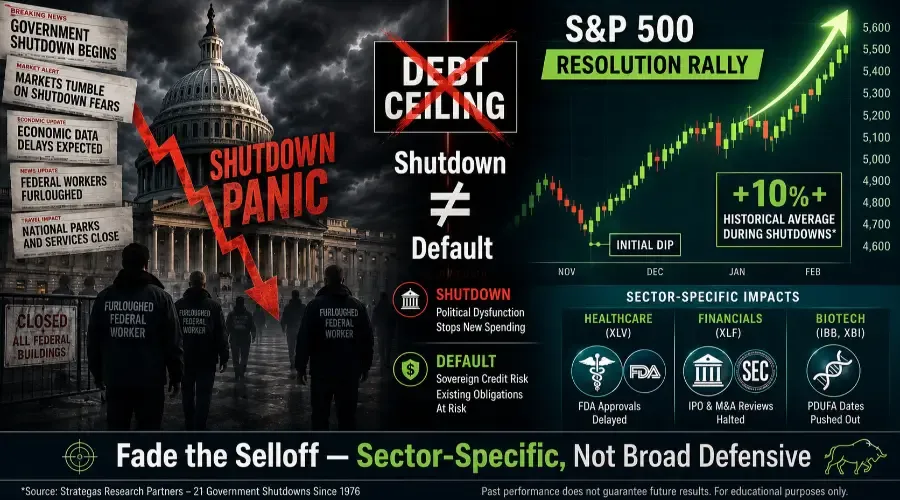
Government Shutdown: Congress has not passed appropriations bills and spending authority for non-essential functions has lapsed. The government cannot spend money it was planning to spend – but it continues paying all existing obligations. Social Security recipients receive checks, Treasury bond holders receive interest payments, Medicare processes claims. A shutdown is a political dysfunction event, not a solvency event.
Debt Ceiling Crisis: The government has hit the statutory borrowing limit and cannot pay existing obligations unless Congress raises the ceiling. This is a potential default risk – categorically more dangerous to equity markets. The 2011 debt ceiling crisis produced a 17% S&P 500 decline. The 2023 standoff produced significant Treasury market stress.
In practice, when you see shutdown and debt ceiling risk getting conflated in the news, the market reaction you’re seeing is usually about debt ceiling fears, not the shutdown itself. Correctly separating these two events is the single most valuable analytical move in government shutdown investing.
Shutdown Historical Returns: The Pattern of Front-Loaded Selling and Reversal
The table below documents S&P 500 performance during the longest and most economically significant government shutdowns since 1990. You’ll notice a consistent pattern across shutdown events: an initial dip – often just a day or two – followed by recovery, with the S&P 500 government shutdown periods actually posting net gains unless a debt ceiling deadline was also in play.
Nov 13–19, 1995
Duration
5 days
S&P 500 Return (Shutdown Period) → +1.3%
Concurrent Debt Ceiling? → No
Dec 16, 1995 – Jan 6, 1996
Duration
21 days
S&P 500 Return (Shutdown Period) → +2.9%
Concurrent Debt Ceiling? → No
Oct 1–17, 2013
Duration
16 days
S&P 500 Return (Shutdown Period) → +2.4%
Concurrent Debt Ceiling? → Yes – selloff was debt ceiling fear, reversed quickly
Jan 20–22, 2018
Duration
3 days
S&P 500 Return (Shutdown Period) → +0.2%
Concurrent Debt Ceiling? → No
Dec 22, 2018 – Jan 25, 2019
Duration
35 days
S&P 500 Return (Shutdown Period) → +10.3%*
Concurrent Debt Ceiling? → No
*S&P 500 dropped 2.7% on Dec 24 (day 2), then rallied ~13% from that low to the shutdown end.
Across all twenty-one government shutdowns since 1976, the S&P 500 has gained an average of approximately 0.5–1% during shutdowns, with selling concentrated in the first day or two and reversing thereafter. The fade trade – buying into the initial shutdown selloff – has outperformed defensive positioning in most historical episodes, provided the shutdown is a pure appropriations event and the macro backdrop is not in freefall. If a recessionary bear market coincides with a shutdown, delay the fade until political signals clarify.
Which Channels Are Active: Narrow and Sector-Specific
Channel 1 – Federal Payment Delay (Not Cancellation)
Contractors, grantees, and federal workers experience delayed payments – not cancelled payments. When the shutdown ends, back-pay is distributed and contracts are funded. The federal worker economic impact reverses, so the drag is temporary.
Channel 2 – Regulatory Process Halt
FDA drug approvals stop. SEC comment letter processing stops, blocking new IPO registrations and merger filings. SBA loan processing stops. These regulatory halts create sector-specific headwinds for XLV and XLF that last the shutdown duration plus processing backlog. The FDA approval delays and SEC IPO delays are the most direct, tradeable effects here.
Channel 3 – Economic Data Release Delay
The most underappreciated shutdown market impact. The BLS, BEA, and Census Bureau face furloughs. Non-Farm Payrolls, CPI, and GDP releases may be delayed – creating genuine uncertainty for the Federal Reserve. In the 2018–2019 shutdown, multiple major releases were delayed. The Fed data delays that come with a shutdown mean the central bank is flying partially blind, and that uncertainty drives above-normal volatility in rate-sensitive sectors like XLRE, XLU, and XLK.
Channel 4 – Consumer Confidence and Sentiment
Federal workers facing delayed paychecks reduce spending immediately, concentrated in DC/Northern Virginia and other government-heavy regions. Confidence effects are modest and reverse rapidly on resolution.
Sector Scorecard: Narrow Impacts, Specific Targets
Defence Contractors Within XLI – Mixed, Counterintuitively.
Defence spending is the most bipartisan budget priority. Congress frequently passes separate continuing resolutions for defence even during broader shutdowns. Large defence contractors (Lockheed Martin, Raytheon, General Dynamics) typically continue receiving contract payments via emergency provisions. Smaller subcontractors face more disruption. Net XLI signal: approximately neutral for large-cap defence names.
Healthcare (XLV) – Mild Negative – Duration-Dependent.
The FDA regulatory halt is the most direct and most mechanically confirmed XLV shutdown impact. New drug approval decisions, clinical trial approvals, and manufacturing site inspections pause. Biotech companies with imminent PDUFA dates face approval delays that shift revenue recognition by one quarter. The magnitude scales with shutdown duration: a five-day shutdown creates a brief backlog; a 35-day shutdown pushes approvals by a full quarter. Traders can monitor the FDA’s PDUFA date calendar at fda.gov. Broad biotech ETFs like IBB (iShares Biotechnology ETF) and XBI (SPDR S&P Biotech ETF) carry aggregate PDUFA exposure, but the real alpha is in single-stock timing risk: a company with a January 15 PDUFA date that gets pushed to February 15 will miss its expected Q1 revenue recognition, often triggering a sharp selloff on delay news. The XLV shutdown impact is real but narrowly concentrated.
Financials (XLF) – Mild Negative – IPO and M&A Timing.
SEC review halts prevent new S-1 registration effectiveness (blocking IPOs) and delay merger proxy reviews. Investment banking fee timing shifts – fees delayed, not eliminated. The XLF IPO delay shutdown effect is mild in absolute terms but it’s the clearest XLF-specific channel.
Real Estate (XLRE) – Mild Negative – FHA and USDA Loans.
FHA mortgage insurance endorsements and USDA rural housing loan guarantees halt, slowing residential closings that depend on government-backed financing. Concentrated in lower-income and rural borrowers; modest relative to the broader XLRE market.
Consumer Discretionary (XLY) – Mild Negative – Federal Worker Income.
Federal employees facing delayed paychecks reduce discretionary spending immediately – visible in DC metro area and government-employment-dense regions. National park closures affect tourism. Aggregate income effect is small (under 0.5% of US employment) but the confidence effect broadens the impact modestly.
Consumer Staples (XLP), Utilities (XLU), Energy (XLE), Technology (XLK), Materials (XLB) – Approximately Neutral.
No direct federal spending or regulatory dependency sufficient to produce shutdown-specific rotation. Broader macro factors dominate. Applying shutdown-specific underweights to these sectors conflates shutdown noise with real economic signals.
Historical Cases
2018–2019 (35 Days) – Data Delay and the Resolution Rally
The longest shutdown in US history delayed multiple BLS and Census releases including the December jobs report. The Fed's January 2019 FOMC meeting occurred without complete current data – contributing to Powell's unusually dovish pivot. XLV biotech names with PDUFA dates in January faced approval delays. Investment banking IPO pipelines held pending SEC reopening. The S&P 500 fell 2.7% on the first full trading day after the shutdown began (Dec 24), then rallied over 10% through the rest of the closure – one of the strongest equity runs in years, driven by the Fed's dovish pivot rather than shutdown resolution. The case confirms that macroeconomic factors dominate shutdown-specific equity effects in all but the most targeted sector analysis.
2013 (16 Days) – The Debt Ceiling Conflation Case
The October 2013 shutdown coincided with a debt ceiling deadline. Markets sold off in late September on debt ceiling fears, then rallied 2.4% during the shutdown itself. Attributing the early selloff to the shutdown was the analytical error; the correct attribution was the debt ceiling credit risk. When both resolved simultaneously, markets added further gains. This remains the definitive case study in why the shutdown–debt ceiling distinction matters for positioning.
The Trading Playbook
Before
Check whether the shutdown coincides with a debt ceiling deadline. The single most important pre-shutdown step. If the budget standoff includes a debt ceiling component, apply debt-ceiling-appropriate defensive positioning – not the narrow shutdown-specific playbook. If it is a pure appropriations shutdown, apply only sector-specific narrow positioning.
Identify imminent FDA PDUFA dates (publicly available at fda.gov). Any XLV biotech or pharmaceutical company with a scheduled FDA decision within the expected shutdown duration is a shutdown-specific underweight – approval timeline shifts by the shutdown length plus backlog, creating a binary earnings timing risk.
Monitor congressional vote counts via Politico and The Hill whip count reporting in the final 48–72 hours before a continuing resolution deadline. Vote count trajectory determines shutdown probability more reliably than political commentary.
During
The most consistently profitable shutdown trade: fade the initial equity market selloff – but only if the macro backdrop is stable. Across twenty-one government shutdowns since 1976, the S&P 500 has gained an average of approximately 0.5–1% during shutdowns, with selling concentrated in the first day or two and reversing thereafter. The fade trade – buying into the initial shutdown selloff – has outperformed defensive positioning in most historical episodes. Crucial caveat: this pattern holds when the shutdown is a pure appropriations event and the broader economy is not in a recessionary freefall. If a recessionary bear market coincides, delay the fade until political signals clarify.
For XLV specifically: Reduce or hedge positions in any biotech with an imminent PDUFA date. This is the only shutdown-specific sector impact with a quantifiable and binary event risk. IBB and XBI offer liquid hedges, but precise single-name exposure is more effective.
Do not reduce XLRE, XLK, or XLI broadly. These sectors face shutdown-specific impacts only through the data delay uncertainty channel – temporary and modest, resolving when the shutdown ends.
After
Rebuild positions when the probability of a continuing resolution crosses a high-confidence threshold. The market often prices the resolution several days before the actual vote, based on whip counts and leadership statements. The shutdown resolution rally is compressed – typically playing out fully within two to three trading sessions after the political signal becomes near-certain. Position for it when the outcome is clear, not on a rigid 24–48 hour timeline. Back-pay distribution to furloughed federal workers and resumption of government data releases create a brief positive pulse visible in retail sales and employment data one to two months post-resolution.
The 3 Mistakes Most Retail Traders Make
Mistake 1: Conflating Government Shutdown With Debt Ceiling Default Risk.
The most consequential error: applying debt-ceiling-level defensive positioning to a pure appropriations shutdown. Shutdowns are political dysfunction events affecting approximately 30% of the budget temporarily. Debt ceiling crises are potential sovereign default events. The 2011 debt ceiling episode produced a 17% S&P 500 decline. A pure government shutdown produces a fraction of that impact. Always confirm whether the budget standoff includes a debt ceiling component before sizing any defensive position.
Mistake 2: Applying Broad Sector Defensive Rotation When Narrow Positioning Is Correct.
Selling XLK, XLRE, and XLI broadly because "the government is shut down" applies a generalised economic weakness framework to what is actually a narrow, sector-specific, and temporary event. The correct shutdown positioning is sector-specific (XLV PDUFA names, XLF IPO pipeline) and sized for the expected shutdown duration (days to weeks), not the generalised defensive rotation appropriate to a recession or rate crisis.
Mistake 3: Missing the Resolution Reversal Trade.
The most consistently profitable shutdown trade is the resolution rally – positioning for it when the probability of a deal becomes overwhelmingly high, typically reflected in whip counts and leadership signals. The relief rally recovers more than the economic improvement warrants, often capturing 0.5–1.5% of S&P 500 performance in a compressed window. Staying defensively positioned through that window gives back a significant portion of any gains from the initial shutdown fade.
Bottom Line: The One-Sentence Institutional Framework
When a pure appropriations government shutdown occurs, fade the initial selloff rather than building broad defensive positions – provided the macro backdrop is not in a recession – apply sector-specific positioning only to XLV PDUFA-date names and XLF IPO pipeline, and position for the resolution rally when congressional vote counts make resolution overwhelmingly likely, because government shutdowns are political dysfunction events with temporary and reversible economic impacts, not economic crisis events warranting the full defensive rotation.
This framework works across cycles because the shutdown mechanism – discretionary appropriations lapsing while mandatory spending continues – has been consistent since 1976. The shutdown-specific sector impacts (FDA halt, SEC delay, federal worker income effect) repeat in the same sectors with the same approximate magnitude in every episode, and the resolution rally follows every shutdown ending.
The retail edge is the contrarian discipline: recognising that the media coverage significantly overstates the equity market impact, that the shutdown–debt ceiling distinction is analytically critical, and that the resolution rally is more consistently profitable than the defensive positioning the coverage suggests is warranted.
Run this scenario through the [Breakout Bulletin Ripple Engine](LINK: Ripple Engine Tool) to compare the government shutdown transmission to other Central Bank hub events – and see how the shutdown's narrow sector impacts differ from the broad policy changes that drive sustained multi-quarter sector rotation.
Frequently Asked Questions About Government Shutdowns and Markets
What is a US government shutdown?
A US government shutdown happens when Congress fails to pass funding bills, causing non-essential federal government operations to temporarily stop. Essential services continue, but many employees are furloughed or work without pay.
Does a government shutdown crash the stock market?
Historically, most government shutdowns have had limited and temporary effects on the stock market. The S&P 500 often recovers quickly after initial panic selling.
What is the difference between a government shutdown and a debt ceiling crisis?
A government shutdown stops certain discretionary spending, while a debt ceiling crisis threatens the government's ability to pay existing obligations. Debt ceiling crises are generally far more dangerous for markets.
Which sectors are most affected during a government shutdown?
Healthcare (XLV), Financials (XLF), Real Estate (XLRE), and some Consumer Discretionary stocks tend to see the most direct effects due to FDA delays, SEC review halts, mortgage disruptions, and reduced federal worker spending.
Why do traders often fade the shutdown selloff?
Historically, shutdown-driven market declines are short-lived because the economic impact is temporary and reversible once funding resumes. Many traders buy into the initial panic.
How does a government shutdown affect FDA drug approvals?
FDA approvals and inspections can pause during a shutdown, delaying biotech and pharmaceutical product launches and impacting companies awaiting PDUFA decisions.
Can a government shutdown delay IPOs?
Yes. SEC review processes may stop during a shutdown, delaying IPO approvals and merger filings, which mainly impacts investment banks and financial firms.
What happened during the 2018–2019 government shutdown?
The 2018–2019 shutdown lasted 35 days, delayed major economic data releases, disrupted regulatory activity, and contributed to increased market volatility, though broader Fed policy shifts mattered more for equities.
Is a government shutdown bad for the economy?
Shutdowns create short-term economic drag due to delayed spending and lower confidence, but most of the impact reverses once the government reopens and back-pay is distributed.
What is the best trading strategy during a government shutdown?
Many institutional traders focus on fading the initial selloff, monitoring sector-specific impacts, and positioning for the resolution rally once Congress moves toward a funding agreement.
This post is part of the BreakoutBulletin "What Happens When" series. [LINK: Central Bank Hub] · [LINK: Series Pillar Page]
Educational content only. Not investment advice. Past sector performance patterns do not guarantee future results.