
March 4, 2026 | BreakoutBulletin Macro Intelligence
Educational commentary only. Not investment advice. Sources include reporting from the Associated Press, Pew Charitable Trusts, ITEP, Barnes Walker, the Florida Department of Revenue, and the Tax Foundation.
PropertyTaxRevolt-StockMap-Blog…
The Legislative Story Investors Are Barely Discussing
Over the past few days, most market conversations have revolved around geopolitical tensions, oil prices, and Federal Reserve speculation. But in the background, something quieter has been unfolding in state legislatures.
Florida and Georgia are both debating major changes to residential property taxes. These discussions are still in early stages, yet the scale of the proposals is large enough that institutional investors have started mapping out potential market implications.
None of this moves stock prices today. In fact, the earliest timeline for any policy impact would likely be the 2027 tax year. But when investors look ahead, they tend to map the transmission channels early. And in this case, those channels are unusually clear.
So the real question isn’t whether property taxes change tomorrow. It’s how markets might respond if they eventually do.
What Is Actually Being Proposed
Understanding the proposals themselves is critical, because many headlines have blurred the details.
In Florida, the state House approved a constitutional amendment proposal in February that would phase out non-school property taxes on homesteaded residential properties over a ten-year period. The Senate has signaled caution, suggesting the final version may look quite different.
Georgia’s proposal followed a different path. A constitutional amendment that would have sharply reduced residential property taxes failed to secure the required supermajority vote in the legislature.
So, at the moment, neither proposal is close to implementation.
Yet across multiple states — including Iowa, Kansas, Missouri, Oklahoma, Wisconsin, and Wyoming — similar discussions are happening. The pattern suggests a broader political shift rather than a one-off legislative experiment.
That matters because markets tend to respond to trends, not single bills.
How Property Taxes Transmit Into Stock Markets
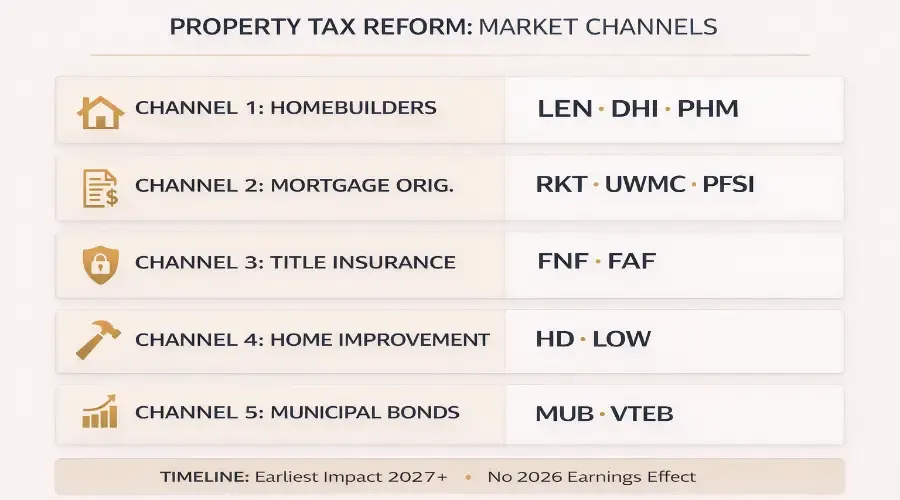
Property tax policy doesn’t directly move equity indices. Instead, it flows through several economic channels. Each channel touches a different set of companies.
Four in particular stand out.
Channel One: Homebuilders
Lower property taxes reduce the total cost of homeownership. Even if home prices remain unchanged, the ongoing cost of living in a property declines.
For buyers near the margin of mortgage qualification, that difference can matter.
If policy changes eventually reduce annual property tax burdens, the effective affordability of purchasing a home increases. Over time, that could expand the pool of potential buyers in affected states.
Homebuilders with large exposure to Florida and Georgia therefore sit closest to this transmission path.
Companies such as Lennar, D.R. Horton, and PulteGroup already operate extensively in Sun Belt markets where population growth remains strong.
That said, these companies are national builders. A policy change in one state would influence only part of their demand profile.
So the potential benefit exists — but it would likely be incremental rather than transformational.
Channel Two: Mortgage Originators
Mortgage companies are sensitive to housing transaction volume. When more homes are purchased, more mortgages are originated.
Lower property taxes can influence that dynamic indirectly.
Because lenders calculate borrower affordability based on total monthly housing costs, a reduction in property tax obligations can slightly improve debt-to-income ratios.
That shift can push some borrowers over the qualification threshold.
Companies such as Rocket Companies, United Wholesale Mortgage, and PennyMac Financial therefore sit downstream of any demand expansion in housing markets.
But there is an important caveat.
Mortgage rates remain the dominant constraint on housing demand today. With the 10-year Treasury yield near 4 percent and mortgage rates still elevated relative to the last decade, financing costs remain a much stronger short-term influence than property taxes.
In other words, tax policy is a structural tailwind. Interest rates remain the immediate headwind.
Channel Three: Title Insurance
Title insurance firms represent a more direct beneficiary of housing transaction volume.
Every residential real estate transaction typically involves a title insurance policy. When the number of transactions increases, revenue increases.
Companies like Fidelity National Financial and First American Financial operate squarely in this part of the ecosystem.
Unlike homebuilders or mortgage companies, their revenue is not tied directly to housing prices. It is tied to the number of transactions taking place.
So if housing turnover increases, these firms benefit relatively quickly.
Channel Four: Municipal Bonds
The final channel receives much less attention in stock market commentary, yet it may be the most important for fixed-income investors.
Property taxes represent a major funding source for local governments. Police departments, fire services, infrastructure maintenance, and other municipal functions often rely heavily on this revenue stream.
When property tax revenues decline, local governments must either replace the revenue or reduce spending.
That dynamic matters for municipal bond investors because the credit quality of municipal issuers depends on stable revenue sources.
Funds holding municipal debt — including ETFs such as iShares National Muni Bond ETF or other municipal strategies — could face new credit considerations if large-scale property tax reductions eventually materialize.
Again, this is not a near-term issue. Policy timelines make that clear.
But bond markets tend to model fiscal scenarios years in advance.
Why This Is Not a 2026 Earnings Story
Even if Florida ultimately approves a property tax reform amendment, several steps would still need to occur before any economic impact appears.
The Senate would first need to pass the proposal. Voters would then need to approve it in a statewide referendum. Only after that would the implementation process begin.
Most proposals currently being discussed would phase in over multiple years.
That means the earliest measurable economic effects would likely emerge in 2027 or later.
For corporate earnings, the timeline could stretch even further.
Investors watching this story today are therefore not reacting to earnings changes. They are simply mapping a potential policy framework.
Lessons From the Prop 13 Parallel
Observers often compare the current property tax debate to California’s Proposition 13, passed in 1978.
That policy capped property tax rates and limited annual assessment increases. It dramatically altered the state’s housing economics.
One of the less obvious effects was on housing supply.
Because property tax advantages were tied to ownership tenure, homeowners had incentives to stay in their existing properties rather than sell. Moving would reset the tax basis.
That dynamic reduced housing turnover in certain markets.
A similar effect could theoretically occur in any system where property tax benefits attach specifically to primary residences.
In other words, lower property taxes may stimulate demand — but they could also reduce supply.
The final market impact depends on how those forces balance.
What Institutional Investors Are Watching
Large institutional investors are not repositioning portfolios based on these proposals yet.
The legislative timelines remain uncertain. And the economic effects remain distant.
Still, the issue is appearing in several research conversations.
Homebuilder earnings calls increasingly include questions about state-level housing policy. Fixed-income analysts are examining municipal revenue exposure. And migration data continues to show strong population flows toward Sun Belt states.
If property tax advantages widen between states, that migration pattern could accelerate.
Which brings us back to the central point.
This story is less about today’s market reaction and more about a structural trend.
The Bigger Picture
The property tax debate reflects a broader political response to rising housing costs.
Home prices increased dramatically during the past several years. Property tax bills rose alongside them. In many states, that combination created political pressure for reform.
Whether the proposed solutions ultimately prove fiscally sustainable is still an open question.
But the direction of the policy discussion is becoming clearer.
For investors, the key takeaway is not immediate stock movement. It is the transmission map.
Homebuilders, mortgage companies, title insurers, and municipal bond markets all sit along that path.
And while the first real economic effects may not appear until 2027 or later, the framework for understanding them can already be built.
Disclaimer
This article is for informational and educational purposes only and does not constitute financial, investment, or trading advice. You are solely responsible for your own investment decisions and should consult a licensed financial professional before acting on any information in this post.