
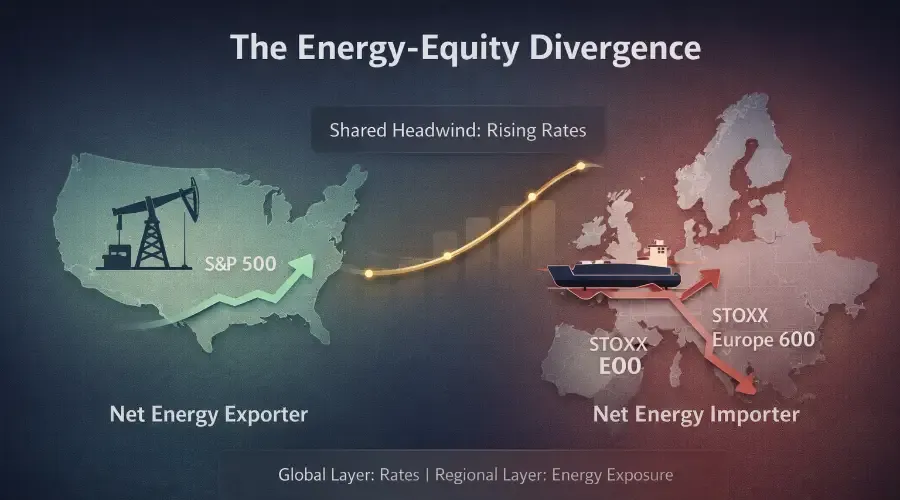
US equities have continued to outperform global markets, even as rising Treasury yields create pressure on valuations. Year-to-date, the S&P 500 is down roughly 2.5%, while the MSCI EAFE has fallen over 6% and the STOXX Europe 600 has declined nearly 5%. The divergence is being shaped less by earnings momentum and more by structural differences in energy exposure. What changed in recent sessions is the recognition that energy sensitivity—not just rate pressure—is influencing relative equity performance. In practical terms, while higher yields are a global headwind, their impact is not uniform, and regional equity performance is now being filtered through how economies absorb energy price volatility.
Primary Driver: Energy Exposure Creates Performance Divergence
The key factor behind US outperformance is its relatively lower dependence on energy imports. The US became a net energy exporter, with domestic oil production exceeding consumption by roughly 2 million barrels per day. In contrast, the European Union imports about 90% of its crude oil, leaving its economy and corporate margins more exposed to price spikes. When oil prices rise, energy-importing economies face higher input costs, creating a dual pressure where inflation rises and corporate margins compress, particularly in energy-intensive sectors. Europe feels this impact more acutely, while the US absorbs energy shocks more effectively due to domestic production acting as a buffer. This dynamic explains why US equities maintain relative resilience even as global markets react more sharply to the same oil movements.
Rates as a Shared Headwind, Not a Differentiator
Rising Treasury yields remain the dominant macro force across all equity markets. The 10-year yield above 4.3% and the 30-year approaching 5% are increasing discount rates and compressing valuations globally. However, this rate pressure is broadly uniform. What differentiates performance is how additional variables—like energy exposure—interact with the rate environment. Europe faces a double pressure of rising yields and higher energy costs, while many emerging markets face triple pressure from energy imports, currency weakness, and tighter financial conditions. The US, insulated on the energy front, primarily contends with the yield-driven valuation drag.
Cross-Market Comparison
The divergence across regions reflects structural differences in energy dependence. The United States, as a net energy exporter, benefits from a relative buffer against rising oil prices, supporting economic stability and corporate margins. Europe, as a heavy energy importer, faces a combination of rising yields and input cost pressure, which weighs on growth and profitability. Emerging markets present a mixed picture, but many experience compounded pressure from energy imports, a strong dollar, and tightening financial conditions. This divergence highlights that global equity performance is no longer synchronized and instead reflects region-specific vulnerabilities within a shared macro framework.
Currency Effects: The Dollar Adds Another Layer
A critical additional factor is the US dollar (DXY). The dollar remains elevated, supported by higher US yields. For Europe and emerging markets, a strong dollar compounds energy pressure, as oil becomes more expensive in local currency terms while financing conditions tighten. The US, by contrast, benefits from capital inflows that can partially offset valuation pressure on equities. This dynamic reinforces divergence, as the dollar acts as an additional transmission channel amplifying global differences in performance.
Why This Divergence May Not Hold
While US equities have outperformed, this trend is not guaranteed to persist. Current resilience may represent a lag rather than a permanent advantage. If oil prices remain elevated and yields continue to rise, even US markets may begin to experience combined pressure from inflation and valuation compression. Additionally, further dollar strength could begin to weigh on multinational earnings within the S&P 500. The key question is whether the US energy buffer is durable enough to offset sustained rate pressure.
Structural Implications
The current setup introduces a two-layer framework for equity analysis. At the global level, rising yields act as a broad valuation constraint across all markets. At the regional level, energy exposure determines relative performance within that constraint. This explains why US equities can outperform even while declining in absolute terms. Relative strength does not imply immunity; it reflects differing levels of pressure across regions.
Portfolio Context
Global Allocation
Investors are increasingly differentiating between regions based on energy sensitivity, rather than treating global equities as a single asset class. Allocation decisions are becoming more dependent on how each market responds to the interaction of energy prices and interest rates.
US Equities
Relative resilience may continue in the near term, but remains closely tied to the broader rate environment. If yields continue to rise, valuation pressure will persist even for US markets.
International Markets
Global markets, particularly in Europe and parts of emerging markets, remain more exposed to energy-driven inflation, creating additional headwinds beyond rising yields.
The Bigger Picture
The recent divergence in equity performance highlights a broader transition in global markets. Energy and rates are no longer independent variables; they are interacting to shape regional outcomes. The key question is whether US resilience represents structural strength or temporary insulation. If energy pressures persist, the gap between US and global equities may narrow as rate effects continue to build.
What to Watch Next
- Whether oil prices remain elevated or stabilize
- Whether Treasury yields continue rising or begin to plateau
- Whether US equities maintain relative strength or converge with global peers
These signals will clarify whether the current divergence is sustainable or part of a broader adjustment phase.
Framework to Consider
If both yields and energy prices remain elevated, their impact will differ across regions. For valuation-heavy sectorslike US technology, rate pressure is likely to dominate. For cyclical, industrial-heavy regions like Europe, energy exposure becomes the tighter constraint. The US may continue to outperform as long as markets focus on energy differentials, but if attention shifts back to valuation compression, the gap could close.
FAQ
Q: Why are US stocks performing better than European stocks right now?
A: The primary driver is energy independence. The US, as a major energy producer, is better insulated from oil price spikes than Europe, which relies heavily on imports. While both regions face rising interest rates, Europe experiences the combined effect of higher rates and increased energy costs.
Q: Does US outperformance mean American stocks are safe from rising yields?
A: No. Rising Treasury yields are a universal headwind that compresses valuations. The US is showing relative strength, not immunity, as its growth outlook is less affected by energy costs compared to global peers.
Q: What should investors watch to see if this trend reverses?
A: Monitor the relationship between oil prices, Treasury yields, and the US dollar. If yields continue rising due to domestic factors while oil stabilizes, the US advantage may diminish, leading to convergence with global markets.
DISCLAIMER:
This article is for informational and educational purposes only and does not constitute financial, investment, or trading advice. You are solely responsible for your own investment decisions and should consult a licensed financial professional before acting on any information in this post.