
What Happened
On March 4, 2026, the White House formally transmitted Kevin Warsh's nomination for Federal Reserve Chair to the U.S. Senate. The nomination itself had been announced earlier on January 30, but the formal transmission now begins the official confirmation process. The approximately five-week gap between announcement and transmission reflects the administrative review period typical for high-level nominations.
The timing matters because it arrives at a moment when macro conditions are shifting. Treasury yields remain elevated, with the 10-year Treasury yield holding near 4.05%, while oil prices are responding to geopolitical tensions linked to the Iran conflict. WTI crude trades near $72.50, Brent near $83.90.
What changed here was not simply the nomination itself. The transmission starts the Senate confirmation clock at the same time markets are debating whether the Federal Reserve can realistically cut interest rates in the current inflation environment.
The Story Most Coverage Focuses On
Most news coverage has concentrated on the political mechanics surrounding the nomination.
Kevin Warsh, 55, previously served as a Federal Reserve Governor from 2006 to 2011, becoming the youngest person appointed to the role at the time at age 35. During the financial crisis, he played a key role in communications between the Federal Reserve and financial institutions. His professional background includes Stanford University, Harvard Law School, Morgan Stanley, and service on the Council of Economic Advisers under the Bush administration.
The confirmation path, however, faces resistance.
Senator Thom Tillis (R-NC) has stated he will not support the nomination until the Justice Department investigation involving current Fed Chair Jerome Powell is resolved. With Republicans holding a 53-47 majority, losing Tillis means Warsh can afford only one additional defection to reach 51 votes without Vice President tie-breaker. Democratic opposition, led by Senator Elizabeth Warren, is expected to be near-unanimous, effectively requiring Warsh to secure all remaining Republican votes.
Senate Banking Committee Chairman Tim Scott has indicated the committee will conduct what he described as a "thoughtful, timely confirmation process."
These political dynamics form the headline story. But they are only part of the broader macro context.
The Warsh Paradox
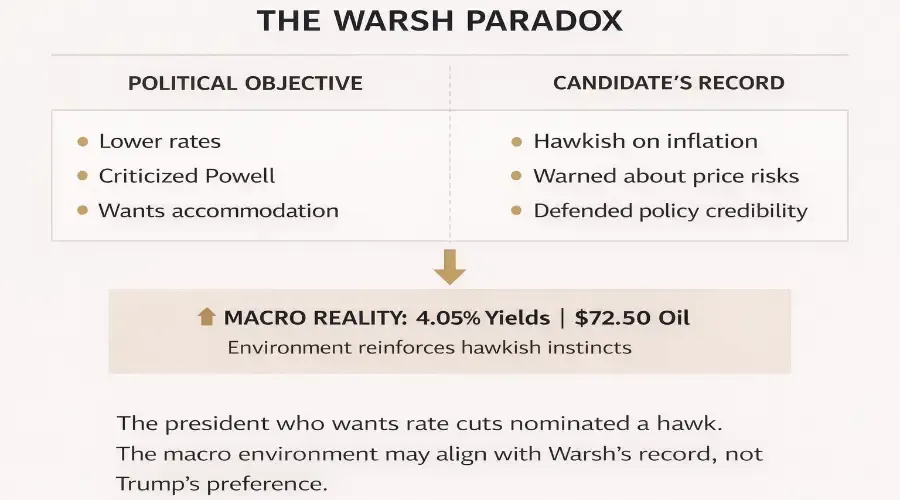
The deeper policy tension is what some analysts describe as the Warsh paradox.
President Trump has repeatedly pushed for lower interest rates, criticizing Jerome Powell for not cutting borrowing costs more aggressively. The nomination of a new Fed Chair is widely interpreted as an attempt to move policy toward a more accommodative stance.
But Kevin Warsh's own record suggests something different. The president who campaigned on lower rates has nominated a chair whose record suggests he may resist them — a tension that markets are only beginning to digest.
Columbia Business School economist Brett House described Warsh as "by far the most hawkish of the four final candidates" for the role. During his tenure at the Federal Reserve, Warsh frequently warned about inflation risks and argued for maintaining policy credibility even when growth pressures mounted.
That creates an unusual alignment problem. A president seeking rate cuts has nominated a central banker whose reputation suggests caution on inflation. And the macro environment Warsh would inherit may reinforce those instincts rather than soften them, with oil at $72.50 and the 10-year yield at 4.05% — levels that argue against immediate easing.
The Macro Environment Warsh Would Enter
The policy environment surrounding the nomination has shifted in recent weeks.
Treasury yields have climbed, with the 10-year yield holding around 4.05% — up 8 basis points from pre-crisis levels. Oil prices are also elevated, with WTI near $72.50 and Brent near $83.90, as geopolitical tensions linked to Iran raise concerns about supply disruptions through the Strait of Hormuz.
This combination complicates the rate-cut narrative. Higher energy prices feed into inflation expectations, while higher Treasury yields tighten financial conditions across the economy. The Federal Reserve's current framework prioritizes price stability when inflation risks appear persistent.
In practical terms, the economic backdrop makes immediate rate cuts more difficult to justify.
The FOMC Calendar Reality
Even if Warsh is ultimately confirmed, the Federal Reserve's policy calendar does not change.
Jerome Powell is expected to chair the March 17-18 and April 28-29 Federal Open Market Committee meetings, since those occur before Powell's current term ends on May 15. If Warsh is not confirmed by May 15, the Fed would operate with a vacancy at the Chair position — an unusual but not unprecedented scenario.
Market pricing currently suggests no rate change at either meeting.
That means the earliest opportunity for Warsh to chair an FOMC meeting would likely be June 16-17, assuming the confirmation process proceeds without delays. If Senate negotiations extend longer, the transition could occur later in the summer or fall.
The key point is structural. Federal Reserve policy moves according to economic data and institutional process, not presidential nomination timelines.
Why Leadership Transitions Matter to Markets
Fed leadership changes rarely alter policy immediately. But they can influence how markets interpret future decisions.
Three channels typically matter most.
Yield Curve Expectations
Treasury yields incorporate what analysts sometimes call a credibility premium. Investors accept lower yields when they believe the Federal Reserve will defend its inflation mandate — which is why countries with high debt but credible central banks can sustain lower yields than their fundamentals might suggest. When that confidence weakens, the term premium embedded in long-term bonds can rise, pushing yields higher.
Dollar Sensitivity
Currency markets react quickly to expectations about interest-rate differentials. When markets anticipate a more accommodative Fed stance, the U.S. dollar often weakens initially. If policy ultimately proves tighter than expected, that move can reverse.
Equity Valuation
Equity markets respond through the discount-rate mechanism. Growth stocks, particularly in technology sectors, are sensitive to changes in interest-rate expectations because much of their valuation depends on projected earnings years into the future. Changes in the perceived Fed reaction function therefore transmit directly into equity valuation models.
The Institutional Independence Question
The broader structural question raised by the Warsh nomination involves Federal Reserve independence.
Central banks rely heavily on credibility. Investors must believe the institution can pursue its mandate without political interference.
The nomination occurs in an unusual environment. The Justice Department is investigating the sitting Fed Chair, while political pressure for rate cuts has intensified over the past several years.
For bond markets, this context matters because institutional credibility feeds directly into the term premium embedded in Treasury yields. Higher uncertainty can translate into higher compensation demanded by investors holding long-duration government debt. The current 4.05% 10-year yield already reflects some uncertainty premium; any further erosion of credibility could push yields toward 4.25% — a level that would meaningfully tighten financial conditions.
What Market Observers Will Be Watching
Four developments will likely shape how markets interpret the nomination in the coming months.
First, the Senate confirmation timeline. If Senator Tillis maintains his position, the confirmation process could extend beyond the expected May transition date.
Second, Warsh's testimony during the confirmation hearings. His statements about inflation risks, Fed independence, and the current oil-price environment will offer the first direct insight into how he views the policy outlook.
Third, the upcoming FOMC meetings under Powell. Decisions and communication from the March and April meetings will shape the policy baseline Warsh would inherit if confirmed.
Fourth, inflation data prints between now and June. CPI reports scheduled for March, April, and May will shape the inflation narrative Warsh inherits. If oil-driven inflation persists, the hawkish instincts from his record may align with the data — creating a different policy environment than the rate-cut narrative currently assumes.
The Broader Context
The Senate transmission of Kevin Warsh's nomination represents a procedural step with meaningful macro implications.
It initiates a leadership transition at the Federal Reserve during a period when inflation risks, geopolitical tensions, and elevated Treasury yields are all influencing market expectations.
The resulting tension — between the political desire for lower rates and the economic environment that may argue against them — illustrates the complexity of modern central banking.
For investors trying to understand movements in Treasury yields, the U.S. dollar, and equity valuations, the institutional dynamics surrounding the Federal Reserve remain part of the broader analytical framework.
DISCLAIMER :
This article is for informational and educational purposes only and does not constitute financial, investment, or trading advice. You are solely responsible for your own investment decisions and should consult a licensed financial professional before acting on any information in this post.