
Most traders use Elliott Wave as a labeling tool. Very few use it as an execution system.
The difference is not knowledge - it is structure.
A wave count becomes tradeable only when entry, stop, target, and exit are defined before the trade is taken. Without this, Elliott Wave remains interpretive, not actionable.
Professional traders do not trade wave counts - they trade predefined scenarios with fixed invalidation and measurable outcomes.
This post converts the analytical framework into a rule-based trading system built around one core idea:
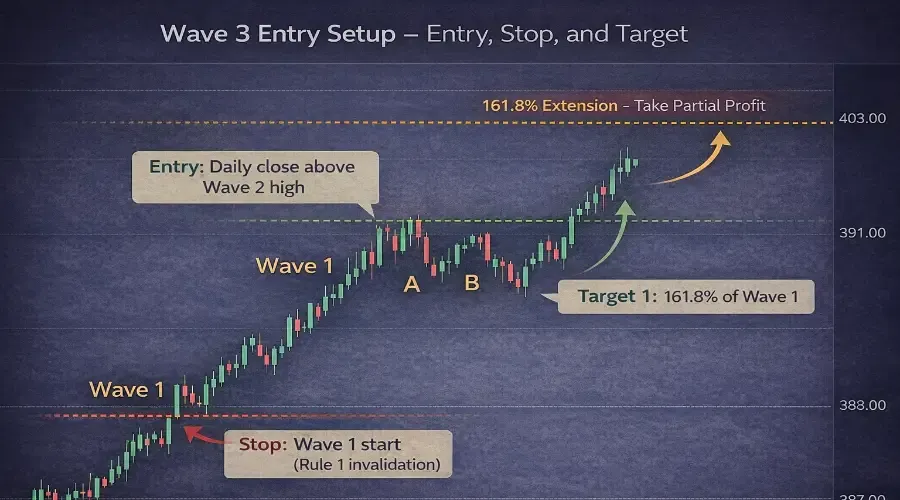
A systematic Wave 3 entry with a stop at the Wave 1 start and a target at 161.8% of Wave 1 is the most reliable Elliott Wave trading framework.
Why Systematic Rules Are Non-Negotiable
Elliott Wave analysis is inherently subjective at the point of interpretation. Two analysts can look at the same chart and produce different counts.
The system does not eliminate subjectivity. It removes discretion after a count is selected.
Every decision - entry timing, stop placement, target projection, and exit trigger — must be rule-based.
The moment discretion enters execution, the edge disappears.
The Core Setup: Wave 3 Entry
Wave 3 is the only phase of the Elliott Wave sequence that offers strong directional momentum, clear invalidation, and measurable expansion.
This creates asymmetric trades where risk is fixed and upside is expandable.
The system focuses on Intermediate degree Wave 3 setups using weekly charts for context and daily charts for execution.
Entry Rules
Entry Trigger
Wave 2 must be a completed three-wave correction. Entry is taken only on a daily close above the Wave 2 high. Intraday entries are not allowed.
Confirmation Filters
A trade is valid only if all conditions are met:
Momentum must show RSI(14) above 50 and rising.
Volume must be above the 20-day average.
Structure must confirm Wave 2 as a three-wave correction on the lower timeframe.
Higher timeframe must support the Wave 3 setup.
If any one of these conditions fails, the trade is invalid.
To understand the structure behind Wave 3: Elliott Wave Motive Wave Strategy (Wave 3 Guide)
Stop Placement
Primary Stop
The stop must be placed at the absolute start of Wave 1.
If price reaches this level, the structure is invalid. There is no interpretation — only exit.
Position Sizing
Risk per trade should remain between 1–2% of total capital. Position size must be calculated based on stop distance.
Stop Adjustment
Once Wave 3 confirms strength and price clearly exceeds Wave 1 high, the stop can be raised below Wave 2 low.
To avoid invalid trades caused by structural mistakes: Elliott Wave Mistakes: B-Wave Trap & Common Errors
Target Framework
Minimum Target
The first target is the 161.8% extension of Wave 1 measured from the Wave 2 low. This is where partial profits are taken.
Extended Target
In strong momentum conditions, Wave 3 may extend to 261.8%.
Final Exit
Final exit occurs at Wave 5 completion or on divergence confirmation.
To calculate precise price targets: Fibonacci Targets for Wave 3, 4 & 5
Fail-Safe Rule
If price retraces more than 50% of the Wave 3 move before reaching the 161.8% target, the trade must be exited.
This prevents capital erosion from failed structures.
Exit Rules
Stop hit requires immediate exit with no exceptions.
Wave 5 target completion requires full exit.
Triple divergence is a mandatory exit signal regardless of target.
Early exit is required if abnormal volume appears during correction or if structure violates core rules.
The market is not wrong - the count is.
Risk-to-Reward Framework
Only trades with a minimum risk-to-reward ratio of 1.5:1 should be taken.
Shallow retracements offer the best reward profile. Deeper retracements reduce edge.
If the trade does not meet minimum reward criteria, it must be skipped.
To confirm whether the trend is continuing or exhausting: Wave 3 vs Wave 5 Divergence Strategy
Backtested Results (SPY 2018-2026)
Total setups: 14
Win rate: 71%
Average R:R: 2.8:1
Average winner: +18.4%
Average loser: -6.2%
Backtest methodology: SPY daily data from 2018 to 2026. All valid setups included. No discretionary filtering. Rules applied consistently.
Results assume zero slippage and no transaction costs. Real performance may vary.
System Summary
Entry occurs on a break above Wave 2 high with confirmation from momentum and volume.
Stop is placed at Wave 1 start with zero tolerance.
Targets are predefined using Fibonacci expansion and structure completion.
Walkthrough Example
Wave 1: $400 to $410
Wave 2: $405
Entry at $411 after breakout.
Stop at $400.
Target at $421 (161.8%) and $425 (Wave 5).
Partial exit at first target. Full exit at final target.
Live Trading Checklist
Higher timeframe confirms Wave 3
Wave 2 is a three-wave correction
Entry above Wave 2 high
RSI above 50
Volume above average
Risk defined
Targets calculated
If any element is missing, the trade is invalid.
Key Takeaways
Elliott Wave becomes powerful only when converted into rules.
Wave 3 provides the most efficient structure for trading.
Stops must be absolute and predefined.
Targets must be calculated before entry.
Discipline determines outcomes more than accuracy.
Frequently Asked Questions
Why focus on Wave 3?
Wave 3 provides the strongest momentum and the clearest invalidation point, making it the most efficient trade setup.
What confirms a valid setup?
Price breakout, momentum strength, volume expansion, and correct internal structure must align.
Where should the stop be placed?
At the start of Wave 1. If breached, the trade is invalid.
What is the most reliable target?
The 161.8% Fibonacci extension of Wave 1.
What if the move fails?
Exit if price retraces more than 50% before reaching the target.
What is the minimum R:R?
1.5:1. Anything below this is not worth taking.
Why is backtesting important?
It validates the system statistically, but does not guarantee future performance.
Final Statement
A systematic Wave 3 entry with a stop at the Wave 1 start and a target at 161.8% of Wave 1 is not a strategy - it is a framework for disciplined execution.
Next Step in the Framework
You now have the complete Elliott Wave trading system - from structure to execution.
The next step is applying this framework consistently across markets and timeframes while refining your ability to identify high-probability setups.
Start from the Complete Guide and rebuild the framework step by step