
The Strait of Hormuz closes tomorrow. Here is exactly what happens next.
Not in general terms. Not “oil will rise and airlines will fall.” The specific sequence — who decides what, when, and why — across the first hour, first day, first week, and first month.
Because when this scenario activates, the gap happens before your trading platform opens. The traders who are prepared are the ones who ran through this sequence before the news broke.
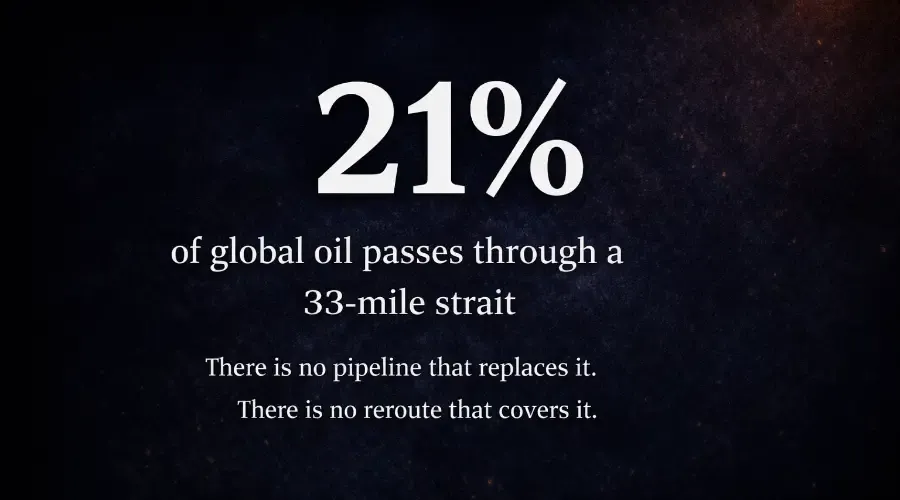
21%
of global oil passes through a 33-mile strait
There is no pipeline that replaces it. There is no reroute that covers it. This is the only number that matters.
The Sequence Nobody Has Published
Most Hormuz scenario analyses give you a sector map. Energy wins. Airlines lose.
You already know that.
What they do not give you is the mechanism — the order in which things break, who triggers each step, and how long each step takes.
Here is the sequence.
Five time windows. Each one activates the next.
1 — H:00
The announcement hits overnight.
Oil futures gap limit-up before US markets open. The gap cannot be pre-empted. This is why position sizing before the event matters more than reaction speed after it.
2 — H+1
WTI crude $120–130. Equity futures down 3–5%.
Airlines gap down 15–20% in pre-market. Defense gaps up 5–8%. Gold jumps $80–120. The VIX moves from 20 to 35–45 in a single session.
These moves happen simultaneously.
3 — H+6
Lloyd’s places Hormuz on its war risk list.
This is the step most retail traders never see.
Standard marine insurance no longer covers Hormuz transits. War risk premiums spike immediately. Tanker operators begin suspending transits voluntarily — before any government directive.
The effective closure of the Strait of Hormuz happens in insurance boardrooms, not naval engagements.
When Lloyd’s lists Hormuz, every tanker operator on Earth receives a notification within hours.
WAR RISK PREMIUM SPIKE
5–15%
War risk premium as % of cargo value after closure
On a $100M supertanker, that equals $10M per voyage before selling a single barrel.
At this cost, most operators stop transiting voluntarily.
4 — H+24
The IEA announces emergency coordination.
Strategic Petroleum Reserve releases are authorized. The US, Japan, South Korea, and Europe collectively offer 2–3 million barrels per day.
Oil pulls back $5–10 on the announcement.
This is the first circuit breaker — and it is temporary.
5 — D+2
Airlines announce capacity cuts.
Delta, United, and American begin pulling seats from winter schedules to reduce fuel burn.
The first corporate press releases hit the tape.
“We are monitoring the situation.”
Translation: we know exactly how much money we are losing per day.
6 — W+1
Gasoline reaches $5.50–6.00 per gallon.
The household math becomes immediate.
At $150 oil, the average US household pays roughly $1,600 more per year for gasoline than at pre-shock $70 oil.
That $1,600 does not come from savings.
It comes directly out of restaurants, retail, and entertainment.
7 — M+2
The second CPI print arrives.
The first CPI release likely understates the full oil impact due to measurement timing.
The second print shows the full passthrough:
0.6–0.8% month-on-month.
At this point, the Fed cut narrative disappears permanently.
Rate hike discussion begins.
8 — Q+1
Alternative supply partially offsets — but only partially.
Saudi and UAE pipelines can bypass Hormuz for roughly 6–7 million barrels per day maximum.
The gross disruption is 20 million barrels per day.
The remaining 13–14 million barrels per day gap has no historical precedent.
Structural $155–175 oil becomes established.
The Number That Changes Everything
$10
per barrel oil rise = 0.25–0.30pp added to headline CPI
From $100 to $175 oil, that adds roughly 2.0–2.25 percentage points of inflation.
CPI moves from 3.2% toward 5.5–6%.
The Federal Reserve cannot cut rates.
It may have to raise them.
The Step Most Analysis Misses
It is not the oil price spike.
It is the insurance market freeze.
When Lloyd’s Joint War Committee lists Hormuz as a war-risk zone, standard marine policies immediately stop covering transits.
War-risk premiums jump from 0.5% to 5–15% of cargo value per voyage.
For a supertanker carrying $100 million in crude, that means $10 million in insurance cost per voyage.
At that level, most operators stop transiting voluntarily.
This is the same mechanism that forced US Navy escort operations during the 1987 tanker war.
The same mechanism activates within hours of a closure announcement today.
Five Signals to Watch Right Now
You do not need to wait for a closure announcement.
Five signals track the probability in real time.
Lloyd’s Joint War Committee — lloydsmarketassociation.org
If Hormuz appears on the Listed Areas, the insurance freeze is imminent.
Brent 3-Month Implied Volatility
Below 40%: normal pricing.
Above 50%: tail risk being priced.
Above 65%: full closure risk.
US Fifth Fleet Positioning — usni.org
Carrier strike group entering the Gulf signals escalation.
EIA Weekly Inventory Data — Wednesday 10:30 AM ET
Draws of 5M+ barrels confirm real supply disruption.
Oil Forward Curve Structure
Deepening backwardation means physical supply is tightening, not just fear pricing.
The Bottom Line
This scenario carries roughly a 15% probability.
That means it probably does not happen.
But it also means that if you manage a portfolio and have never thought through this sequence, you are carrying a 15% chance of a shock whose mechanism you cannot interpret in real time.
Smart risk management does not predict when the clock starts.
It simply knows exactly what each hour sounds like when it does.
Go Deeper - The Oil Shock Education Series
This post covers the sequence. The rest of the series covers the mechanisms that each step in the sequence activates.
Why Oil Could Surge Toward $200 if the Strait Closes - https://www.breakoutbulletin.com/article/hormuz-hurricane-oil-200-scenario
What Happens to Stocks When Oil Hits $90 - https://www.breakoutbulletin.com/article/oil-shock-sector-map-winners-losers-guide
Deep dive on similar topic - https://www.breakoutbulletin.com/article/what-happens-if-the-strait-of-hormuz-closes-tomorrow-hour-by-hour
Disclaimer
This article is for informational and educational purposes only and does not constitute financial, investment, or trading advice. You are solely responsible for your own investment decisions and should consult a licensed financial professional before acting on any information in this post.